

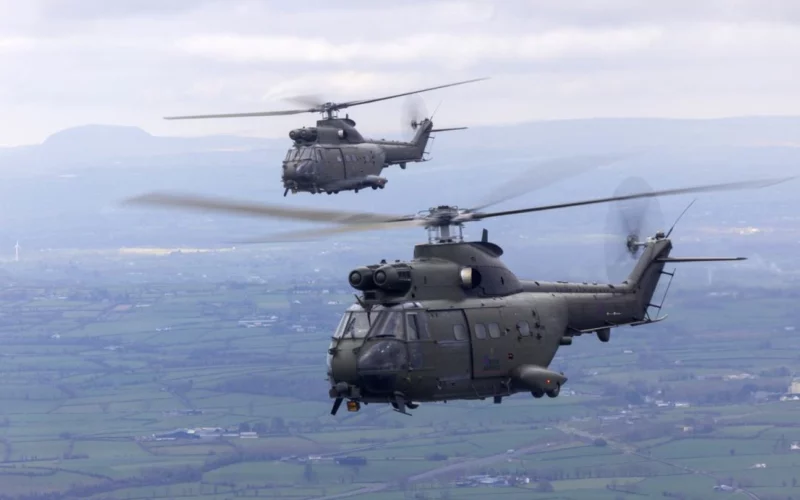
Britain’s last remaining military helicopter production line is again at the center of a Whitehall fight, as the UK government delays a decision on the New Medium Helicopter program, a roughly £1 billion effort to replace the Royal Air Force’s aging Puma HC2 transport helicopters.
According to The Sunday Times, the contract and the future of Leonardo’s Yeovil site in southwest England have become the subject of a cabinet-level dispute, with ministers missing their own target dates for a decision and pushing the timetable into early 2026.
The report said ministers missed their own internal target dates for a decision, and that further delay risks undermining the company’s willingness to keep the site open without a new UK order.
Jobs, industrial policy, and a narrowing decision window
At the heart of the dispute is Leonardo’s helicopter factory in Yeovil, Somerset, which employs around 3,000 people, with far more supported across the supply chain. Union pressure has sharpened as the timetable slips.
Unite general secretary Sharon Graham told the newspaper that Keir Starmer and Defence Secretary John Healey had previously appeared supportive of awarding the contract to Yeovil, but that “something has changed” within government in recent weeks.
The UK Ministry of Defence has so far maintained a holding line, saying the program is ongoing and that no final procurement decision has been made.
For Leonardo, the question is whether the UK intends to anchor long-term work at a plant that has become politically symbolic as the last UK facility associated with building military helicopters at scale.
The aircraft being replaced: Puma HC2 at the end of its runway
The NMH program was launched to replace the RAF’s Puma HC2, a platform whose origins date back to the late 1960s. Although the fleet underwent a life-extension and upgrade program in the 2010s, including new engines, avionics, and structural work, the aircraft remains constrained by payload, range, and growth margins typical of a legacy design.
In practical terms, the Puma continues to perform day-to-day utility tasks, troop transport, and support missions, but sustaining the fleet has become increasingly expensive and operationally limiting. The replacement effort is therefore less about adding new capabilities than about avoiding a looming medium-lift gap as airframes age out.
Treasury skepticism, drones, and the Ukraine lesson
The Sunday Times report pointed to skepticism inside HM Treasury, where some officials are said to be questioning whether crewed helicopters still justify their cost after combat lessons from Ukraine and the rapid growth of drones and air defenses.
That critique reflects a real shift in how many armies are rethinking what helicopters should, and should not, do in a high-threat environment. Where helicopters have come under the most pressure is deep reconnaissance and stand-in strike missions that require pushing into dense, layered air defenses. Several NATO armies are shifting those roles toward drones, loitering munitions, and air-launched effects, arguing that expendable unmanned systems can absorb risks that crewed aircraft cannot.
The US Army has gone furthest. In 2025, it confirmed plans to cut several legacy manned helicopter units and expand drone swarms, attritable sensors, and launched effects as part of a broader aviation overhaul. The cancellation of the Future Attack Reconnaissance Aircraft armed scout effort reinforced the trend; reconnaissance deep inside contested airspace is now treated primarily as an unmanned mission set.
That opinion is not equally shared across NATO. In an interview with Le Point, France’s Army Light Aviation argued that Ukraine is changing how it uses helicopters rather than ending their utility. It pointed to the role of tactics and flight profiles in shaping attrition, and emphasized the continued need for medium lift, medevac, and logistics missions behind the line of contact, even as the highest-risk penetration tasks migrate toward unmanned systems.
A competition that collapsed to a single bidder
The NMH procurement is also politically awkward for another reason: it is no longer a real competition. The program began with multiple expected contenders, but by September 2024, it had effectively become a single-bidder process after Airbus and Lockheed Martin, via Sikorsky, withdrew from the tender.
That left Leonardo as the sole remaining offer, pitching the AW149 and final assembly in Yeovil. The AW149 sits at the upper end of the medium-lift category, offering higher payload, range, and growth margins than the Puma, as well as modern mission systems and supportability aligned with current NATO standards. For the UK, the bid is as much about industrial continuity as it is about aircraft performance.
With only one bidder left, the government’s room for maneuver is limited: proceed, redesign and recompete the requirement, or delay. Each option carries costs, and time is the one variable that cannot be replenished once the Puma replacement timeline turns into a capability gap.
The Westland shadow and why Yeovil still matters politically
The Yeovil site carries historical weight in UK industrial politics, dating back to early 20th-century aviation manufacturing and later the postwar shift toward rotorcraft. It is also inseparable from the Westland Affair of 1986, when Margaret Thatcher’s cabinet split over the future of the helicopter manufacturer, triggering the resignation of Defence Secretary Michael Heseltine and, shortly after, Trade and Industry Secretary Leon Brittan.