

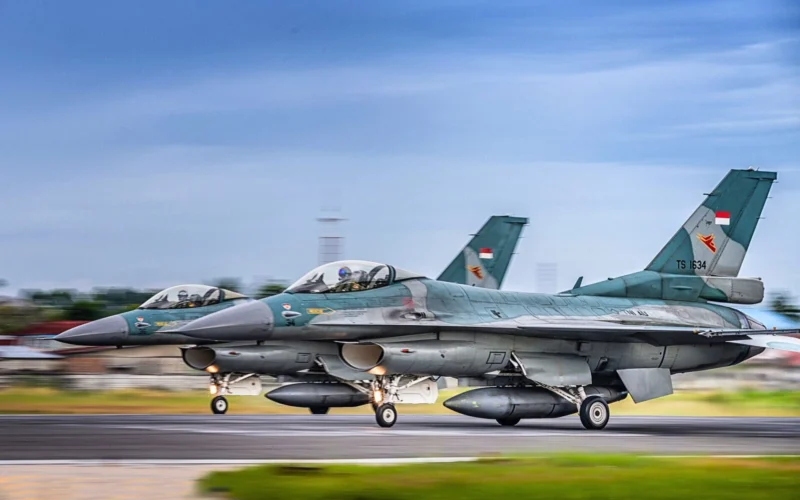
Indonesia successfully demonstrated its first fighter aircraft landings on a toll road on February 11, 2026. The exercise has launched an ambitious plan to transform highway infrastructure across the sprawling archipelago into emergency military runways.
Two Indonesian Air Force aircraft, an F-16 fighter and an EMB-314 Super Tucano, conducted landing and takeoff tests on the Terpeka section of the Trans-Sumatra Toll Road in Lampung Province.
The demonstration marked the first time fighter jets have used Indonesian toll roads as runways, according to local news outlet Antara.
The exercise has highlighted Indonesia’s novel approach to military readiness, across a nation spanning more than 6,000 inhabited islands over 3,100 miles of ocean. The country plans to leverage its extensive road network for emergency air operations.
Strategic vision for provinces
According to Indonesia’s Air Force Chief of Staff Marshal, Tonny Harjono, the military hopes that each of Indonesia’s 38 provinces will eventually have at least one toll road section capable of serving as an emergency runway, though no specific timeline for this has been provided.
“This success marks an important milestone in strengthening the universal defense system,” Deputy Defense Minister Donny Ermawan Taufanto told Antara. The former air marshal emphasized that using civilian infrastructure for defense purposes ensures operations can continue even if main airbases face disruption.
The concept involves preparing road segments approximately 3,000 meters (nearly two miles) long to accommodate military aircraft operations.
Officials have stressed that the initiative aims to optimize existing infrastructure rather than build costly new facilities.
🇮🇩#Indonesia is launching a bold plan to use toll roads as emergency runways for its fighter jets — creating air bases across the country without building aircraft carriers pic.twitter.com/Qy6E06J9Qv
— News.Az (@news_az) February 12, 2026
Technical challenges and pilot skill
The demonstration has highlighted the technical demands of road-based aviation operations. Indonesian pilots successfully landed on toll road sections only 24 meters wide, roughly half the width of standard airport runways, which typically measure 45 to 60 meters.
Praising the skill required for such precision landings to Antara, Taufanto noted: “It’s risky, but Air Force pilots are trained for these conditions.”
The two aircraft types used represent different military capabilities. The F-16 serves as Indonesia’s primary air defense fighter, while the turboprop Super Tucano handles reconnaissance, patrol and close air support missions.
International precedent
Indonesia joins several nations that have tested military aircraft on civilian roads. Similar demonstrations have occurred in the United States, Finland and Sweden, reflecting broader military interest in infrastructure dual-use capabilities.
The US military in particular has emphasized dispersing fighter aircraft across Pacific islands, as part of strategies to complicate potential targeting by adversaries. However, Indonesian officials stressed that their toll road program is not directed at any specific country, despite ongoing South China Sea territorial disputes with China.