

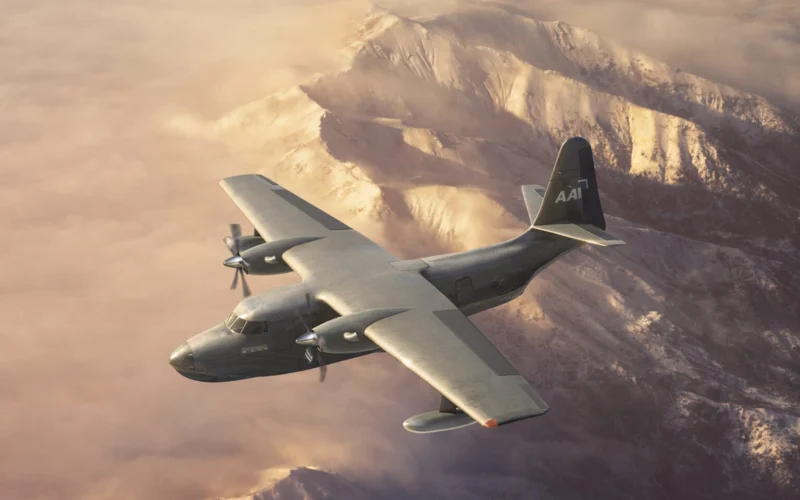
A classic flying boat that first flew in the late 1940s may be headed back into production.
Amphibian Aerospace Industries (AAI) of Brisbane, Australia, and India’s Apogee Aerospace announced a deal for 15 “Albatross 2.0” amphibious aircraft, a modernized version of the original Grumman HU-16 Albatross that could see duty in the future in maritime patrol, paramilitary, search-and-rescue, and commercial roles.
The agreement carries a reported value of about $420 million and includes plans to establish manufacturing, maintenance, and systems integration capability in India, the companies said.
The original HU-16 rolled off Grumman production lines on Long Island near New York City between 1947 and 1961. The US Coast Guard retired its last example in 1983. Only a handful remain airworthy today.
AAI acquired the type certificate for the Albatross and its military variant and now plans to revive the aircraft as a certified transport-category amphibian capable of carrying up to 28 passengers or 10,000 pounds of cargo, depending on configuration.
The companies suggest the Albatross could be headed back into full-rate production, though the path forward appears to be focused on a phased approach. Early aircraft may rely on refurbished legacy airframes, but AAI also signaled intent to build new aircraft under the existing type certificate. The partnership includes establishing tail-section manufacturing in India and developing military variants for Indian defense customers.
Unlike the radial-engine HU-16s that became common sights in the 1950s, the Albatross 2.0 will use Pratt & Whitney Canada PT6 turboprops. The companies have not identified a specific dash number, but the PT6 remains one of the most widely supported turboprop engines in service. The aircraft will feature a modern glass cockpit and updated interiors tailored to passenger, cargo, surveillance, or government roles.
AAI describes the aircraft as the only FAA or EASA certified transport-category amphibious aircraft with more than 19 seats. If it reenters production, that would place it in a niche market with little direct competition. Viking’s Twin Otter can operate on floats, but it does not match the Albatross in cabin size or open-sea capability.
The closest modern comparison to the proposed Albatross revival is the De Havilland Canadair 515, a newly relaunched twin-turboprop amphibian built for wildfire suppression. It operates in a similar size class and under modern certification standards, though it serves a specialized firefighting role rather than passenger or multi-mission transport.
A handful of privately owned Grumman HU-16 Albatross aircraft remain airworthy today, some with refitted executive interiors and upgraded avionics, demonstrating that the platform itself can still fly, even if large-scale production has been dormant for decades.
Performance numbers for the Albatross 2.0 were not detailed in the announcement. The original HU-16 cruised at roughly 200 knots with a range around 2,800 nautical miles, depending on configuration. Whether the modernized version improves meaningfully on those figures remains to be seen. The companies say the aircraft can operate in open-sea conditions with wave heights of six to eight feet.
At $420 million for 15 aircraft, the implied unit price approaches $28 million per airplane, though that figure likely also includes support, infrastructure, and industrial investment. Apogee also plans to invest additional funds to establish maintenance, overhaul, and training capability in India.
3 comments
Would have thought a PW 100 series engine would be a better choice; Larger prop; better thrust.
Although buying an aircraft for any Air Force is a laborious process. When selecting an Amphibious Aircraft which was in production more than 50 years ago, definitely raises Eyebrows. Airforce Aircraft are destined for Combat Service. Amphibious aircraft could be Rightfully Useful on Bangladeshi Terrain. Definitely NOT in Pakistan or China, who are main Adversary of India. Is India preparing to attack Bangladesh????
In my youth, I worked on avionics for SU-16 and SU-22 aircraft for the US Corp of Engineers and a private PBY-5A. I also had the opportunity to fly on the Albatross and Catalina. All were magnificent aircraft, but they all suffered from an ongoing battle with corrosion.
I hope that that AAI will have good luck in their endeavor to resurrect the Albatross and another US firm‘s effort to revive the PBY-5A. Amphibian aircraft should still have a place in the aviation community.