

Throughout Europe’s history, Vienna has played a pivotal role between east and west, a market position that has served Vienna International Airport (VIE) well.
While the development of nonstop low-cost air connectivity between Eastern and Western Europe has eroded the airport’s traditional gateway role, the emergence of new markets further east has continued to fuel the airport’s growth in the years since the COVID-19 pandemic.
Vienna International Airport saw a record year in 2025, handling 32.6 million passengers, while the other two airports it manages, Malta (MLA) and Kosice (KSC), Slovakia, also reported healthy growth.
Undeterred by the departure of Wizz Air, which is relocating its Vienna base to nearby Bratislava, across the border in Slovakia, and Ryanair’s plans to reduce activity , Vienna Airport is working on a major expansion of its Terminal 3.The project, scheduled for completion in 2027, is expected to expand capacity and elevate the passenger experience.
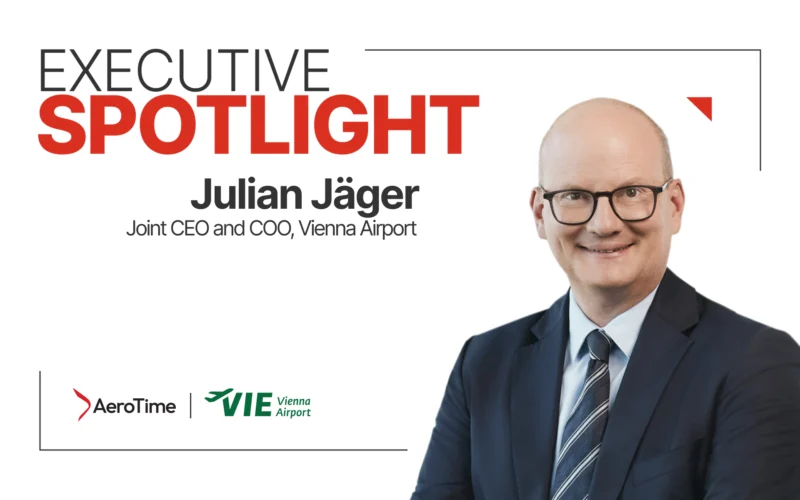
AeroTime spoke with Vienna Airport Chief Executive Officer (CEO), Julian Jäger, during the Aviation-Event 2026 Germany, an industry conference which took place in Frankfurt on February 3, 2026.
“We have quite an interesting mix. 50% of our traffic is Lufthansa Group, mainly Austrian Airlines, and 30% is low-cost,” Jäger said, adding that the latter segment of the market is facing some pressure with both Wizz Air and Ryanair reducing operations at the airport.
But what is the reason for Wizz Air’s departure?
Jäger said the decision was based on cost. “It’s always about cost,” he added.
However, the CEO noted that there were other factors involved in the low-cost carrier’s decision to no longer base itself at Vienna Airport. “Wizz Air has had a major strategy shift,” he said. “They relocated from the UAE. They removed aircraft from the Arabian Peninsula. At the same time, obviously, the cost level in Bratislava is lower.”
According to Jäger, Vienna Airport was recently in talks with Wizz Air regarding plans to station its A321XLRs at the airport.
“They intended to buy more than 40 XLR, but now it turns out they’re buying less than 10,” he added. “And what they’ve seen is that from Central Europe it’s difficult to operate the XLR. You don’t reach the East Coast of the United States and in the other direction, the only major market is India. But India is very restrictive. You can get to Dubai or Abu Dhabi, but you don’t need an XLR for this.”
Jäger went on to note noting that, in late 2025, for example, Austrian Airlines successfully launched flights between Vienna and Dubai using regular A320neo aircraft.
Nevertheless, despite Wizz Air and Ryanair decreasing their footprint at the airport, Jäger said he still expects traffic numbers in 2026 to remain stable, at around 30 million passengers.
Investment abroad
Vienna Airport also has investments in two other airports, Malta and Kosice. Jäger expressed his satisfaction with the way these investments are performing. The company is even leveraging some synergies, by temporarily transferring some staff from Kosice International Airport to work in Vienna when needed. However, Jäger expressed caution when it comes to considering further overseas investments.
“We decided in 2011, when I became joint CEO and COO, that we would not invest anymore. However, we always communicated that there would be one exemption and this is Bratislava,” he said, referring to the airport in the nearby Slovak capital, located around 50 miles from Vienna. “But Bratislava has not come to the market yet, and I don’t think it will [happen] in the future. So, we are concentrating on the three airports we currently operate.”
“I’m not ruling out that in the future this strategy could change,” he added. “But this is something we would have discussed with our board. Overall, I think it’s a very contested market. You have big players, like Vinci, like Fraport, like Zurich [Airport], and lots of financial investors. We are a small country and a relatively small airport, and our shareholders are not really major risk takers, so, therefore, I think the potential is very limited. That’s why we don’t want to spend money on running after every privatization project.”
“We did that for quite some time, and that’s how we bought Malta and Kosice,” he continued. “But we are not doing this right now.”
Jäger then went on to highlight the strong institutional component of the airport’s shareholding.
“We have an interesting shareholder structure: 20% is the government of Vienna, 20% the government of Lower Austria, 10% is an employee’s fund and 44% is IFM, which is an Australian pension fund,” he said. “The remaining 6% is floating on the stock exchange. We are one of the few listed airports in Europe.”
Vectors of growth
As an airport with traditionally good connections to eastern markets, Vienna has seen some major routes axed as a result of the ongoing war in Ukraine.
“Geopolitics didn’t help. Ukraine was a very important market for us. And Russia, Belarus, they were also important markets, and these are now completely closed,” he said.
But Jäger was also clear to minimize the impact this has had on the airport’s traffic performance.
“But, nevertheless, we are still above the passenger levels we used to have before the pandemic,” he said. “This potential remains latent for the future. At one point even this war will end. Austrian Airlines is already the designated carrier to start to fly to Ukraine again. And Austrian has always had a strong network in southeastern Europe.”
“We have a strong focus on the Middle East, southeastern Europe and Southern Europe, obviously, because of the leisure traffic,” he added. “And we have India! I’m sure the Indian market will also grow.”
There is a shift in the global aviation center of gravity. However, Vienna has managed to retain its role as Europe’s eastern gateway, with quite a few Asian airlines serving Vienna.
“We just had the announcement that China Eastern Airlines will fly to Xi’an, and we’ve also got Air India, Scoot flying to Singapore, ANA, Air China, Hainan Airlines, Eva Air, China Airlines, Korean Airlines…Taiwan is a very strong destination,” he said. “Korea is also a very important destination for us, as well as for passengers and for cargo. So, we’re doing well on Asia.”
He added: “Most of this traffic [to Asia] is independent from Star Alliance. The transfer on these flights is relatively low, to be honest. The majority of transfer traffic is coming from southeastern Europe or the Middle East via Vienna to North America. This is where Austrian Airlines is really strong.”
Jäger quantified that connecting traffic is roughly 20% of total traffic, or around six million passengers.
Air+Rail connectivity
Vienna Airport has a wide catchment area that stretches well beyond Austria’s borders and spans large parts of western Slovakia and Hungary, as well as the southern Czech Republic. However, unlike other major hubs, domestic air connectivity in Vienna is quite limited.
In fact, Austria was the first European country to impose severe restrictions on short haul air services on environmental grounds, which means that all connections between Vienna and cities such as Linz and Salzburg is now done by rail. Some regional air services to Innsbruck (INN), Klagenfurt (KLU) and Graz (GRZ) remain in place.
“We operate the CAT train together with OBB [the Austrian national rail operator – ed. note], which operates the train from Vienna airport directly to the city center,” Jäger said. “We now have very fast connections to Linz, Salzburg and Innsbruck from the airport.”
“More than 50% of the people coming to the airport use public transport. So, rail is very important,” he added. “ÖBB cooperates with Austrian Airlines as well. So, you can buy a ticket from Linz, for instance, travel by train to Vienna, then fly with Austrian.”
While talking about the Austrian rail operator rolling out fast long-distance rail services from Vienna, Jäger did not appear concerned. This includes the highly praised “NightJet” overnight service which links the Austrian capital to cities across Central and Northern Europe.
“This is not a lot of capacity,” he said. “I don’t see really see this as competition, but I guess for Austria, for these places, it’s a good.”
Jäger also talked a bit about the future he envisages for Vienna Airport. Key to that future is the completion of the new €420 million Terminal 3 project.
“We abandoned our third runway project. We believe we can grow to 52 million passengers per year with the current two-runway system,” he explained. “This is good enough for the next 25 years.”
“Right now, we are investing €420 million in the terminal expansion project, which will add 70,000 square meters of additional terminal space and a new bigger security area,” he added. “We will add 10,000 square meters of retail space, shopping, and F&B [food and beverage – ed. note] and 5,000 square meters of additional lounge space.”
The airport has also invested in a massive solar panel park, which produces 35 megawatts of power at its peak and is able to produce around half of the energy its facilities consume. This is an effort, Jäger lamented, that it is not always fully appreciated by passengers nor the wider public.
Quality over quantity
“We focus a lot on quality,” he said. “So, I think it’s important for us to develop with the future terminal expansion and with our strong operations backbone.” Jäger underlined how the fortunes of the airport are closely tied to those of the national flag carrier, Austrian Airlines.
“We work very closely with Austrian Airlines. They are the smallest within the Lufthansa Group, and they have to fight for their position within it, and we have to fight for our position as a hub as well,” he said. “So, we try to improve operations together. Austrian Airlines is the most punctual and most reliable airline in Lufthansa Group, but we want to make this better and to improve the transfer experience at Vienna Airport. Therefore, we need more space. This is the ambition for the coming years.”
Jäger did not shy away from expressing two tangible goals he expects to achieve for Vienna Airport in the coming years.
“We have the ambition to become the third European Skytrax 5-star airport. Right now, only Rome (FCO) and Munich (MUC) have this status in Europe, out of 12 airports globally,” he said. “We are the third most punctual airport, above 25 million passengers. In Europe only Stockholm is more punctual than us. We are trying to limit waiting and security processing times. We focus on operations and, overall, we try to give a good hub experience.”
The other pending achievement for Vienna Airport is improving its connectivity to certain parts of the world. Hong Kong (HKG) is one of the destinations that came up in conversation.
“It would be great to have it in our network,” said Jäger.
However, if there is a glaring gap in Vienna’s coverage, it is the lack of US carriers. Currently, no US carriers serve Vienna, a situation which Jäger hopes will soon change.
“It would be great to have Atlanta (ATL), Dallas (DFW) or San Francisco (SFO),” he said. “I think it’s difficult, but we want to get a US carrier here.”