

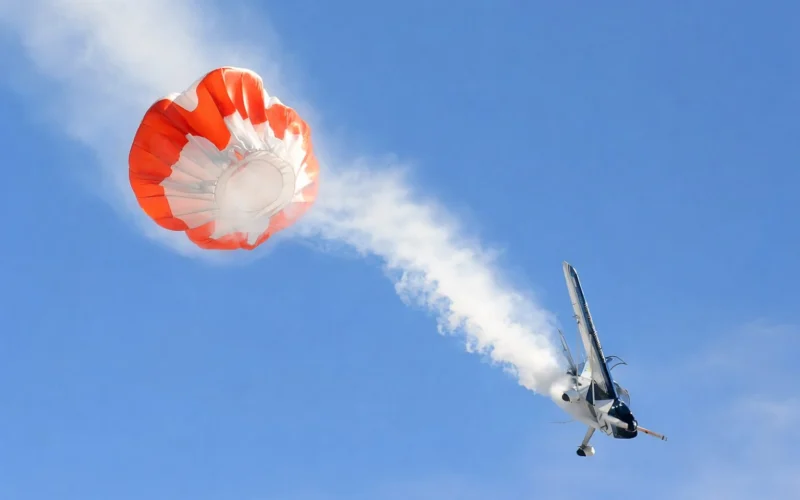
The National Transportation Safety Board (NTSB) has issued a safety alert warning first responders about on-scene hazards posed by ballistic parachute recovery systems when the rocket that deploys the parachute does not fire before or during impact.
In Safety Alert SA-102, the NTSB said ballistic parachute recovery systems, or BPRS, are “rocket-powered parachutes installed on some airplanes as an optional safety device” designed to help an airplane descend gradually during an in-flight emergency. But the agency warned that “they pose a hazard to first responders at an accident site if the rocket did not activate before or during ground impact.”
The alert emphasizes that responders should assume a rocket may remain active at the crash site even if the parachute did not deploy. The NTSB noted that all Cirrus airplanes include the Cirrus Airframe Parachute System (CAPS), and similar systems appear on other aircraft types, including aftermarket installations.
The NTSB urged responders to “IDENTIFY and NOTIFY,” starting with visual cues on the airframe. “Look for a triangular warning label on the fuselage that may indicate where a rocket would leave the airplane,” the safety alert said. “If you see such a label, avoid that area.” The agency also warned crews to use caution inside the cabin and to avoid “any red T-shaped handles,” which can activate a parachute system.
If responders need to cut through the fuselage to reach occupants, the NTSB told crews to avoid the system’s activation cable. “If you need to cut the cable, be aware that this could activate the rocket,” the alert said, adding that “all non-essential personnel should be cleared from the area” and essential personnel should remain clear of the rocket tube.
The agency also noted that accident damage can pose a danger related to the activation cable. The NTSB warned that the cable “may be under tension and near its breaking point, which could activate the rocket at any time.”
Once responders identify a ballistic parachute system, the NTSB directed them to contact the agency immediately. “Once a BPRS is identified on scene, immediately contact the NTSB at the 24/7 Response Operations Center at 844-373-9922 and notify them that a BPRS has been identified at an aircraft accident site,” the alert said. “An on-call regional duty officer will assist in contacting the manufacturer.”
The NTSB said it has documented multiple accidents in which first responders worked near wreckage with an undeployed parachute rocket on scene. The alert lists examples including a 2025 Cirrus SR22 crash in Georgia in which the agency said a BPRS rocket activated several minutes after impact while first responders were nearby.