

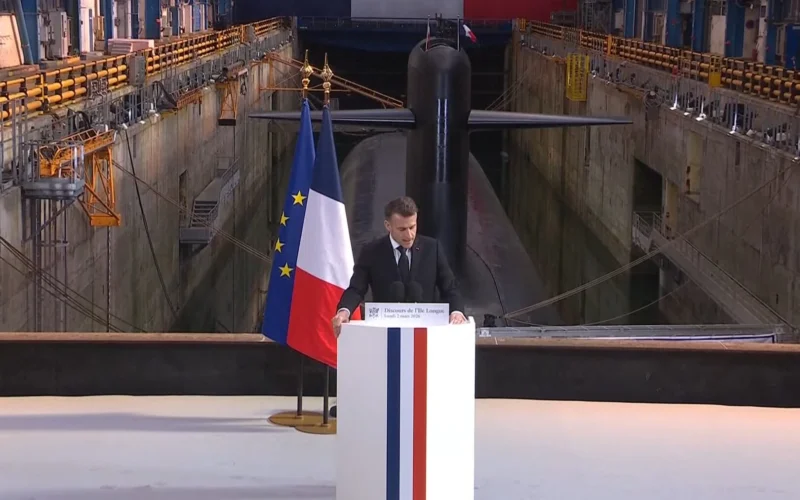
Speaking from the Île Longue naval base in western France, the home port of the country’s nuclear-armed ballistic-missile submarines, on March 2, 2026, French President Emmanuel Macron unveiled what he described as a major evolution of France’s nuclear doctrine, explicitly anchoring the country’s deterrent in a broader European strategic context while reaffirming strict national control over nuclear decision-making.
At the core of the speech was a reaffirmation of France’s long-standing doctrine: nuclear deterrence is intended to dissuade any state threatening France’s vital interests. Macron stressed that these interests are deliberately undefined and cannot be made explicit. While they include metropolitan France and overseas territories, he underlined that they “cannot be limited to the national territory alone,” a formulation that gives concrete meaning to the European dimension previously invoked by successive French presidents.
“This is a major evolution,” Macron said, arguing that today’s strategic environment finally allows France to translate long-stated European rhetoric into operational reality, one that would benefit both France and its partners.
Toward a framework for European deterrence dialogue
Macron outlined the creation of a new strategic framework in which European partners willing to engage more deeply on deterrence issues would have a role. He described the current international rules-based order as “a field of ruins,” justifying recent and forthcoming decisions aimed at restoring strategic credibility.
According to the president, France has already intensified discussions with several partners. He cited a tightening of ties in the Northwood Declaration with the United Kingdom in July 2025, including the opening of possibilities for coordination between the two countries’ deterrents. British representatives have already observed “Operation Poker”, the nuclear-deterrence exercise held four times a year in which France’s Strategic Air Forces (FAS) rehearse all the stages of a nuclear strike.
France has also initiated contacts with a group of allies, starting with Germany, which Macron said responded favorably. Other countries mentioned in ongoing or prospective discussions included Poland, the Netherlands, Belgium, Greece, Sweden, and Denmark, with talks continuing with additional partners.
No sharing of the nuclear trigger
Macron rejected the notion of formal nuclear guarantees for allies, warning that codified guarantees would be imprudent and risk lowering the nuclear threshold. Instead, he presented what he termed an “forward deterrence” approach.
Despite the expanded dialogue, Macron drew firm red lines. There will be no sharing of the ultimate nuclear decision, its planning, or its execution. These remain the sole responsibility of the French president, accountable only to the French people. Likewise, the definition of France’s vital interests remains entirely sovereign.
“Forward deterrence”, what does it mean?
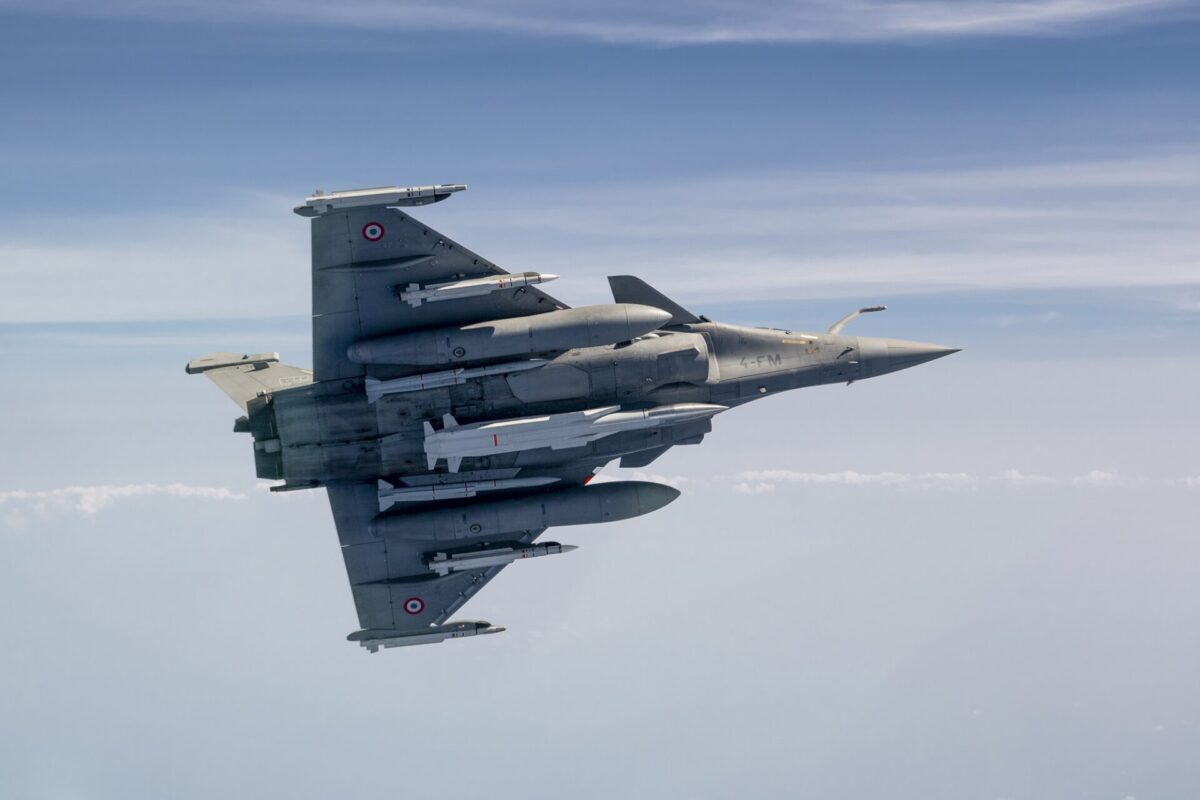
Under Macron’s “forward deterrence” concept, France could, in a crisis, deploy strategic elements on allied territory, including dispersing the FAS’ nuclear-capable Rafale force across other European countries. Such a posture would be intended both to reassure France’s allies and to complicate any adversary’s targeting calculus by spreading the force across multiple locations rather than concentrating it on a small number of French bases.
Such moves would be accompanied by political and military signaling beyond French borders, closer coordination with allied forces to provide conventional support for nuclear operations (CSNO), and a shared understanding of escalation dynamics.
Macron was explicit that this French-led approach would not replace the existing NATO nuclear sharing arrangements. It would operate in addition to them, with coordination maintained with the United States. France, however, will remain outside NATO’s Nuclear Planning Group, preserving its independent posture.
The president also confirmed an increase in the number of French nuclear warheads, while stating that the overall stockpile figure will now be kept secret, a shift from previous transparency practices. France is generally assessed to currently have around 290 nuclear warheads.
Strategic autonomy as the end goal
Framing the speech in broader political terms, Macron returned repeatedly to the theme of European strategic autonomy. What he wants above all, he said, is for Europeans to “take back control of their own destiny,” invoking mass, power, independence, and strategic solidarity.
“Let us be powerful. Let us be united. Let us be free,” Macron concluded.
Shortly after the speech, Chancellor Friedrich Merz said Germany and France have created a nuclear steering group to coordinate deterrence issues, adding that the two countries aim to take concrete steps before the end of 2026, including conventional German participation in French nuclear exercises. The effort is said to improve Europe’s ability to manage escalation below the nuclear threshold, pointing to early warning, air defense, and deep precision strike.
1 comment
Ça a été un bon discours de la part de Macron, mais il va falloir éclaircir le fait d’avoir dit (un groupe de pilotage nucléaire avec L’Allemagne) : L’Allemagne ne possède rien en nucléaire et, suivant certaines conventions, n’a pas le droit de posséder l’arme nucléaire. Macron essaye une fois de plus de trouver en l’Allemagne un allié de “choix” alors que ce pays roule pour lui et ne nous apportera rien de concret. Les pays qui veulent notre protection hors OTAN devront payer pour avoir notre protection, comme le fait L’OTAN, ce qui a été oublié dans LE discours de notre cher président. La France n’a aucun intérêt à raser gratuitement, la France doit rester maitre et souveraine de sa dissuasion nucléaire. Nous avons bradé trop souvent des fleurons français, maintenant cela suffit.