

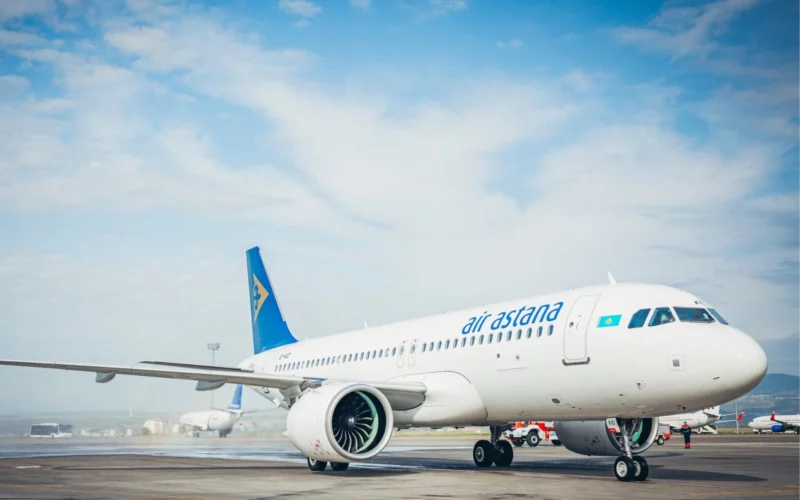
On March 13, 2026, Air Astana presented its full year results for 2025 – the final set while long-time CEO Peter Foster is still at the helm. The veteran British executive is to retire in April 2026, after more than two decades heading Kazakhstan’s largest airline.
Presenting the company’s results alongside Ibrahim Canlie, the company’s current Chief Financial Officer and designated successor as CEO, Foster highlighted the financial and operational health of Air Astana’s group.
“The airline is in extremely good shape,” he stated during the investor’s call.
The Kazakh airline group, which includes both Air Astana and its low-cost subsidiary FlyArystan, posted strong revenue growth of 11.4% during 2025.
However, this revenue increase, which is somewhat aligned with the growth in capacity, has not resulted in a similar profitability increase.
EBITDAR has remained stable at US$321.2 million (+0.8% compared to the previous year). Profit after tax actually decreased, from US$49.4 million to US$13.6 million.
Foster blamed two factors for this decrease. One is the deterioration in the exchange rate between the Kazakh Tenge and the US dollar, the impact of which has been quantified in US$18.4 million. Air Astana is particularly sensitive to the local currency volatility, since a significant part of its revenue comes from its domestic operations.
The other is that, like many other airlines around the world, Air Astana has also been heavily impacted by technical issues which have, since 2023, plagued the Pratt & Whitney PW1100G engines that power the airline’s A320 fleet. According to Air Astana, these engine issues have increased costs and limited opportunities for capacity expansion significantly throughout the year.
During 2025, Air Astana had to remove 22 PW1100G engines from service due to this problem. Despite being able to lease some replacement engines at short notice, the airline was forced to ground up to 13 aircraft during the peak season.
Another external development which has affected Air Astana is the ongoing conflict in the Middle East. The Kazakh carrier had been expanding its presence in the Gulf countries in 2025 but has now been forced to redeploy this capacity to other markets.
However, this crisis has had a silver lining of sorts for Air Astana. Due to its strategic geographical position halfway between Europe and Asia, Air Astana has absorbed some of the East-West connecting traffic that was previously traveling via the Middle East hubs. In this regard, Air Astana confirmed that it has seen a significant uptick in traffic with the related revenue surge, as it scrambled to redeploy capacity away from the conflict area and onto its European and Asian routes.
In response to questions from financial analysts, Canliel also explained that Air Astana is relatively insulated from tensions in the oil market, since more than 70% of its fuel uptake is done locally in Kazakhstan, itself an oil producing country.
While Air Astana has posted a slightly lower EBITDAR margin, this remains a relatively solid 22.1%, which compares well to industry standards.
Commenting on the airline’s longer-term prospects, Canliel expressed his view that there is still a significant growth potential in the Kazakh market, which remains largely untapped. He referred to the fact that the propensity to travel of the Kazakh population has trebled since the Air Astana introduced the FlyArystan low-cost carrier a decade ago. Canliel thinks it may still be possible for the domestic market to double before reverting to a more stable GDP-driven growth pattern.
In any case, Air Astana is also betting strongly on its international expansion. In 2025, it launched some 25 new routes, including a handful of new leisure destinations in Asia, and international growth is likely to continue with the strengthening of the airline’s long-haul fleet.
In 2026, Air Astana expects to receive the three Boeing 787-9s that it has long had on order, the delivery of which has been repeatedly delayed, reportedly due to manufacturing constraints. Over the years to come, these will be followed by an additional five Dreamliners ordered in 2025, together with five options and five purchase rights. The additional B787s should be delivered between 2032 and 2035.