

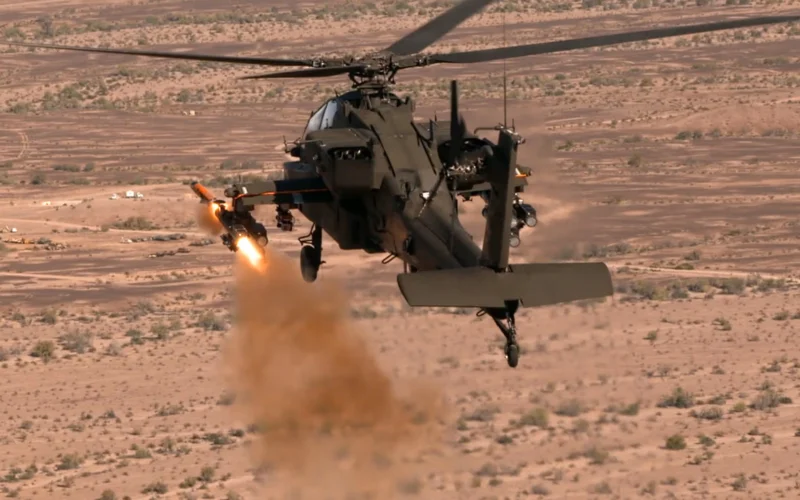
The US Army has for the first time launched a drone from an AH-64E Apache attack helicopter, firing an Anduril Industries Altius 700 medium-range launched effect during a warfighting experiment at Yuma Proving Ground, Arizona, on February 26, 2026.
The test took place during a warfighting experiment known as CDF CFWE 26 at Yuma Proving Ground and was led by the US Army’s Aviation Future Capability Directorate. The project went from a formal US Army requirement to a demonstrated capability in under six months.
US Army aviators executed rocket-powered launches of the Altius 700, including while the Apache was in forward flight. A launch during forward movement is closer to how attack helicopters actually operate in combat, where crews may need to deploy a launched effect while maneuvering, masking behind terrain, or disengaging from threats.
Extending the Apache’s reach
New Test Footage: AH-64 Apache attack helicopter executes rocket-powered launch of Altius-700.
— Anduril Industries (@anduriltech) April 6, 2026
This is the first time an Apache has employed a launched effect. https://t.co/tzq6soyNdi pic.twitter.com/YBsdP68si3
The Altius 700 is a tube-launched autonomous air vehicle with a reported range of up to 460 kilometers (about 250 nautical miles) and an endurance of roughly four hours, extendable to around five hours depending on the configuration.
Its modular payload architecture supports intelligence, surveillance, and reconnaissance (ISR), signals intelligence (SIGINT), electronic warfare (EW), and communications relay missions. A kinetic variant, the Altius 700M, carries a warhead payload of up to 33 pounds, comparable in effect to the AGM-114 Hellfire missile. The Altius 700 is part of a broader family of loitering munitions developed by Anduril.
The AH-64E‘s own combat range is approximately 260 nautical miles with an endurance of around 2.6 hours. Deploying an Altius 700 in flight extends the helicopter’s effective sensing and strike reach well beyond those limits without exposing the crew to forward air defense threats, similar to the concept of ‘loyal wingman’ being developed for fixed-wing combat aircraft.
Building on Black Hawk tests
The Altius 700 has served as the primary testbed for a new government-developed universal launch system designed to enable low-altitude launch deployment of effects from rotary-wing aircraft.
The Apache demonstration builds on a September 2025 test in which US Army aviators executed multiple successful airborne launches of Altius 700s from a UH-60 Black Hawk. In late 2025, Sikorsky received a $43 million contract to upgrade the UH-60M fleet with structural and digital backbone enhancements specifically for air-launched drone integration.
Keeping the Apache relevant
For the Apache fleet specifically, the demonstration is part of a broader effort to sustain the helicopter’s relevance. The AH-64 has accumulated more than 5.3 million flight hours, including over 1.3 million in combat, and is expected to remain in service past 2060.
But senior US Army leaders have questioned whether legacy attack helicopters can survive in the kind of dense air defense environments seen in Ukraine, where both Russian and Ukrainian rotary-wing operations have been sharply constrained. The ability to push sensors and effectors forward using expendable unmanned systems, rather than the manned aircraft itself, is one of the ways the US Army is exploring to keep the Apache tactically viable against peer adversaries.