
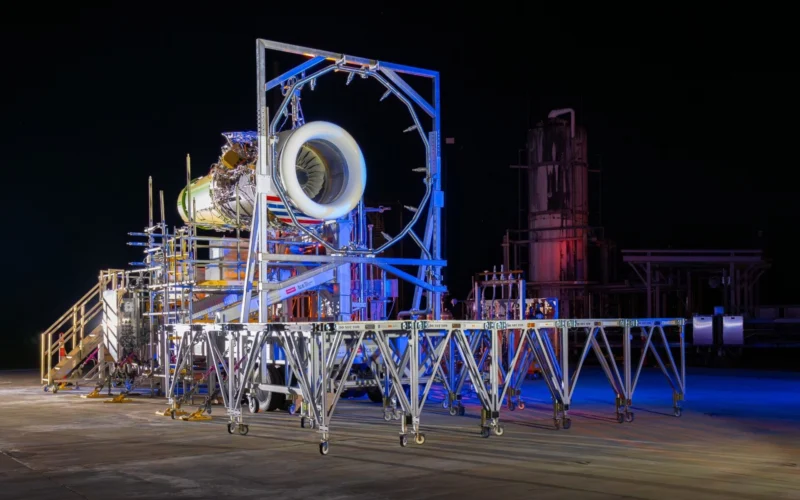
Rolls-Royce and easyJet have completed ground testing of a modified Pearl 15 engine running on 100% hydrogen at full takeoff power, marking a significant step in the companies’ effort to advance hydrogen as a potential future aviation fuel.
The test took place at NASA’s Stennis Space Center near Bay St. Louis, Mississippi. Rolls-Royce and easyJet said the engine ran on hydrogen across a simulated flight cycle, including start-up, takeoff, cruise and landing.
The companies described the test as an industry first and said it showed that a modern jet engine can run safely on gaseous hydrogen under simulated real-world conditions.
The test regimen grew out of a four-year demonstration program among easyJet, Rolls-Royce and several partners. The companies previously ran a Rolls-Royce AE2100 engine on 100% green hydrogen at Boscombe Down in the UK in 2022. Rolls-Royce later tested a full annular combustor from a Pearl engine on 100% hydrogen at the German Aerospace Center in Cologne in 2023.
“This industry-first is a real testament to the progress our partnership with Rolls-Royce has achieved, taking hydrogen from early concept through to full engine build and successful testing in just a few years,” easyJet Chief Operating Officer David Morgan said.
Morgan said the test marked “an important step” toward easyJet’s net zero carbon emissions pledge and the broader shift toward lower emissions across aviation.
Rolls-Royce said the test program helped validate hydrogen combustion, fuel and control systems. Engineers also tested fault scenarios and maximum-power operation.
“This program has given us the clearest understanding in the industry of how hydrogen behaves in a modern aero gas turbine,” said Adam Newman, Chief Engineer of the Rolls-Royce Hydrogen Demonstrator Program.
He said the results strengthened the company’s view that gas turbines will remain part of aviation’s lower-emission future.
The Pearl 15 is a business jet turbofan engine developed by Rolls-Royce for aircraft such as the Bombardier Global 5500 and 6500.
Newman said Rolls-Royce will apply lessons from the work to future programs, including UltraFan, Rolls-Royce’s next-generation large turbofan engine program. It is designed to deliver higher efficiency and lower emissions than current widebody engines.
The successful hydrogen test does not mean hydrogen-powered commercial aircraft are close to service. Hydrogen still presents major challenges for aircraft design, airport infrastructure, fuel storage and certification. But the companies said the program provided useful data on combustion, fuel systems and engine integration.
The Health and Safety Executive’s Science and Research Centre in the UK helped build and test pressurized hydrogen infrastructure for the project. Tata Consultancy Services also supported Rolls-Royce engineering work.
Hydrogen remains part of easyJet’s long-term plan to cut emissions, alongside operating newer Airbus A320neo-family aircraft, shifting to sustainable aviation fuel, making operational improvements and other technologies.
The UK-based airline carried more than 100 million passengers in 2025 and operates more than 350 aircraft across more than 1,000 routes.
1 comment
Uh oh, Tata was involved – means lower quality & outsourced work. As if Rolls Royce needed to add more woes to its business.