

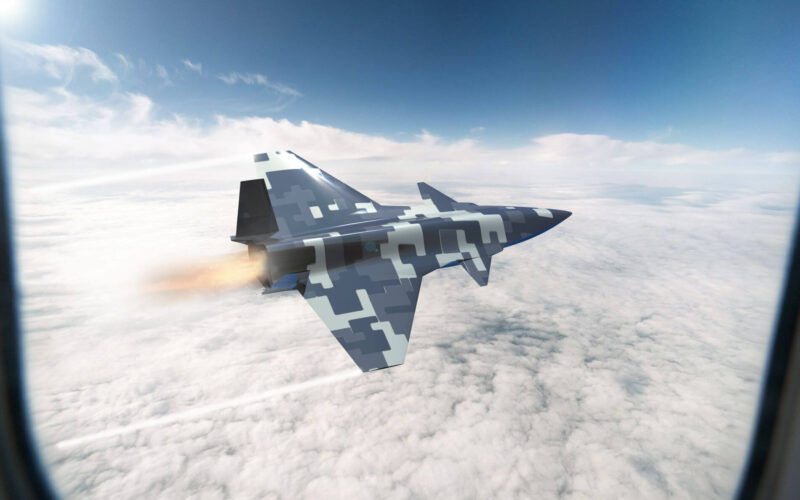
Turkey’s Baykar has signed an export agreement with Indonesian defense company PT Republik Aero Dirgantara (Republikorp) for the supply of 12 Bayraktar Kizilelma unmanned combat aircraft, with deliveries scheduled to begin in 2028.
The framework agreement was signed on May 6, 2026, on the sidelines of the SAHA 2026 defense fair in Istanbul. Baykar described it as the first export contract for the jet-powered Kizilelma, which the company markets as one of the world’s first unmanned fighter aircraft.
Beyond the initial 12-aircraft squadron, the framework includes options for four additional squadrons, for a potential total of 48 Kizilelma aircraft. The deal also covers the establishment of local production and maintenance facilities in Indonesia, as well as technology transfer, training, and the certification of Indonesian technical personnel.
“Bayraktar Kizilelma, one of the world’s first unmanned fighter jet technologies, made its first flight in 2022. Since then, intensive flight activities have continued,” Baykar CEO Haluk Bayraktar said at the signing ceremony. He added that serial production of the aircraft was completed in 2025 with Turkish Air Force induction targeted for 2026.
A third Baykar platform for Jakarta
The Kizilelma agreement extends an already substantial defense industrial relationship between Baykar and Indonesia. Republikorp signed a joint venture agreement with the Turkish manufacturer in 2025, covering local production of the Bayraktar TB3 carrier-capable drone and the larger Bayraktar AKINCI. Separately, Indonesia has also ordered the combat-proven Bayraktar TB2.
Republikorp, formally known as PT Republik Aero Dirgantara, is a privately held Indonesian defense holding company that positions itself as a national strategic partner in the country’s defense industrial base, focused on bridging international technology transfers through joint ventures to support Indonesia’s push for greater self-sufficiency in military equipment.
The group signed a joint venture agreement with Baykar in 2025, covering local production of the Bayraktar TB3 carrier-capable drone and the larger Bayraktar Akinci. Indonesia has also ordered the combat-proven Bayraktar TB2 separately.
Republikorp’s footprint at SAHA 2026 extended beyond the Kizilelma deal: the company also signed two contracts with Turkish defense electronics group Aselsan covering payloads for unmanned naval vehicles destined for the Indonesian Navy and mission-critical communications systems for the Indonesian Armed Forces.
Republikorp Chairman Norman Joesoef framed the latest deal as a continuation of that broader industrial partnership, citing maintenance, repair and overhaul facilities, workforce development, and joint research as parts of the cooperation framework.
For Jakarta, the order is the latest in a series of moves diversifying the country’s combat aircraft sources. Indonesia signed a contract for 48 KAAN fifth-generation fighters from Turkey at IDEF 2025, becoming the first international customer for that program. The country received its first three Dassault Rafale jets from France in January 2026 under a 42-aircraft order and has confirmed plans to acquire Chinese J-10 fighters while remaining a junior partner in South Korea’s KF-21 Boramae program.
A jet-powered UCAV with combat aspirations
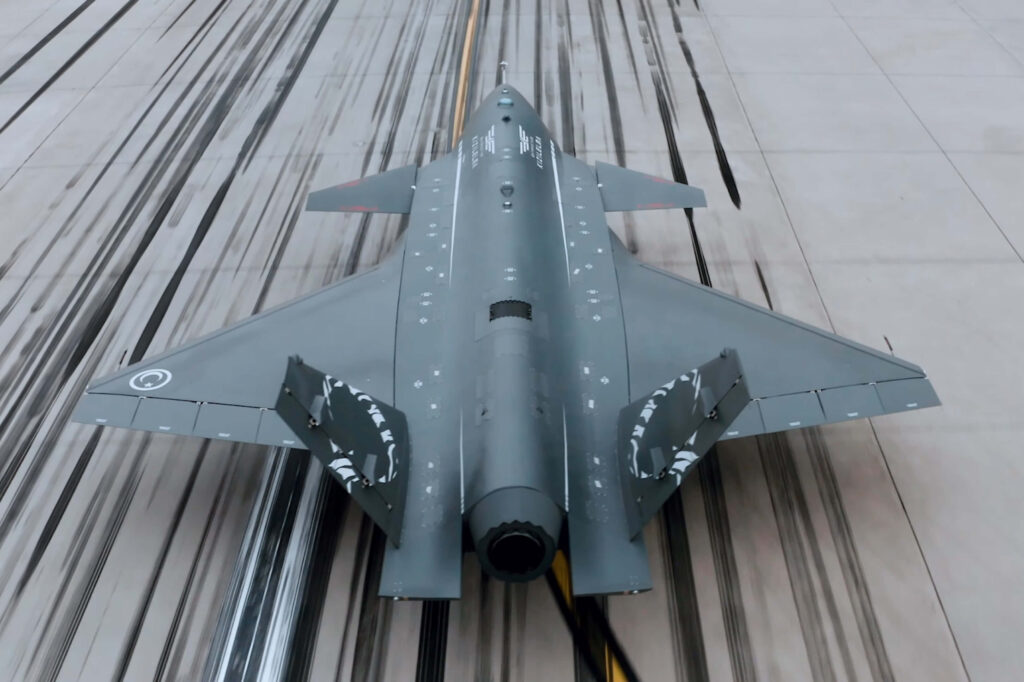
The Kizilelma is Baykar’s first jet-powered unmanned combat air vehicle, with a maximum take-off weight of 8.5 tons and a payload capacity of 1.5 tons. The platform features an internal weapons bay, a low radar cross-section, and an Aselsan-developed AESA radar. Baykar advertises a 500-nautical-mile combat radius; a Mach 0.6 cruise speed; a maximum speed of Mach 0.9; and a service ceiling of 45,000 feet.
The aircraft was designed from the outset for short-runway operations and aircraft carrier compatibility, in line with the Turkish Navy’s plans to operate unmanned aircraft from the TCG Anadolu amphibious assault ship. Indonesia’s interest in carrier-capable drones is consistent with reports that Jakarta has acquired the Italian carrier Giuseppe Garibaldi and ordered the Bayraktar TB3 to operate from it.
Baykar has progressively expanded the Kizilelma’s combat envelope through a series of weapons integration tests. In late 2025, the aircraft conducted its first beyond-visual-range air-to-air missile shot, engaging a jet-powered target over the Black Sea using a Gökdoğan missile cued by its onboard AESA radar. The trial was presented as the first known air-to-air kill by an unmanned aircraft using its own sensors and indigenous weapons.
The Indonesian order extends Baykar’s track record as one of the most prolific drone exporters of the past decade. The TB2 alone has been sold to more than 30 countries, and the company has signed UAV agreements with 37 nations to date, according to its own figures. With the Kizilelma now entering the export market, Baykar is positioning itself as one of the few non-Western suppliers offering a fielded jet-powered UCAV, in a segment otherwise dominated by US and European programs such as the Boeing MQ-28 Ghost Bat, the Anduril Fury, and the loyal wingman concepts being developed under FCAS and GCAP.
1 comment
Great job Indonesia air force.