

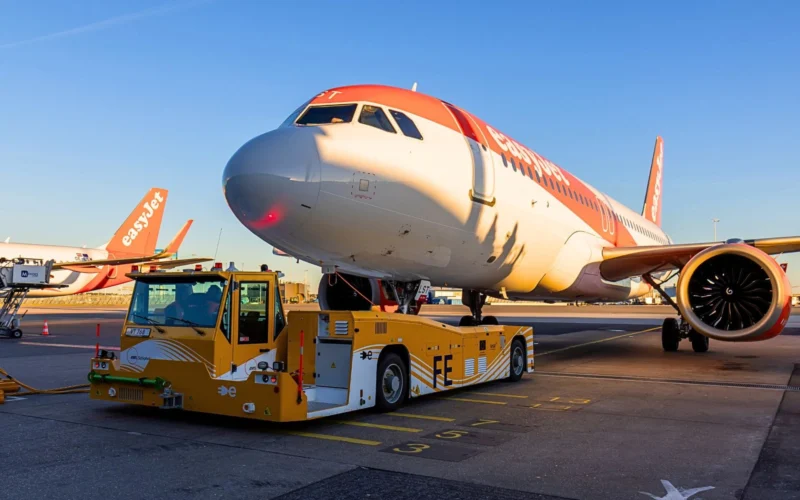
easyJet and Amsterdam Airport Schiphol (AMS) are rolling out automated taxiing technology designed to reduce fuel consumption, carbon emissions, and noise during ground operations.
The deployment of electronic TaxiBot systems, announced on May 26, 2026, follows a successful trial earlier this year. Schiphol becomes the first airport in Europe to use the technology for Airbus aircraft operations.
How TaxiBot works
TaxiBot is a semi-robotic tractor that pushes and pulls aircraft between the gate and runway without requiring the plane’s main jet engines. Instead, the aircraft operates using only its Auxiliary Power Unit, significantly cutting fuel burn and emissions during taxiing.
Four easyJet Airbus aircraft are being equipped for TaxiBot use at Schiphol, delivered in collaboration with Menzies Aviation, Airbus, and Smart Airport Systems. An initial test took place in March 2026, and the first passenger flight using the system operated on April 30, 2026.
easyJet estimates the technology will save an average of 95 kilograms of fuel and 299 kilograms of CO2 per flight, while also reducing noise on the apron.
2030 goal: fully sustainable taxiing operations
According to Schiphol, large-scale deployment of TaxiBot could reduce fuel consumption during taxiing by up to 65%, while also cutting nitrogen oxide and ultrafine particle emissions. The airport aims to achieve fully sustainable taxiing operations by 2030.
David Morgan, Chief Operating Officer at easyJet, said the technology delivers immediate benefits while supporting more efficient ground operations at one of Europe’s busiest airports.
“As we continue to modernize our operations, initiatives like this demonstrate how innovation and collaboration across the industry can help reduce aviation’s environmental impact both in the air and on the ground,” Morgan said.
Esmé Valk, Chief People and Transformation Officer at Amsterdam Airport Schiphol, said the deployment is another practical step toward reduced emissions and noise.
“This is how we’re creating a healthier and cleaner workplace, and an ever more sustainable and modern airport that is ready for the future,” Valk said.
Part of roadmap to netzero by 2050
The TaxiBot rollout is part of easyJet’s roadmap to net zero by 2050. The airline has set an interim target of a 35% reduction in carbon emissions intensity by 2035, validated by the Science-based Targets initiative.
The purchase of the first electric TaxiBot was made possible in part by the European Climate, Infrastructure and Environment Executive Agency under the Connecting Europe Facility, in collaboration with the SESAR 3 Joint Undertaking as part of the HERON project.