

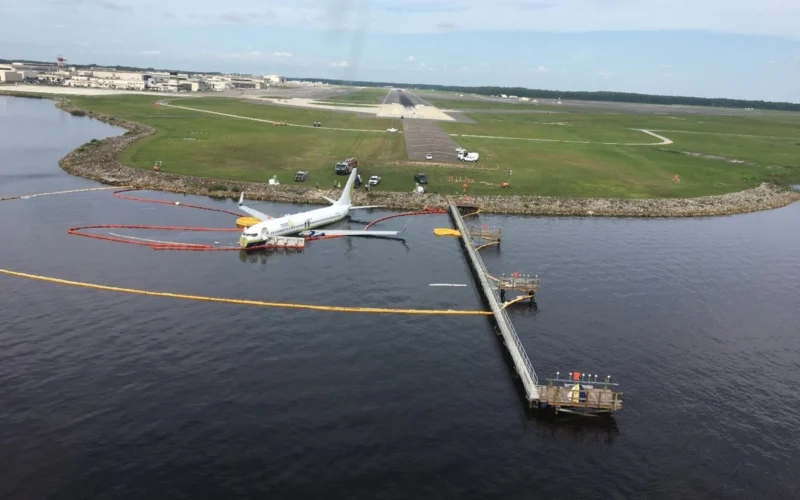
The US National Transportation Safety Board (NTSB) is calling for the Federal Aviation Administration (FAA) to rethink wet runway landing guidance following a spate of overruns.
On May 26, 2026, the NTSB published several recommendations in a report entitled ‘Accounting for the Progressive Decrease in Runway Friction Associated with Increasing Rainfall Intensity’.
According to the report, the new NTSB recommendations result from investigations into 11 runway overrun accidents and incidents over a 15-year period (2008–2022) that occurred after an aircraft landed on wet runways.
The NTSB found that wheel braking friction during landing on a wet runway can be “substantially less than that specified by runway condition assessment matrix (RCAM),” and can “underestimate the actual landing distances required and increase the risk of a runway overrun”.
“The runway condition assessment matrix would better represent the behavior of the maximum wheel braking friction coefficient on wet runways if progressively higher rainfall intensities corresponded to progressively lower runway condition codes,” the NTSB said.
According to the board, flight crews are limited in their ability to accurately assess the runway conditions and the required landing distance during periods of heavy rain, because “rainfall intensity descriptors currently used in aviation weather reports do not identify the highest rainfall intensities that are possible at an airport”.
The NTSB added: “A broader range of available rainfall intensity descriptors would help to more accurately associate progressively higher rainfall intensities with progressively lower runway condition codes in the runway condition assessment matrix.”
NTSB recommendations
The NTSB has put forward three recommendations in its report, as follows:
- Update RCAM runway condition codes assigned to wet runways to account for the progressive decrease in the wheel braking friction coefficient associated with increasing rainfall intensity;
- Add additional rainfall intensity descriptors to be used in aviation weather reports to identify rainfall intensities that can substantially exceed the current heavy rain threshold of 0.3 inches per hour;
- Once the rainfall intensity descriptors used in aviation weather reports are updated, incorporate these descriptors on RCAM.
The full report can be read on the NTSB website.
1 comment
Why not just go back to having a human do weather observations?