

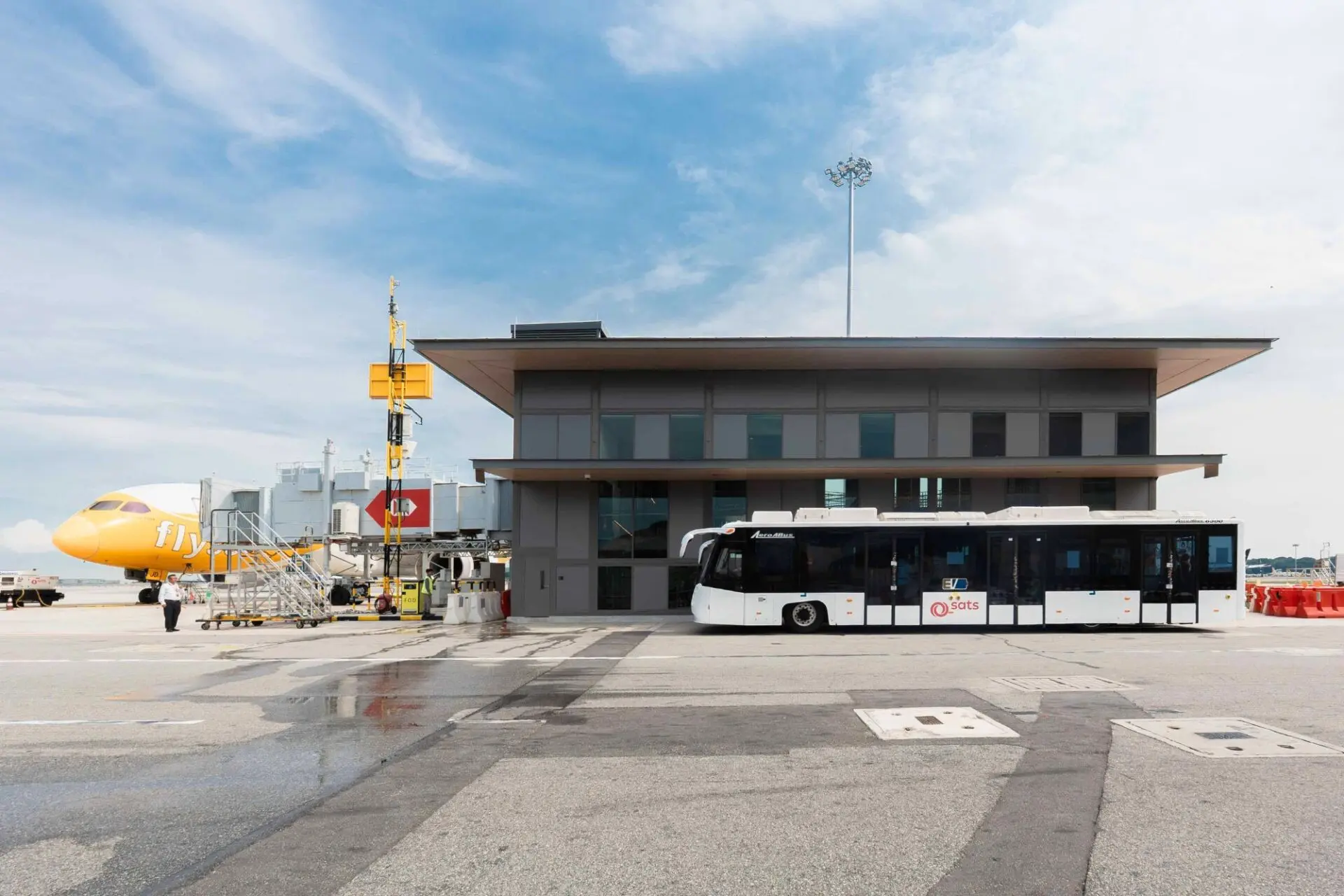
Singapore’s Changi Airport (SIN) has announced that construction has been completed of its first satellite gate, a standalone facility designed to improve the boarding experience for passengers on flights parked at remote stands.
Changi Airport Group (CAG) declared on July 10, 2026, that the facility will begin handling selected flights by August, with operational preparations currently underway.
#NEW: Meet Changi Airport’s new satellite gate! ✨
— Changi Airport (@ChangiAirport) July 10, 2026
Designed to offer a more terminal-like boarding experience, it keeps travellers sheltered and comfortable on their journey to and from aircraft parked away from the terminal ✈️ pic.twitter.com/u4kyDrJkrY
Solving the remote stand problem
The airport said that around 98% of its passenger flights currently use contact gates with aerobridges at the terminals. The remaining flights are assigned to remote stands, requiring passengers to be bused between the terminal and the aircraft, often boarding via stairs exposed to the weather.
The satellite gate changes that. Located in the airfield, the 200-square-meter facility is equipped with two aerobridges, providing a fully sheltered, air-conditioned pathway between buses and aircraft. It supports both narrowbody and widebody operations.
Departing passengers will be bused from the terminal to the satellite gate when it is time for boarding. Arriving passengers will disembark into the facility before transferring to buses for the trip back to the terminal.
Accessibility in mind
A key feature is a gently sloping 60-meter ramp connecting the aerobridges to ground level. The design improves accessibility for wheelchair users and makes the facility easier to navigate for seniors, families with strollers, and travelers with wheeled carry-on luggage.
The building also provides a sheltered working environment for ground handling personnel, passenger service officers, and cleaning teams working remote flight operations.
Zero-energy design
The satellite gate is designed as a zero-energy facility, powered entirely by rooftop solar panels. Electricity is stored in an off-grid battery system nearby, reducing reliance on the airport’s power supply.
Smart features include air-conditioning that activates automatically based on real-time flight information, and electrical fault detection that wirelessly alerts maintenance teams at the main terminal.
Koh Ming Sue, Executive Vice President of Engineering and Development at Changi Airport Group, noted that the facility was focussed on passengers, staff and sustainability.
“Every element of the satellite gate has been designed with passenger experience, universal accessibility, staff-friendliness and operational practicality in mind,” Koh said.
More gates could follow
More than 500 airport staff have been training on satellite gate operations since May. The initial flights will serve as tests for end-to-end passenger journeys, with the results helping Changi Airport Group to assess whether or not to build more satellite gates.
Yeo Kia Thye, Managing Director of Airport Operations Control, argued that facilities like the satellite gate will become increasingly important as traffic grows ahead of the opening of Terminal 5 in the mid-2030s.
“These support our long-term capacity planning by providing greater operational flexibility when contact gates are fully utilised, helping to ensure a smooth and seamless passenger journey,” Yeo said.