

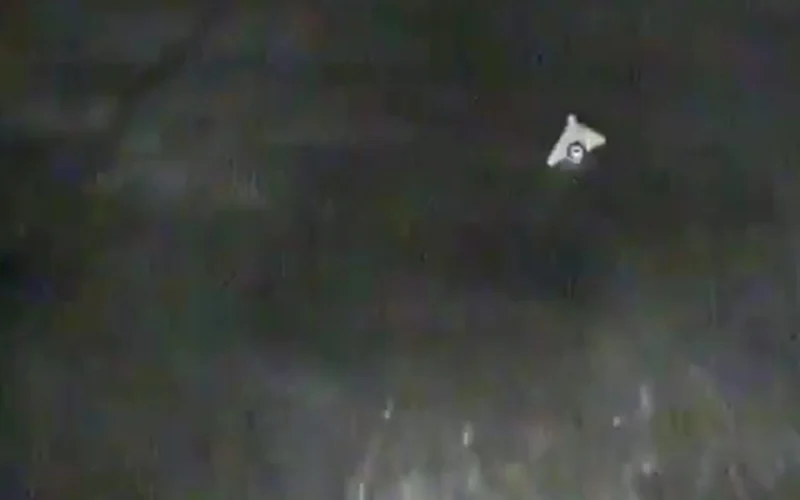
One of Ukraine’s cheapest and most effective air defense innovations was designed around a target that Russia is steadily moving beyond.
Jet-powered drones now make up as much as two-thirds of some Russian attack waves, Ukrainian Air Force spokesperson Colonel Yurii Ihnat told Business Insider on August 13, 2026.
A Ukrainian MiG-29 chasing a Russian jet-powered Shahed at extremely low altitude over the coastline. pic.twitter.com/crUm81XjOG
— Special Kherson Cat 🐈🇺🇦 (@bayraktar_1love) August 14, 2026
In a technical breakdown published on May 25, 2026, Ukraine’s Defence Intelligence (DIU) said that Russia developed the Geran-4 specifically to counter the growing effectiveness of Ukrainian interceptor drones.
The first jet-powered model, the Geran-3, reused the propeller-driven Geran-2 airframe, which DIU noted was structurally ill-suited to high-speed flight and maneuvering under heavy G-loads. The Geran-4 features a new airframe powered by a Chinese Telefly turbojet.
It operates at between 300 and 400 kilometers per hour (185 to 250 miles per hour) and can reach 500 kilometers per hour (310 miles per hour). Nevertheless, its range of around 450 kilometers (280 miles) falls far short of that of the Geran-2.
Different ways to counter an interceptor
Outrunning the interceptor is one answer: blinding it is another. Ukrainian radio specialist Serhii Beskrestnov, who publishes under the name ‘Flash’, released footage in mid-August 2026 showing an interceptor’s video feed cutting out as it closed in on a Shahed.
Upgraded Shahed drones are now using onboard electronic warfare systems designed to disrupt Ukrainian interceptor FPV drones. Ukrainian military expert Serhii “Flash” published footage he said showed an interceptor’s video feed being overwhelmed by interference as it approached a… pic.twitter.com/UTbsUkufDO
— NOELREPORTS 🇪🇺 🇺🇦 (@NOELreports) August 11, 2026
He attributed the interruption to an onboard jammer whose transmitter overwhelmed the interceptor’s video downlink to its operator on the ground. Beskrestnov noted that Russia can identify the relevant frequencies, because Ukrainian manufacturers publish them.
However, he cautioned that no such device was among the recovered wreckage. The explanation therefore remains his expert interpretation of the observed effects, rather than a physically confirmed finding. He added that the technique is not new and carries a cost for Russia: any drone that transmits can potentially be detected and located through its own emissions.
Interceptors get faster and smarter
Ukraine’s most direct response is raw speed. Former Ukrainian defense minister Mykhailo Fedorov said on August 14, 2026 that an unnamed Ukrainian manufacturer was conducting combat trials of one of the country’s first jet-powered interceptor drones.
The interceptor can exceed 600 kilometers per hour (375 miles per hour), giving it a substantial speed advantage over the Geran-4. Its first confirmed shoot-downs were still awaited, however. Fedorov added that several Ukrainian manufacturers were developing systems intended to counter jet-powered drones.
Speed alone only creates the opportunity for an engagement. Successful interception still depends on radar cueing, positioning and timing, particularly against a target that may be maneuvering or approaching from an unfavorable direction.
Other developers are working to make the interceptor less dependent on its operator. SkyFall, which builds the P1-SUN, unveiled a faster derivative called JetKiller at the Farnborough International Airshow on July 20, 2026. The company lists a top speed of 370 kilometers per hour (230 miles per hour), up from roughly 310 kilometers per hour for the baseline aircraft.
JetKiller can also be fitted with an artificial intelligence module that automatically detects, tracks and locks on to targets. That reduces its dependence on an uninterrupted video link to the operator—and potentially its vulnerability to the jamming technique described by Beskrestnov.