

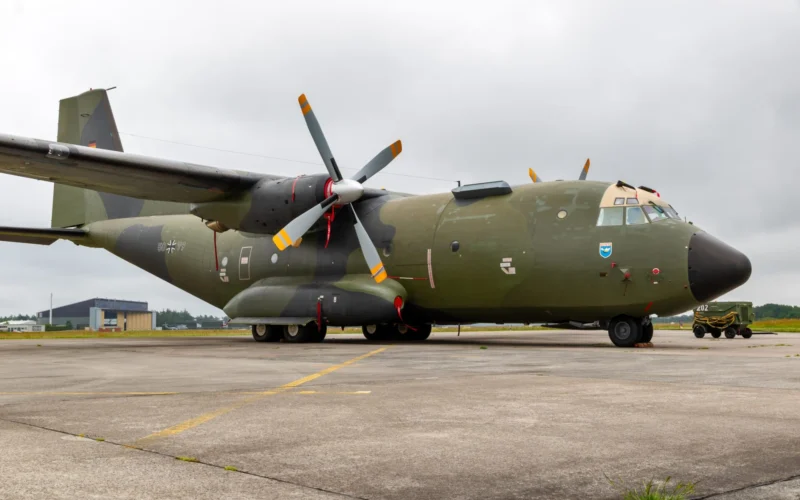
Two Transall C-160Ds retired by the German Air Force are being prepared for a return to flight as firefighting aircraft, carrying Kevlar armor inherited from their military career that their operator believes will let them work over ground contaminated by unexploded ordnance.
MachJet owns the aircraft and is expected to operate the C-160D in Europe and Australia. Lower Saxony-based Total Aeronautical Services (TAS) is the German partner in the project. Germany’s Federal Aviation Office (LBA) and Bundeswehr procurement agency BAAINBw are supporting the project.
The partners aim to have the first aircraft operational for the summer 2027 wildfire season, Flug Revue reported. It has been allocated the registration D-AMJT, which would make it the first C-160 to fly on the German civil register.
TAS is aiming to move fast. If D-AMJT enters service as planned in summer 2027, the Transall will return to German skies less than six years after the Luftwaffe retired the type, and five after France retired its own fleet, this time carrying water and retardant instead of troops and cargo.
A 14-tonne payload, and armor
The conversion uses a Helitak tank installed inside the cargo hold, carrying around 14 tonnes of water or retardant.
Rather than releasing the load through the rear ramp, the arrangement used by the A400M kit France deployed over the Gironde in July and that Spain is fitting to part of its own fleet, the system discharges through the belly near the aircraft’s center of gravity, at up to 3,000 liters per second. TAS says the tank can be refilled on the ground in about three minutes.
The armor beneath the cockpit and forward cargo compartment was installed by the Luftwaffe for operations in hostile environments. TAS sees it as an asset over former military ranges and other munitions-contaminated ground, where fires are often difficult or impossible to attack from the ground.
Germany is being reminded of that problem as the project advances. A fire that broke out in the Hürtgenwald in North Rhine-Westphalia on August 13, 2026, on terrain still saturated with ordnance from the 1944 battle fought there, has grown into what officials describe as the state’s largest recorded forest fire.
Munitions detonated on the burn area overnight into August 14, 2026, around 2,000 residents of the village of Gey were evacuated, engineer tanks were brought in to cut firebreaks, and crews were unable to enter parts of the site on foot. In May 2026, a fire at the former Jüterbog training area in Brandenburg burned at least 152 hectares under similar constraints.
This article was updated to clarify that MachJet owns the C-160D aircraft and will operate them in Europe and Australia. Total Aeronautical Services is the German partner in the project.