

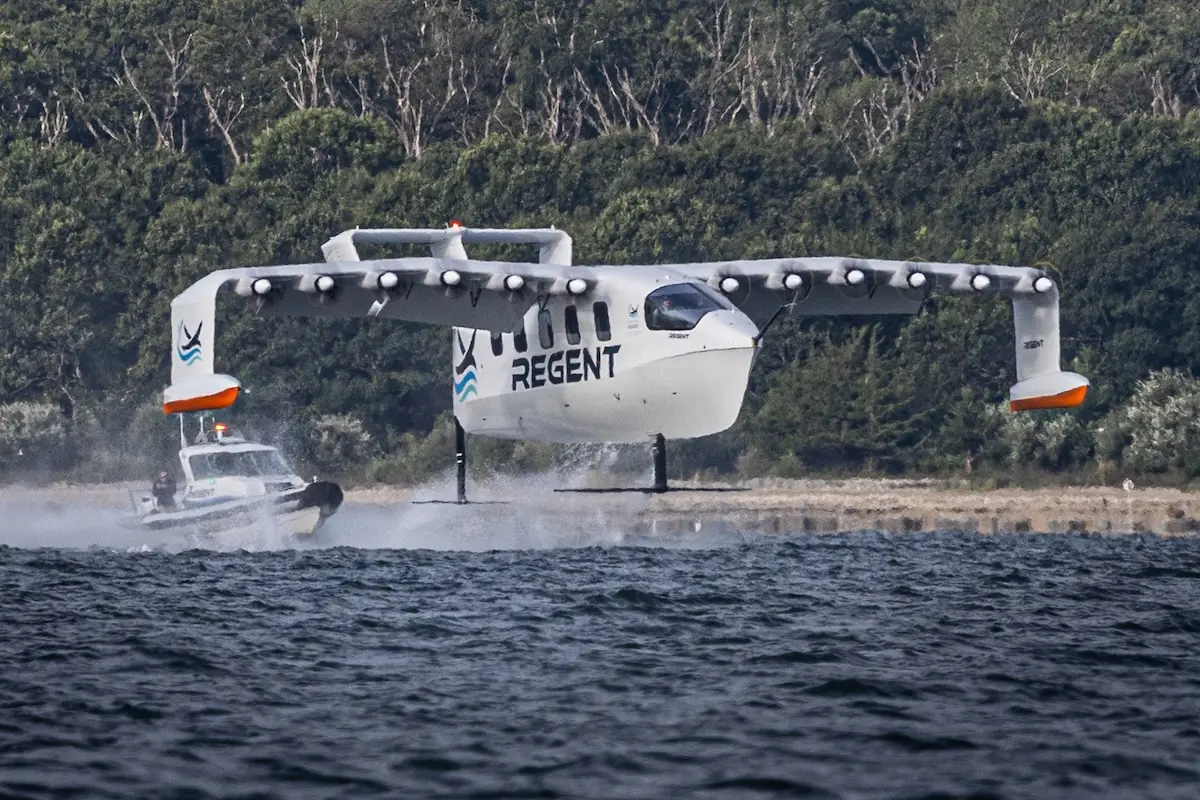
REGENT announced on September 2, 2026, that it has successfully completed the first crewed flight of its Viceroy wing-in-ground seaglider.
The Viceroy is designed to carry up to 12 passengers skimming at 180 mph (289 km/h) over the surface of the sea, making use of an aerodynamic principle called ‘ground effect’.
With this milestone, the Viceroy also becomes the largest-ever all-electric wing-in-ground-effect craft to fly with people onboard. Larger crewed experimental wing-in-ground vehicles, known as ekranoplans, were operated by the Soviet Union in the 1970s, but were powered conventionally and had an exclusively military purpose.
Viceroy’s first crewed flight took place on Narragansett Bay, Rhode Island, where REGENT is based. During the flight test, the seaglider flew a distance of 1,956 ft (596 m) at a height of 33 ft (10m) above the water for 30 seconds with a crew of two onboard.
Prior to the flight, REGENT had been testing the Viceroy with the hull on the water and on hydrofoils. The latter are fins which provide the seaglider with stability in choppy sea conditions. Those hydrofoils are also a point of contact with the surface of the water which facilitates the transition to full flight as the craft accelerates.
Just two days prior to the completion of the crewed flight, REGENT announced the closing of a $240 million Series B funding round to accelerate the development of its wing-in-ground seaglider program.
In 2026, REGENT has also performed flight tests of Squire, a smaller wing-in-ground vehicle with military applications, which is uncrewed.
1 comment
If this is an answer, What’s the question?