

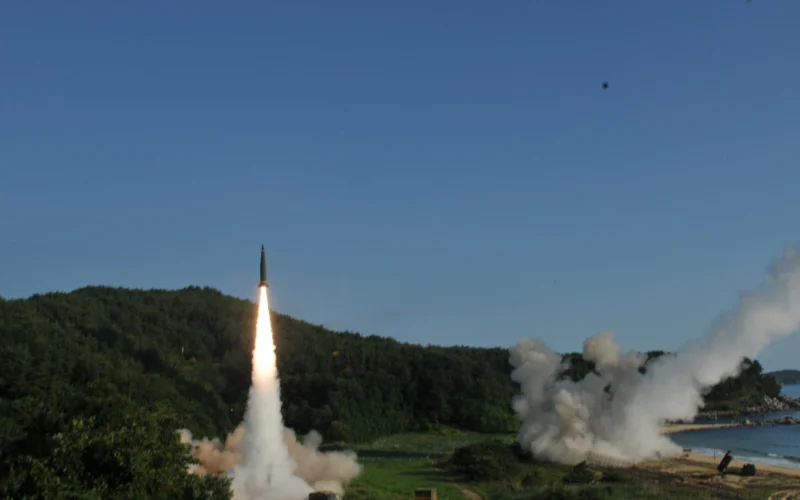
South Korea conducted the first test launch of a domestically developed hypersonic glide vehicle (HGV) on October 8, 2026, with President Lee Jae-myung observing at the test site, according to a written briefing by presidential chief spokesperson Kang Yu-jung.
The launch was carried out in the afternoon by the Agency for Defense Development (ADD), the state-run institute responsible for South Korea’s major weapons programs. The presidential office did not disclose the location.
Hypersonic vehicle completes low-altitude maneuvers
According to the presidential office, the vehicle climbed to its planned altitude on a booster, separated, and completed its planned flight under hypersonic conditions.
After separation, the glide vehicle descended to a lower altitude and followed an irregular trajectory, changing course both vertically and horizontally before striking its designated target point.
The test was designed to verify three core technologies: heat-resistant materials capable of withstanding the extreme temperatures of hypersonic flight, guidance and control systems, and the ability to perform irregular maneuvers at low altitude.
The presidential office did not release figures for speed, altitude, range, or flight duration.
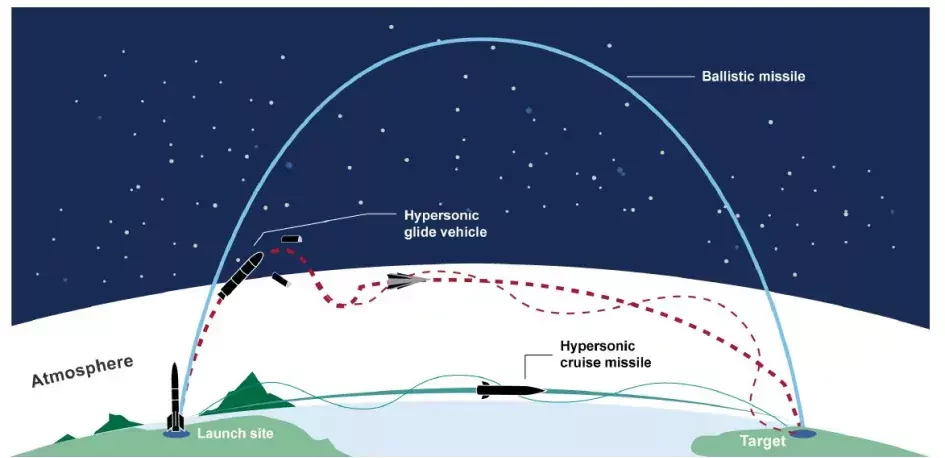
Unlike a conventional ballistic missile, which follows a largely predictable trajectory after its boost phase, an HGV can maneuver during its unpowered flight through the atmosphere. Combined with hypersonic speed, typically defined as exceeding Mach 5, these maneuvers complicate detection, tracking, and interception.
The presidential office described the successful test as an important step toward securing a new deterrent capable of striking critical targets across the Korean Peninsula. The vehicle remains under development, with no publicly announced deployment timeline.
President Lee calls for rapid deployment
“Our security is something we secure through our own strength,” Lee said, according to the presidential briefing.
He urged researchers to continue refining the system into a strategic asset and called for its rapid development and deployment, pledging government support for advanced weapons programs.
ADD officials, senior national security advisers, Defense Minister Kang Shin-chul, and Defense Acquisition Program Administration head Lee Yong-chul also attended.
Following the launch, Lee inspected the Hyunmoo-5, the high-power surface-to-surface ballistic missile designed to strike hardened underground targets. South Korea first displayed the missile publicly during its Armed Forces Day parade on October 1, 2024.
A separate path from South Korea’s HyCore program
The HGV is distinct from HyCore, a scramjet-powered hypersonic cruise missile demonstrator that ADD has been developing with Hanwha since 2018.
While a hypersonic glide vehicle travels without propulsion after separating from its booster, a scramjet-powered cruise missile uses an air-breathing engine to sustain powered flight through the atmosphere.
Both approaches are part of South Korea’s efforts to develop advanced indigenous strike capabilities. ADD also leads other weapons programs, including a long-range air-to-air missile for the KF-21, with development scheduled to continue through 2033.
The HGV test comes amid heightened tensions on the Korean Peninsula. On September 21, 2026, explosions attributed by Seoul to North Korean antipersonnel mines injured three South Korean service members inside the Demilitarized Zone. Pyongyang has denied responsibility.
North Korea has also continued testing its own hypersonic weapons. On October 3, 2026, it launched an intermediate-range missile that state media described as part of a hypersonic strategic weapon system, with leader Kim Jong Un supervising the test.
According to the Korean Central News Agency (KCNA), the missile struck a target approximately 1,000 kilometers away, while South Korea assessed that it had traveled more than 700 kilometers.