

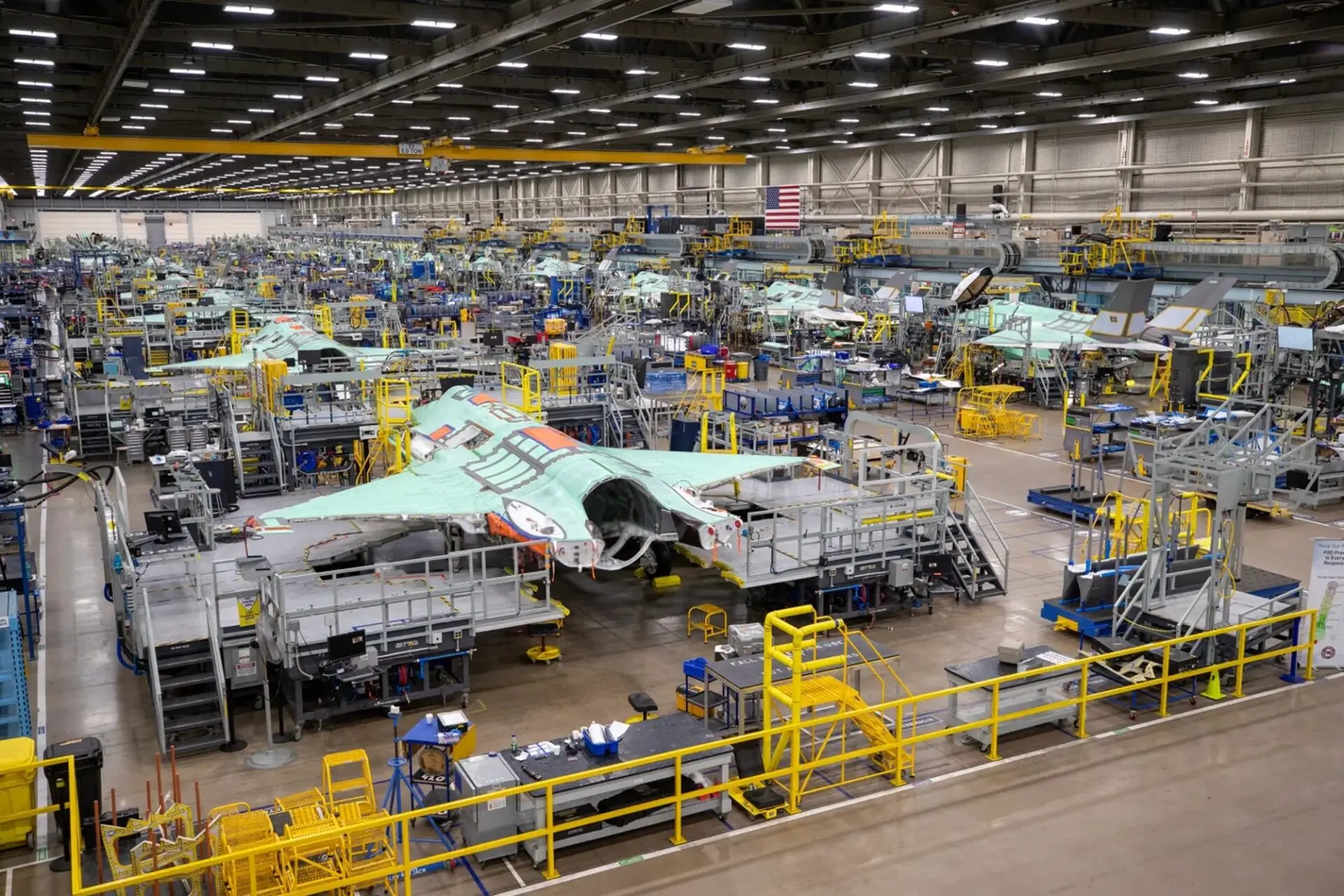
The US Department of Defense and Lockheed Martin have agreed on a 10-year framework covering at least 850 F-35 Lightning II fighter jets for the US military, the two sides announced on October 22, 2026.
The agreement is not yet a production contract. It still requires congressional authorization for multiyear procurement and the corresponding funding before the two parties can finalize its terms.
Under the framework, Lockheed Martin will self-fund at least $7 billion in initiatives supporting the F-35 program, according to the Pentagon announcement.
The company stated that the arrangement spans production Lots 21 through 30, including initial spare parts, 10 years of modification kits and sustainment, and orders from international customers. Total production would remain at 156 aircraft per year.
The 850-aircraft commitment amounts to an average of 85 US jets annually, matching the figure that Lockheed CEO Jim Taiclet suggested that the Pentagon had requested for US forces back in July 2026.
The previous finalized production agreement, covering 296 F-35s across Lots 18 and 19, was signed on September 29, 2025, for a combined $24.3 billion.
Congress holds the key to a decade-long F-35 deal
Neither side has disclosed the potential contract value. Once Congress approves the required procurement authority and funding, the F-35 Joint Program Office and Lockheed Martin can begin negotiating prices, delivery schedules and other terms.
Both the House and Senate versions of the fiscal 2027 National Defense Authorization Act include provisions for multiyear F-35 procurement, although the legislation has yet to become law.
The Pentagon sees the agreement as part of a broader effort to give defense manufacturers more predictable orders and encourage investment in production capacity. Similar arrangements have already been reached for missile systems, including Lockheed Martin’s seven-year, $58.62 billion PAC-3 MSE interceptor contract awarded in July 2026, as well as earlier agreements to increase Patriot and strike missile production.
Under Secretary of Defense Michael Duffey said that the approach would align “financial incentives with actual performance”.
For Lockheed Martin and its suppliers, the longer planning horizon could make it easier to buy materials in bulk, expand production capacity and manage demand for spare parts. OJ Sanchez, president of Lockheed Martin Aeronautics, remarked that the company expects the arrangement to deliver “higher mission capable rates and a more resilient supply chain”.
Those improvements would address some of the problems that have affected the F-35 fleet in recent years. A September 2025 Government Accountability Office report pointed to delays in the Technology Refresh 3 (TR-3) and Block 4 upgrades, alongside continuing shortages of parts and other supply chain difficulties.
Lot 20 negotiations remain unresolved as F-35 deliveries slow

The long-term framework comes as Lockheed Martin continues to negotiate its more immediate F-35 production commitments.
In its third-quarter 2026 financial results, released the same day, the company said that talks with the Pentagon over Lots 20 and higher were still underway. During the quarter, costs on its Lot 20 advance acquisition contract began to exceed the amount authorized and funded by the government. Lockheed warned that further delays in securing additional funding could affect its financial results and cash flow.
F-35 deliveries have also fallen behind last year’s pace. Lockheed handed over 43 aircraft in the third quarter, bringing its total for the first nine months of 2026 to 94, compared with 143 during the same period in 2025. The company had delivered just 19 aircraft in the second quarter.
The new framework could provide Lockheed Martin and its suppliers with greater certainty over the next decade of F-35 production, but its implementation will depend on congressional approval and the outcome of subsequent contract negotiations.