


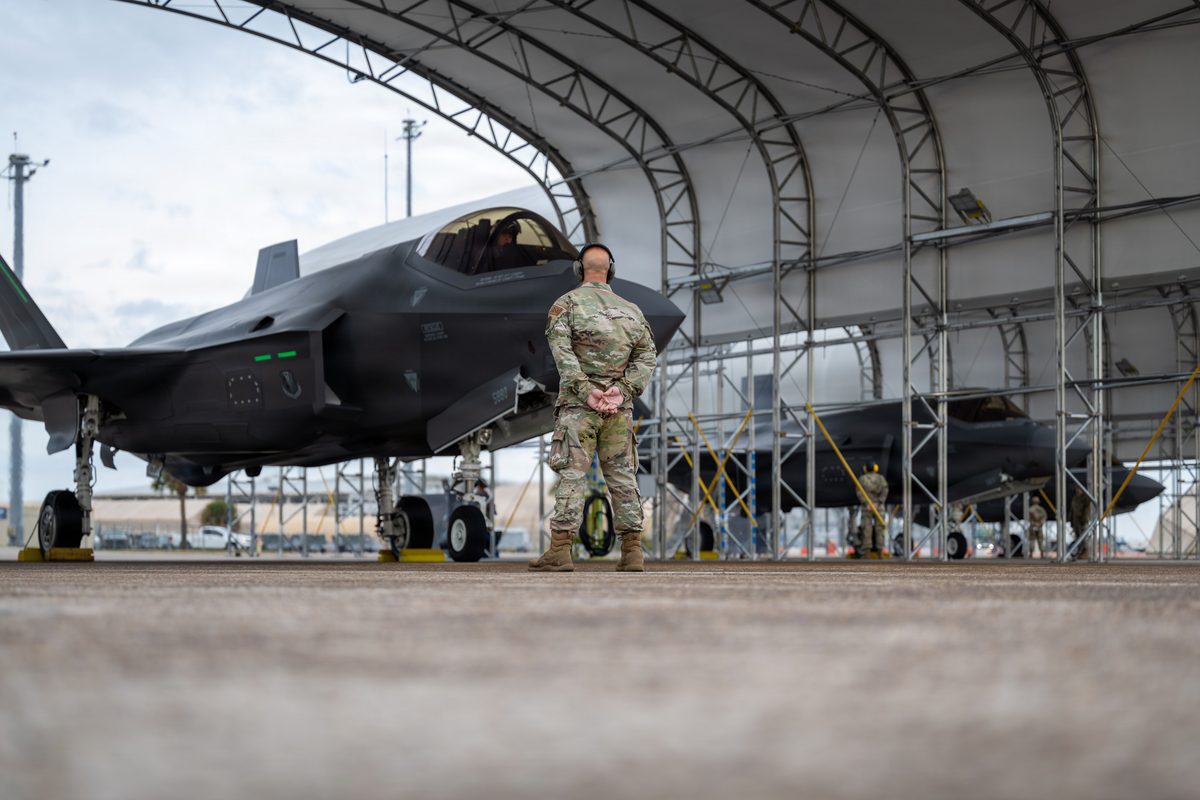
The US Air Force is looking at enclosing six F-35A parking shelters at Tyndall Air Force Base, Florida, with protective netting designed to keep small drones away from parked fighters and the personnel working on them.
A sources sought notice published on SAM.gov on November 6, 2026, asks contractors to design, supply and install counter-unmanned aircraft system (C-UAS) netting on all four sides of the existing sunshade structures. The notice is part of a market research effort and does not commit the service to a purchase.
Six shelters with room for 72 F-35As
Each sunshade measures approximately 192 meters (630 feet) long, 20 meters (65 feet) wide and nine meters (30 feet) high, with six bays per structure, according to the notice.
Design drawings attached to the notice, prepared for the US Army Corps of Engineers’ Mobile District in 2023, show two F-35As parked side by side in a typical bay.
That arrangement would give the six structures room for up to 72 fighters, matching the number the US Air Force planned to assign to Tyndall’s 325th Fighter Wing when it selected the base to host three F-35A squadrons in March 2021.
Retractable nets to stop small drones
The netting must be capable of stopping Group 1 drones, the smallest category in the US military’s classification, covering aircraft weighing up to approximately nine kilograms (20 pounds).
The US Air Force specifies UV- and moisture-resistant material capable of withstanding temperatures of up to 204 degrees Celsius (400 degrees Fahrenheit), mesh openings no larger than 7.6 centimeters (three inches), and a minimum tensile strength of 91 kilograms (200 pounds). The system must also meet Miami-Dade County wind-load requirements, particularly relevant for a base on Florida’s Gulf Coast.
The north and south faces, where aircraft enter and exit the shelters, must be fitted with netting that can be quickly retracted without disrupting normal flight-line operations.
The service is also asking contractors to assess whether the existing metal structures can support the additional loads and whether modifications would be necessary. The notice encourages small businesses to respond.
Protecting fighters from drones on the ground
Tyndall is not the first US fighter base to consider protective netting. In October 2024, Langley Air Force Base, Virginia, sought a prototype installation for one of 42 F-22 Raptor sunshades, following a series of unexplained drone incursions in December 2023.
The vulnerability of parked aircraft was demonstrated on June 1, 2025, when Ukraine launched Operation Spiderweb, using small first-person-view (FPV) drones concealed in trucks to strike Russian military air bases. A subsequent US Department of Defense report, citing the Defense Intelligence Agency, assessed that at least 10 Russian strategic bombers were destroyed.
Physical barriers have since featured in Pentagon counter-drone guidance. In January 2026, Joint Interagency Task Force 401 published recommendations that include netting and tensioned cables to prevent small drones from reaching critical infrastructure.