

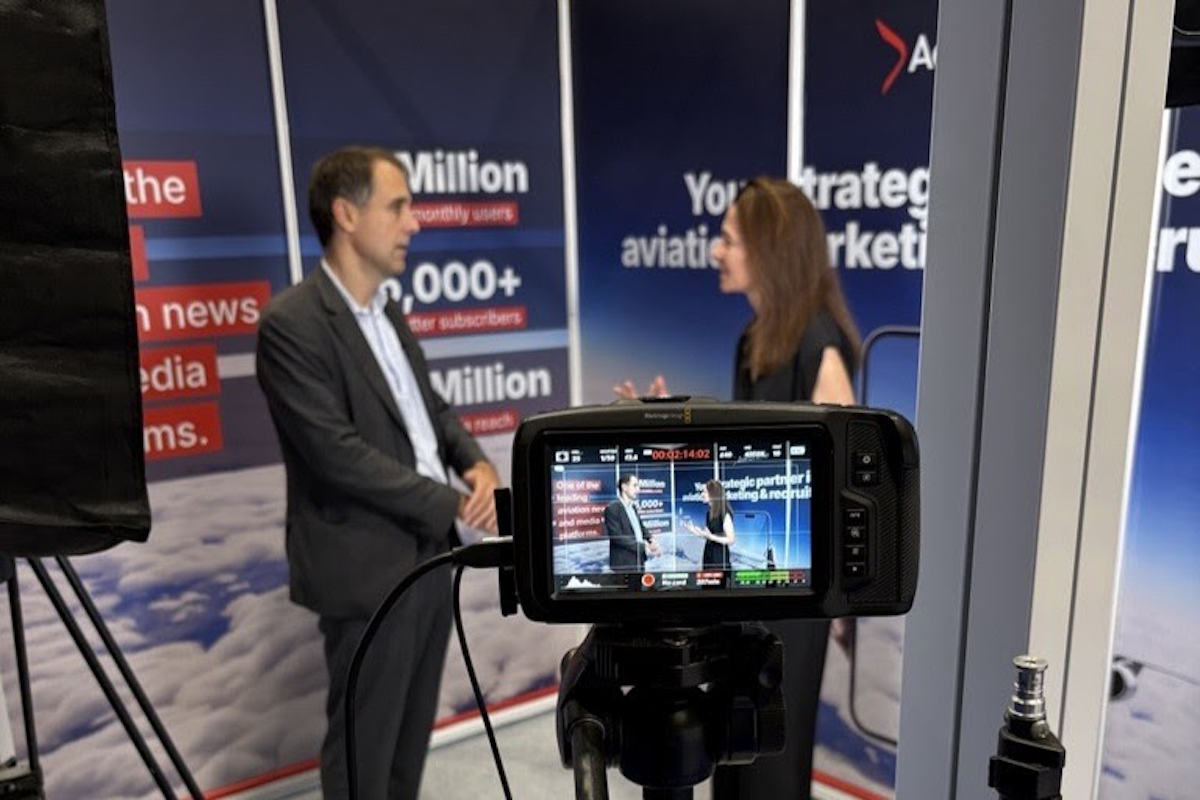
In October 2026, the World Aviation Festival (WAF) returned to the FIL convention center in Lisbon, Portugal, gathering some of the world’s leading airlines and airports.
The conference, which spanned three days, has established itself as one of the industry’s main events for airline and airport digital transformation, with this year’s edition probing to be no exception.
As well as featuring conference stages and the exhibition area, which saw a whole section dedicated to startups, WAF is also a massive platform for networking among aviation professionals. Over the course of three days, more than 4,500 attendees and 600 speakers shared expert insights and showcased the latest solutions in the fields of aviation software and technology.
As is always the case, a number of airline CEOs, including those of TAP Air Portugal, All Nippon Airways (ANA), LATAM Airlines and Abra Group, also took to the stage.
When it comes to high-stakes corporate moves, the announcement of Lufthansa Group’s acquisition of a 44.9% stake in local Portuguese flag carrier TAP Air Portugal was doubtlessly the main headline-grabber. The airline group outbid the only other contender left in the race, Air France-KLM, to gain effective control of one of the few remaining independent flag carriers and one of the largest players in the Europe to Brazil market.
The latest advancements in AI and automation
However, with the World Aviation Festival being such a technology-centric event, it was inevitable that artificial intelligence (AI), which is no longer a side topic or a fancy new experimental technology, would be a major theme. Most companies at the conference were discussing plans to utilize AI to better run operations and sell more.
Agentic booking may be one of the most visible applications of AI and one that holds the most promise when it comes to transforming the way travelers plan and organize their trips. Quite a few firms present at the World Aviation Festival are developing solutions in this space.
But taking into account conversations AeroTime had with a cross-sample of exhibitors, it is behind the scenes that AI is already showing its transformative potential, quietly making the whole precision machine that the industry relies on much more efficient, faster and, importantly, cheaper.
For example, Italy’s Value Group is using it to help airlines better handle disrupted operations (IROPS), proactively anticipating the consequences for travelers following a diverted or cancelled flight.
Another firm, payments orchestration specialist CellPoint Digital showcased “Zenith”, an AI-driven platform that helps airlines gain more revenue by reducing the number of declined card payments through smart optimization of processes.
The airport environment is also ripe for AI transformation, which is perhaps not that surprising given the complexity and multi-dimensional nature of the movements which take place within and around them.
Assaia, a company which uses AI to monitor aircraft turnarounds in real time, presented its 2026 Turnaround Report at the festival. According to data from the report, turnarounds at North American and European airports run on average 11 minutes over schedule. AI-assisted turnarounds could help airlines close at least part of this gap, which Assaia estimates as up to $44 billion per year. With these types of opportunities ahead, it is no wonder that airports are going all in when it comes to technology.
Cavu, the technology arm of Manchester Airport Group (MAG) also had a prominent presence at WAF. Valentina Moise, the company’s Vice President for Growth, spoke with AeroTime about the company’s integrated approach to the passenger experience.
In the following video interview Moise explains how Cavu understands the connected journey from the moment travelers leave their homes to when they return, and how the company’s technology is lifting its customers’ revenue per passenger by servicing every ancillary along the way.
Friction-free travel?
By removing friction from operational processes, is AI enabling airlines to focus on their investment in other areas, such as delivering a more elevated customer service?
Speaking with AeroTime, Renato Ramos, VP Corporate Strategy at Star Alliance, emphasized the alliance’s focus on NPS (Net Promoter Score), a key metric for evaluating the passenger experience.
And while Star Alliance measures up to 50 different parameters impacting the customer’s experience, there’s one that has become essential to its mission: delivering a smooth and seamless experience between the multiple partners involved in a travel journey.
Alliances offer a framework for that, but technology is also available to help non-aligned carriers, including low-cost airlines which have traditionally avoided the mere notion of connectivity, let alone multi-modal journeys.
Icelandic tech firm Dohop builds software that helps low-cost carriers, such as easyJet, and independent airlines interline with each other and with third party operators. The company has recently added Wizz Air to its list of customers and is also making inroads into air-rail connectivity.
What’s more, its CEO, David Gunnarsson, also shared with AeroTime the success of “Weya”, Dohop’s B2C business, which already accounts for over a third of the company’s revenue.
Dohop is able to leverage the fact that it has access to the airline’s seat inventory to market specific itineraries involving two or more low-cost airlines directly to travelers.
Dohop has made it possible for point-to-point carriers to outsource their interlining technology. Some low-cost airlines are now also responding to the growing premiumization of demand in certain markets, like the United States.
A perfect example of this is Allegiant Air, an ultra-low-cost carrier, the CEO of which recently featured on AeroTime’s Executive Spotlight series. This time it was the airline’s Chief Commercial Officer (CCO), Drew Wells, who was in attendance in Lisbon.
Speaking with AeroTime, Wells confirmed some details about the upcoming launch of the carrier’s new Allegiant First product, which will be rolled out in 2027 when the airline takes delivery of its new Boeing 737 MAX aircraft. This will be a proper business class product, Wells stated, complete with differentiated seats and better food and drink options.
So, is internet connectivity coming next to Allegiant?
“We’ll be addressing this point soon,” was Wells rather enigmatic answer.
The World Aviation Festival is expected to return in autumn 2027, and while it is hard to predict how far some of the showcased technologies will have evolved by then, it is likely to remain the forum to gauge the scale of technological progress in the industry.