

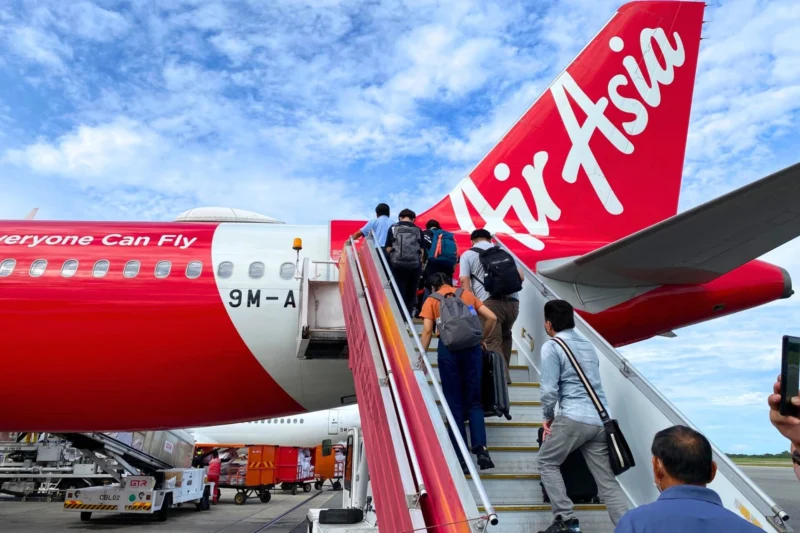
AirAsia Philippines is to cut jobs and scale back routes and flight frequencies, with high jet fuel prices and a weak peso driving up its operating costs. Local media has reported that about 90 captains and first officers have been told their employment will end on December 31, 2026.
“AirAsia Philippines has made the very difficult decision to reduce our workforce. Sustained pressure from elevated jet fuel prices and unfavorable exchange rates has significantly increased our operating costs,” President and General Manager Anna Victoria Lu said in a statement on November 26, 2026.
“In response, we had to carefully evaluate and optimize our routes and flight frequencies to keep operations sustainable, which have a significant effect on our manpower requirements,” Lu added. “These tough adjustments are being made to ensure the long-term stability of the airline, in the best interest of our passengers and our dearest Allstars.”
The airline did not say how many employees were affected or which routes and flights will be cut, although local media, citing the pilots’ union, has reported that about 90 pilots have received retrenchment notices.
Lu stressed that the company would support those who are leaving. “We deeply recognize the impact this has on our colleagues and their families, and we are committed to supporting them with care and transparency through this transition,” she said.
The Philippine Star reported that AirAsia Philippines has been one of the country’s hardest-hit carriers, closing some flights to save costs as jet fuel crossed USD 200 per barrel. Like other local airlines, it earns most of its revenue in pesos but pays most of its expenses in US dollars, so the peso’s weakness has added to the strain.
On November 27, 2026, the airline declared that its flights would operate as scheduled. “AirAsia Philippines remains fully operational and committed to serving the Philippine market,” Lu said. “We want to assure our passengers that the announced workforce adjustment will not affect their flight, booking, or other services.”
Pilots’ union files strike notice as labor department steps in
The layoffs have spawned a labor dispute. According to the Manila Standard and Bilyonaryo, the AirAsia Philippines Pilots Union (APPU) filed a petition for a certification election on September 4 so that pilots could choose their collective bargaining representative. The Department of Labor and Employment (DOLE) granted the petition on November 19, and the union received the order on November 25.
That same week, management announced the workforce reduction at a meeting with pilots, the union said. Around 90 pilots then lost access to their crew schedules and were called to individual meetings with management between November 25 and 27. Those who attended on November 25 received retrenchment notices effective December 31, 2026.
APPU President Oscar Joseph Ramos Jr. told local media that the retrenchment had been rushed, with too little consultation and outstanding issues left unaddressed. The Philippine Star reported that the union had sought to represent close to 200 pilots, which implies that nearly half of them will be gone by the end of the year.
The Trade Union Congress of the Philippines (TUCP) questioned the timing, called the move ‘union busting’ and asked lawmakers to investigate.
APPU filed a notice of strike at the DOLE main office in Manila on November 26. Labor Secretary Francis Tolentino said the agency had formed a task force and convened the National Conciliation and Mediation Board to bring both sides together on November 27. He told local reporters the dispute was a top priority because a strike could disrupt flights ahead of the year-end holidays, and that he would oversee the talks himself.
Group defers salaries as losses and fuel costs mount
The cuts in the Philippines come as the wider group tightens its finances.
On November 27, 2026, Reuters reported that AirAsia had informed its Malaysia-based employees that their salaries would be paid at the end of each month from November through March 2027.
According to an internal email sent by Chief People Officer Muhammad Khurram Zia, the change is a temporary operational adjustment. AirAsia had previously paid salaries earlier, during the second half of each month, one person familiar with the matter told the news agency.
AirAsia, which employs about 26,000 people, mostly in Asia, reported its third consecutive quarterly loss on November 23, 2026, although the loss was narrower than in the previous quarter. Its cash and bank balances stood at MYR 905 million (USD 220 million) as of September 30, down 5% from the end of June.
To conserve cash, the airline has suspended unviable routes and returned 25 aircraft to lessors, with more expected to leave the fleet during 2027. A creditor restructuring is also underway, as part of a plan to reset the business before rebuilding in 2028.
Group CEO Bo Lingam, the third-quarter results suggested the worst was over, but warned that fuel costs would rise further in the fourth quarter. The company’s shares have fallen more than 70% this year.
Reuters also reported that Malaysia’s government has been weighing options to support AirAsia without putting public funds at risk. The finance ministry said on November 26 that, if it decided to step in, it would seek priority over other lenders and closer oversight of the airline’s board and management.
Other airlines are facing similar pressure. The war with Iran has pushed jet fuel prices to levels that have put airlines under their worst financial pressure since the COVID-19 pandemic. US low-cost carrier Spirit Airlines collapsed in May, Latvia’s airBaltic sought bankruptcy protection in September, and Norse Atlantic suspended flights on November 26 while it searched for short-term financing.
Cuts come two months after Fernandes insisted AirAsia was on solid footing
The layoffs and salary changes come about two months after AirAsia co-founder Tony Fernandes pushed back against reports that the airline was in trouble.
At a press conference in Bangkok on September 18, 2026, Fernandes dismissed a Reuters report that Malaysia’s government had asked Malaysia Airlines and Batik Air whether they could take over AirAsia’s domestic capacity as a contingency plan. He said the airline had neither sought nor received government assistance.
Fernandes described AirAsia as sustainable, strong in liquidity and good at managing cash, and said it was not an airline about to collapse. He presented the return of 25 older, less fuel-efficient aircraft as part of a fleet optimization program rather than a sign of strain.
At the time, he acknowledged that fuel was a real pressure. AirAsia posted a second-quarter net loss of MYR 831 million (USD 204 million), and Fernandes said the airline would need to adjust its cost structure and fares. He added that liquidity was catching up by the end of the third quarter and that AirAsia was raising USD 1 billion in international debt markets and MYR 700 million (USD 172 million) in local credit facilities to refinance existing debt at a lower cost.