
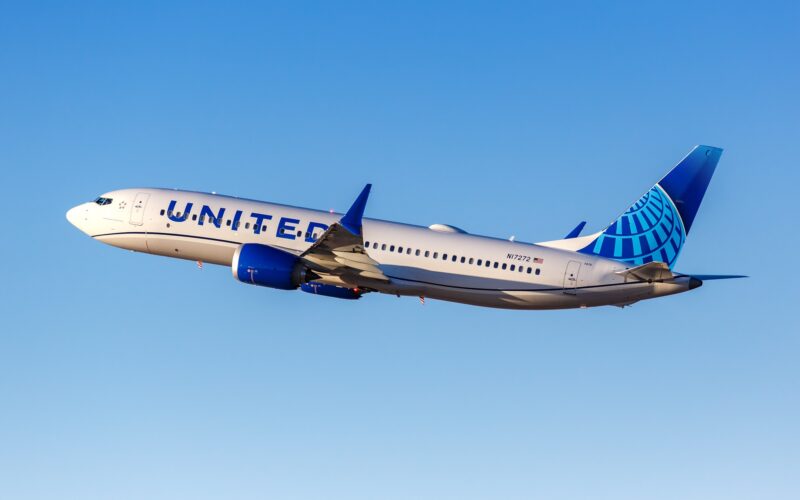
The National Transportation Safety Board (NTSB) has published a preliminary report into an incident involving “stuck” rudders on a United Airlines Boeing 737 MAX 8.
The Boeing 737-8, registered N47280, landed at Newark Liberty International Airport (EWR) on February 6, 2024, when the captain reported that during the landing rollout, the rudder pedals failed to move in response to the “normal” application.
The pilot said that while trying to maintain the runway centerline the pedals remained in their neutral position resulting in the nosewheel steering tiller being used until the aircraft slowed to a safe taxi speed.
The first officer also reported the same problem when he was asked by the captain to test his rudder pedals.
In a statement given to the NTSB the captain said that the pedals began working as normal shortly after.
A review of preliminary flight data recorder (FDR) data showed that around 30 seconds after touchdown, a “significant pedal force input was observed along with corresponding rudder surface movement.”
On February 9, 2024, following the 737-8 being removed from service, United conducted a test flight in which the same rudder system malfunction was identified, and the NTSB was subsequently notified of the issue.
“Post-incident troubleshooting and inspection of the rudder control system found no obvious malfunctions with the system or any of its components whose failure would have resulted in the restricted movement observed during flight 1539 and the test flight,” the NTSB said in its preliminary report.
The decision was then made to remove the aft rudder input torque tube and associated upper and lower bearings and the rudder rollout guidance servo for further examination by the NTSB systems group.
“Following the removal of the rudder system components, UAL conducted a second test flight on the airplane and found the rudder control system operated normally,” the NTSB explained in its report.
On February 28, 2024, the SVO-730 rollout guidance servo was tested at the Collins Aerospace facility in Cedar Rapids.
“The testing was conducted to evaluate the effects that temperature “cold soaking” of the servo might have on the torque required to move the servo’s output crank arm,” according to the NTSB.
At room temperature the inspectors found no issue with the rollout guidance servo, but after the unit was cold soaked for one hour, testing found that the torque to move the servo’s output crank arm was “significantly beyond the specified design limits”.
“Because the servo output crank arm is mechanically connected to the rudder input torque tube, the restricted movement of the servo’s output crank arm would prevent the rudder pedals from moving as observed during flight 1539 and the test flight. Further examination of the SVO-730 rollout guidance servo will be conducted as the investigation continues.,” the NTSB concluded in its preliminary report.
N47280 is a four-year-old aircraft and was delivered to United Airlines on February 20, 2023.
2 comments
Yet another serious design flaw by Boeing. The company appears to have a death wish.
That a servo might lockup and fail is “expected” within the lifetime of the aircraft and servo. (Though clearly Collin’s servo design is a total failure and needs to be removed from all aircraft ,given it cannot handle the every-flight cold soak reality of operating at 30,000 ft.) But the flight control system itself is badly redesigned on the 737 MAX, 737 Next Gen (NG), and only Boeing knows what other aircraft. If a single servo failure can fail on a cold soak, and lock up the rudder control (a primary flight control), Boeing needs to send its engineers to design school. A design that specifies that the servo must be “pushable” by peddle torque (so the peddles can operate the controls even in the event of a servo electrical failure) has only contemplated an electrical failure, not a SERVO failure. Servo’s can fail for all sorts of reasons. In this case, clearly, when cold soaked, the grease freezes up, and the control mechanism locks up as well. But a servo can break for a 100 reasons, and this same Boeing system will fail in all of those cases as well.
Just another example of “an airplane designed clowns” and an FAA certification process executed by monkeys. The 737 MAX plan is ONCE AGAIN shown to be unsafe by design. And even those parts of the aircraft that are designed in a satisfactory manner are not BUILT in a satisfactory manner. (Hence the whole door plug incident.)
Boeing executive management consistently lies about the design, design culture, production, production culture of their aircraft. They were living on the expert experience of 10% of their employees, until COVID struck, and a lot of these people were laid off, or quit. Now, NOTHING is holding the company together. Their systems of production control do not work, because they do not use and follow those systems. The door plug incident, the manager is on “medical leave”.. e.g. He’s hiding from the NTSB. All the Boeing management between that guy, and the CEO Dave Calhoun are liars. Mr. Deal certainly is.
Anyone who flies (or pilots) a Boeing aircraft does not value their life.