
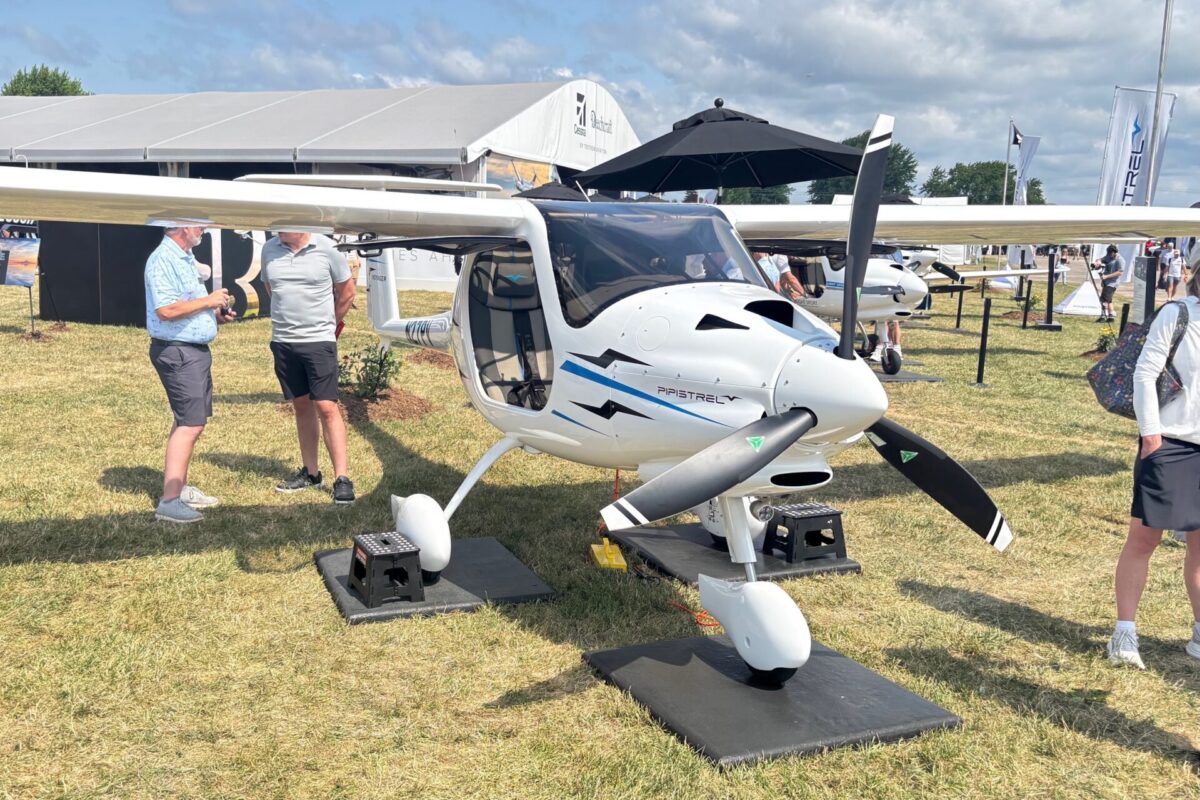
Pipistrel introduced a two-seat trainer called the Voyager that is designed to give flight schools day-and-night IFR capability, advanced touchscreen avionics and a three-axis autopilot at a substantially lower price point than many legacy training aircraft.
Parent company Textron Aviation unveiled the new aircraft at EAA AirVenture Oshkosh on July 20, 2026, saying the Voyager will enter the market in early 2027.
The aircraft carries a 2026 base price of €240,000, or roughly $275,000 at current exchange rates. By comparison, the 2026 base price of a Cessna 172 Skyhawk is $580,000, said Chris Crow, Vice President of Piston Sales at Textron Aviation. Adding the autopilot commonly selected by flight schools pushes the price of a Skyhawk to around $620,000.
“That means a flight school essentially can buy two Voyagers for the price of one 172,” Crow said.
Pipistrel designed the Voyager around the FAA’s Modernization of Special Airworthiness Certification regulations, known as MOSAIC. The new framework allows larger and more capable aircraft to qualify under performance-based certification standards.
Crow described the Voyager as an advanced trainer intended to complement rather than replace the Skyhawk, which remains the most widely used training aircraft in the world.
The Voyager will also be approved for intentional spins, allowing schools to use it for spin recovery and upset recovery instruction, and will carry an integrated ballistic parachute.
The cockpit features Garmin’s new Axis flight display system with touchscreen controls, a single-lever throttle system and the digital autopilot as standard equipment. The autopilot includes Garmin’s blue Level button, electronic stability and protection and functions intended to reduce workload.
The avionics suite also includes a haptic stall-warning system and can display aircraft, engine and systems information on full-screen or split-screen layouts.
Crow said Pipistrel’s existing product line and manufacturing capabilities allowed Textron Aviation to bring a MOSAIC aircraft to market faster than it otherwise could have under the Cessna brand.
“We didn’t want to wait to be able to introduce a MOSAIC-capable aircraft,” Crow said. “We wanted to bring something to market much more quickly, and Pipistrel’s capabilities allowed us to do that.”
Textron Aviation’s order book for new Skyhawks currently extends into 2028, Crow said.
Epic Flight Academy is the aircraft’s launch customer, with plans to purchase as many as 50 Voyagers. The Florida-based flight school operates 12 locations across the United States and primarily flies Cessna Skyhawks.
Crow said the Voyager will be tasked with handling primary instruction, time building, instrument training and other two-seat missions, while schools could retain four-seat Skyhawks for cross-country flights and training missions requiring additional seats or payload.
The Voyager is powered by a 100-horsepower Rotax 912 ULS engine. Pipistrel lists a maximum takeoff weight of 1,389 pounds, a useful load of 552 pounds and a maximum range of 740 nautical miles with IFR reserves.
Crow said MOSAIC gives manufacturers greater flexibility to introduce new technology while reducing development time and cost. Despite the large price difference, Crow said Textron Aviation does not view the Voyager as a threat to the Skyhawk.
“I think we have to rethink the product strategy and the lineup, and where that balance is going to be between how many 172s we produce and build versus how many Voyagers we’re able to produce and sell,” Crow said. He said Pipistrel has capabilities to ramp up production that would be harder for Cessna to do.
Cessna has delivered more than 45,000 Skyhawks since the model entered production in 1955. Crow described it as a proven platform that remains the trainer of choice for flight schools around the world.
The Voyager is making its public debut at the Textron Aviation display at AirVenture, where the show runs through July 26, 2026.