

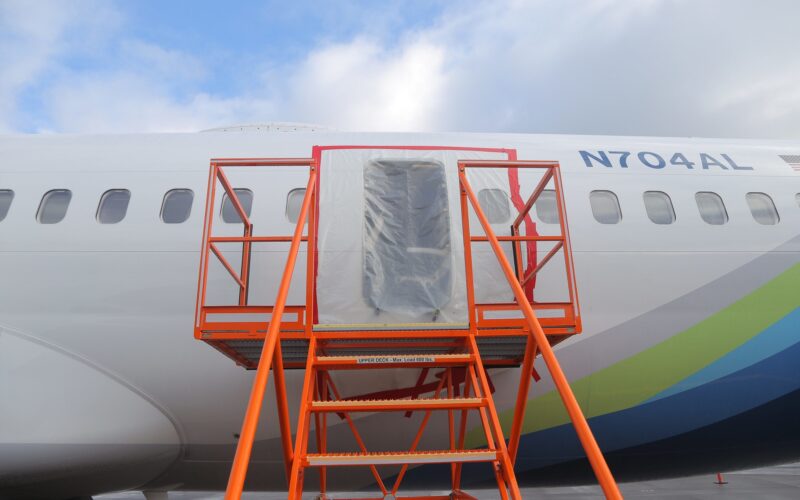
Almost a year since a door plug separated from an Alaska Airlines 737 MAX 9, the head of the Federal Aviation Administration (FAA) Mike Whitaker has said that “enhanced oversight” of Boeing is “here to stay”.
In a statement titled ‘One Year after Boeing Door Plug Incident’, published on January 2, 2025, Whitaker addressed the 12 months since the bizarre incident of January 5, 2024.
In laying out the steps he has taken since the incident, Whitaker said that the enhanced scrutiny of Boeing is “not a one-year project”.
Whitaker wrote: “What’s needed is a fundamental cultural shift at Boeing that’s oriented around safety and quality above profits. That will require sustained effort and commitment from Boeing, and unwavering scrutiny on our part.”
Whitaker, who will step down from his role as the most senior aviation regulator on Donald Trump’s Inauguration Day, said that the “goal is to develop even more dynamic oversight protocols that enable us to anticipate and identify risks before incidents occur”.
In a vote of confidence for new Boeing CEO Kelly Ortberg, Whitaker said that they spoke directly after a seven-week strike by staff ended in November 2024.
Whitake wrote: “As the strike ended, I spoke directly with the CEO about the importance of adhering to safety-management principles as Boeing resumed production. It’s clear that message hit home, as Boeing spent a full month post-strike making sure the necessary safety steps were taken before restarting production.”
Since the Alaska Airlines incident, the FAA has put more of its inspectors on Boeing’s factory floors, capped production on the 737 MAX, conducted an in-depth audit of the production line and required Boeing to develop a comprehensive plan to fix its production quality problems.
On January 5, 2024, Boeing published an update on the steps the company had taken since the mid-exit door (MED) plug detached from the Alaska Airlines 737-9.
The planemaker said: “Boeing’s Safety & Quality Plan generally aligns to four focus areas: investing in workforce training, simplifying plans and processes, eliminating defects, and elevating our safety and quality culture. The plan also sets forth measures to continuously monitor and manage the health of our production system.”
Among dozens of initiatives, Boeing said it had “strengthened training for mechanics and quality inspectors with an enhanced support system, including workplace coaches, peer trainers, and skill enhancement centers”.
Boeing also claimed to have invested in improvements to the ‘Speak Up’ system, to strengthen confidentiality for employees who submit reports.
3 comments
What they call enhanced should be their normal. I had a helicopter project in Wahington State as an FAA DER, and when I contacted them, they told me that they knew nothing about helicopters so we will approve whatever you do!! When the Fort Worth Region that is mostly helicopter’s, they called me and my pilot and asked many questions. All the Washington office had to do was review the FAA Helicopter Regulations and come out and review what I was doing. Could not believe it
Whitaker is on the correct path, however it is not just Boeing.
The FAA has essentially abandoned all manufacturers and facets of aviation.
If not for the FAA Designee program the FAA would have virtually no oversight or function involving actual FAA employees.
Is anyone at the FAA even in the office, or is everyone still “working” from home.
No doubt Boeing screwed up, but that started back in 1997 when engineering was booted out of the top management and the bean counters took over.
It’s very important to finally recognise such major root cause analysis conclusion which stipulate that profits orientation was above “Safety”. But How to mitigate and eliminate such dangerous behaviour or orientation or governance (decision making grinder).
I don’t think that training and enhanced porcesses control … will be enough for Safety garantee (zero fatal accident target) . It’s time to look out of the box and rethink, review or redesign the aviation SMS fundamentals, principles pillars, implementation and monitoring.