

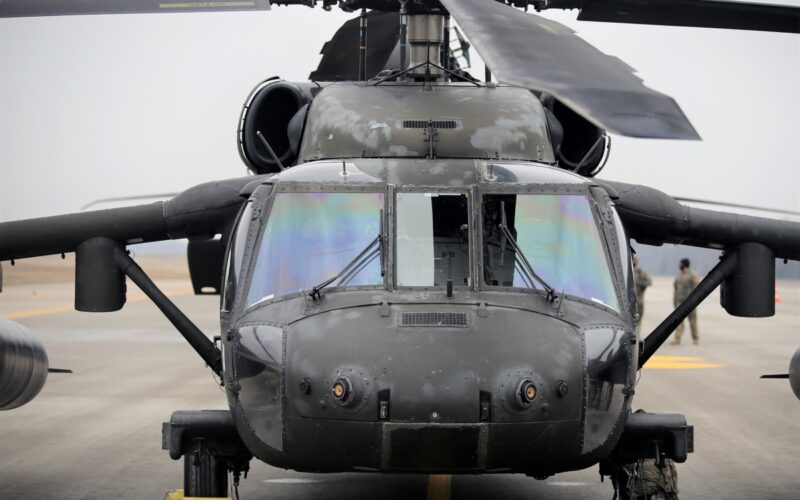
The US Senate has passed the Rotorcraft Operations Transparency and Oversight Reform (ROTOR) Act, legislation aimed at tightening aircraft surveillance requirements in the Washington, D.C., region by narrowing exemptions that have allowed some government and military aircraft to operate without broadcasting their position using ADS-B.
The bill now moves to the US House of Representatives and is widely expected to pass into law.
The Senate vote comes against the backdrop of the January 29, 2025, midair collision near Ronald Reagan Washington National Airport (DCA), in which an American Airlines regional jet operating as PSA Airlines Flight 5342 collided with a US Army Black Hawk helicopter, killing all 67 people on board both aircraft. That accident intensified scrutiny of how military and civilian aircraft share some of the most congested airspace in the country.
Under existing rules and provisions proposed in the FY2026 National Defense Authorization Act (NDAA), certain government aircraft could operate in the D.C. area without ADS-B Out, relying instead on transponder-based systems. Aviation groups and lawmakers warned that those exemptions reduced situational awareness for both pilots and air traffic controllers.
The ROTOR Act seeks to eliminate that possibility by requiring aircraft already subject to ADS-B Out mandates to also operate ADS-B In, allowing pilots to see nearby traffic in the cockpit in addition to being visible to air traffic control. The FAA would have up to two years after enactment to issue implementing regulations.
The bill still allows limited exemptions for sensitive government missions, but it explicitly excludes routine military flights, training flights, proficiency checks, and most flights carrying federal officials. The measure also calls for improved reporting and oversight of any approved exemptions.
During a recent House aviation hearing, FAA Administrator Bryan Bedford said the agency does not intend to return to a less visible operating environment in the Washington area following the January collision. He emphasized that increasing awareness for both pilots and controllers remains a priority, while also acknowledging concerns about cost for general aviation aircraft owners, who faced a broad ADS-B mandate in 2020 only to now likely face a new ADS-B equipment mandate.
To address those concerns, the ROTOR Act includes flexibility for aircraft weighing less than 12,500 pounds and operating under Part 91. In those cases, pilots could comply using portable or electronic flight bag-based ADS-B In solutions, rather than requiring expensive panel-mounted upgrades, provided the equipment does not interfere with existing avionics or airworthiness.
Portable ADS-B In receivers are already widely available and typically cost several hundred dollars, while many newer avionics installations in light aircraft, turboprops, and business jets include the ADS-B In capability.
1 comment
I have documented video of ADS-B in being wrong by hundreds of feet and I believe that the helicopter likely was receiving and monitoring ADS-B and that the rapid climb through the 200ft ceiling was due to ADS-B error while they tried to avoid the target. I have seen the altitude error twice and have video documentation of the Garmin GDL-50 ADS-B receiver misreporting altitude, which would result in misinterpretation of vertical separation. There’s no telling how many times this has occurred where I didn’t catch it as the map/traffic pages don’t report the altitude that we see.