

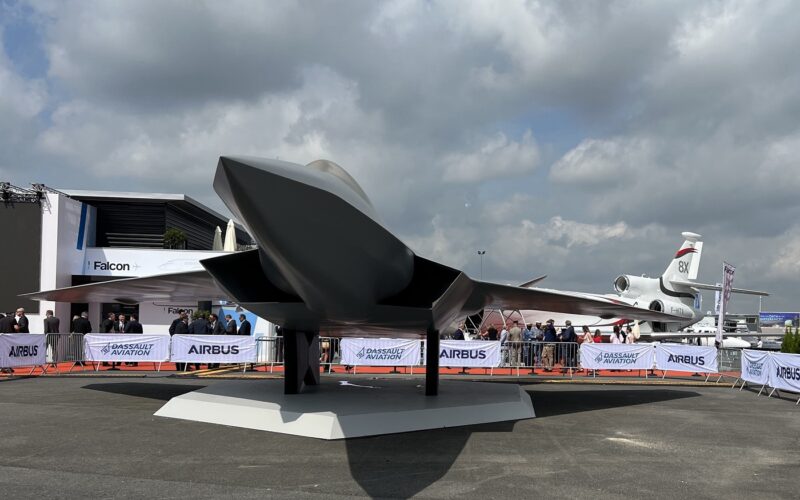
A French senator has claimed that Airbus Germany failed to produce several technical sub-assemblies for the Future Combat Air System, and that this shortfall is what pushed Dassault Aviation to demand stronger governance over the New Generation Fighter program.
The remarks, first identified by Opex360, emerged during a Senate budget hearing. According to Senator Hugues Saury, co-rapporteur for France’s defense equipment program, Airbus’ German subsidiary “was not able to carry out the technical sub-assemblies for which it had responsibility.”
Saury told the Senate’s Foreign Affairs and Defense Committee that this alleged failure contributed to strained relations between engineering teams and led Dassault to request greater authority as NGF prime contractor.
“The FCAS has not moved in the right direction during 2025. We are now facing a double deadlock, industrial and political,” Saury said, adding that the industrial blockage he described came first and triggered the governance rupture.
Dassault argues current structure limits its leadership
Dassault has long argued that the current governance structure limits its ability to lead the project effectively, since Airbus holds double voting weight through its German and Spanish subsidiaries.
Dassault CEO Eric Trappier has previously warned that the existing model resembles the joint-venture structure used on Eurofighter, which he says dilutes leadership and slows progress, contrasting it with the leaner governance applied to the nEUROn demonstrator.
Wider uncertainty around FCAS
The senator’s comments come as FCAS faces wider strategic uncertainty. The German Air Force has examined long-term alternatives to the program, and Paris and Berlin have discussed the possibility of separating the fighter from the broader system-of-systems architecture.
Saury also warned that political obstacles remain unresolved, particularly Germany’s parliamentary veto on arms exports, which he said continues to threaten the program’s long-term business model despite a 2022 export framework. France, Germany, and Spain are expected to decide on Phase 2 funding by the end of 2025.
4 comments
Same procedure as it was with Eurofighter/Rafale?
Dassault always tries to obtain more influence on decisions – and to reject exportation obstacles made by democratic parliaments…
No single argument or explanation for the Airbus delay was mentioned here…
Very true. And transparency has never been a French virtue
I Hope that, this Time, germany Will leave the lead to Dassault. For over 70 years they have the capacity to build planes alone. They have the experience ! Germany always wants to keep the control… please, this time, do not! Trust the CIO Éric Drappier when he said « We can build a 6 Gen jet alone, we already have the capacity to do it! But , if we keep the lead, we Will do it with Airbus ! » France is not always arrogant ! Sometimes they are just really more able to do it !
confundes “mernos capaz” con imposibilidad, alemania tambien puede hacer ese avion y seria al menos tonto poner 40 mil millones de dolares para un avion frances. ese avion ni siquiera le servira a alemania, alemania necesita un avion pesado de al menos 18 toneldas de peso vacio para ataque profundo a rusia. alemana necesita hacer su propio avion