

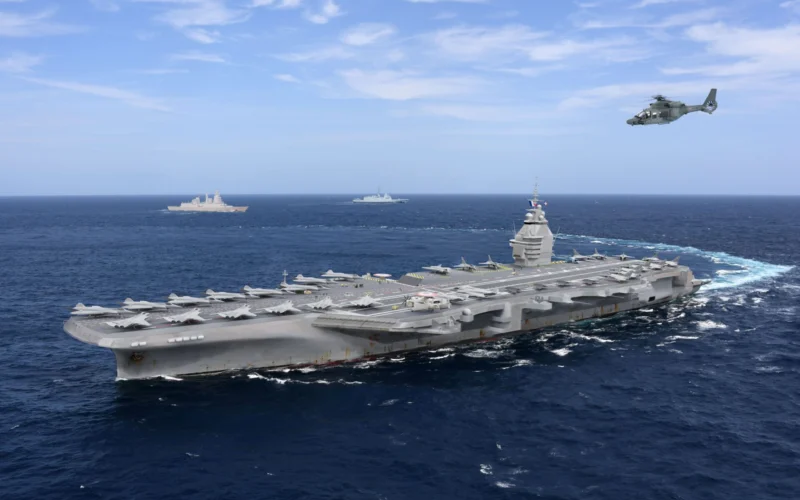
France has advanced its next-generation aircraft carrier program to the realization phase.
President Emmanuel Macron confirmed on December 21, 2025, that construction of the successor to the Charles de Gaulle has been approved. The announcement was made during his visit to French forces deployed in Abu Dhabi.
The decision marks a significant political milestone for a project that has been under preparation for several years, with its first public details unveiled in 2023. The carrier is now firmly embedded in France’s long-term force planning, with entry into service scheduled for 2038, setting a 15-year timeline from initial disclosure to operational deployment.
“We must be strong in order to be feared”
Addressing troops stationed in the United Arab Emirates, Macron said the decision to launch the program had been taken “this week,” in line with France’s latest military programming laws. He framed the future carrier as both a military and industrial statement.
“At a time of predators, we must be strong in order to be feared, and in particular, strong at sea,” Macron said.
The political green light comes amid heightened security concerns, with senior French military leaders warning that the country must be prepared for high-intensity conflict in the coming years.
In this context, the future aircraft carrier is positioned as a long-term pillar of France’s power projection and maritime autonomy, reflecting not only European security imperatives but also the need to safeguard France’s vast overseas interests, including an exclusive economic zone that spans the Atlantic, Indian, and Pacific Oceans.
A larger, nuclear-powered successor
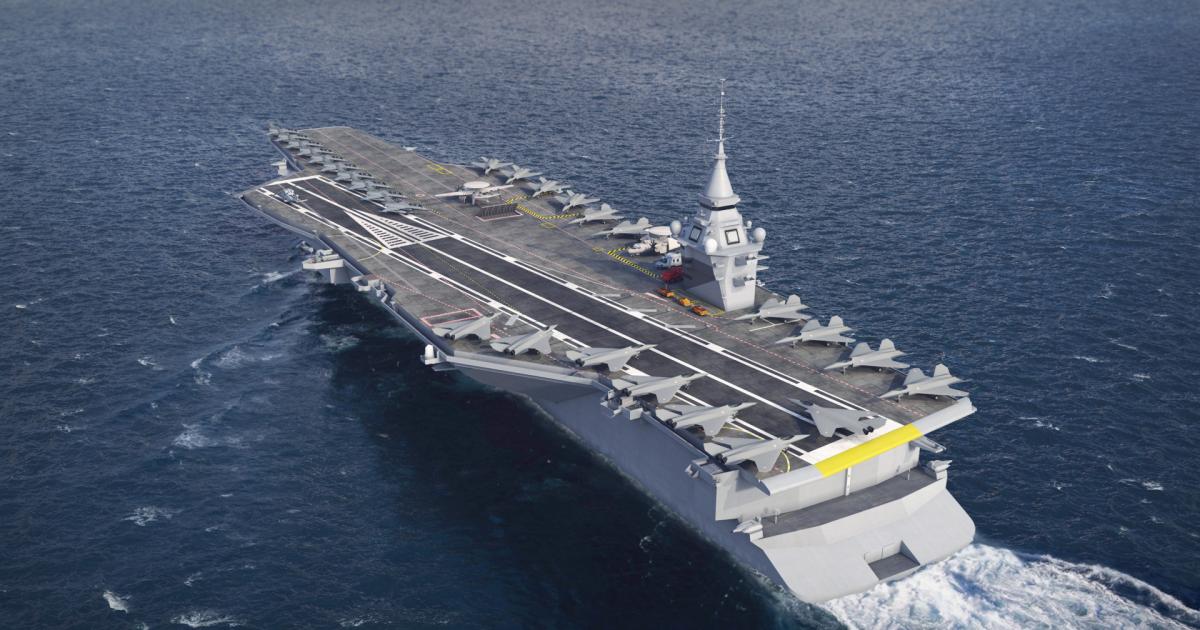
Designated the Porte-Avions Nouvelle Génération (PANG), the future vessel will be significantly larger than the Charles de Gaulle. Current specifications point to a displacement of close to 80,000 tons and a length of around 310 meters, compared with 42,000 tons and 261 meters for the existing carrier.
It is expected to embark an air wing of around 30 combat aircraft, alongside helicopters and drones, with a crew of approximately 2,000 sailors. The future air wing is also expected to include the Next Generation Fighter (NGF), the manned combat aircraft component of the strained Future Combat Air System (FCAS).
Like its predecessor, the new carrier will be nuclear-powered, preserving France’s unique position as the only navy outside the United States to operate a nuclear-powered aircraft carrier. Unlike the Charles de Gaulle, however, the PANG will be equipped with US-developed electromagnetic aircraft launch systems (EMALS), replacing steam catapults and enabling the operation of heavier and more diverse aircraft, including future combat aircraft and unmanned platforms.
Macron also emphasized the industrial dimension of the program, stating that around 800 suppliers, most of them small and medium-sized enterprises, will be involved. The project is expected to sustain France’s naval, nuclear, and high-technology industrial base, and the president said he plans to visit the construction site in early 2026.
Addressing continuity and the single-carrier constraint
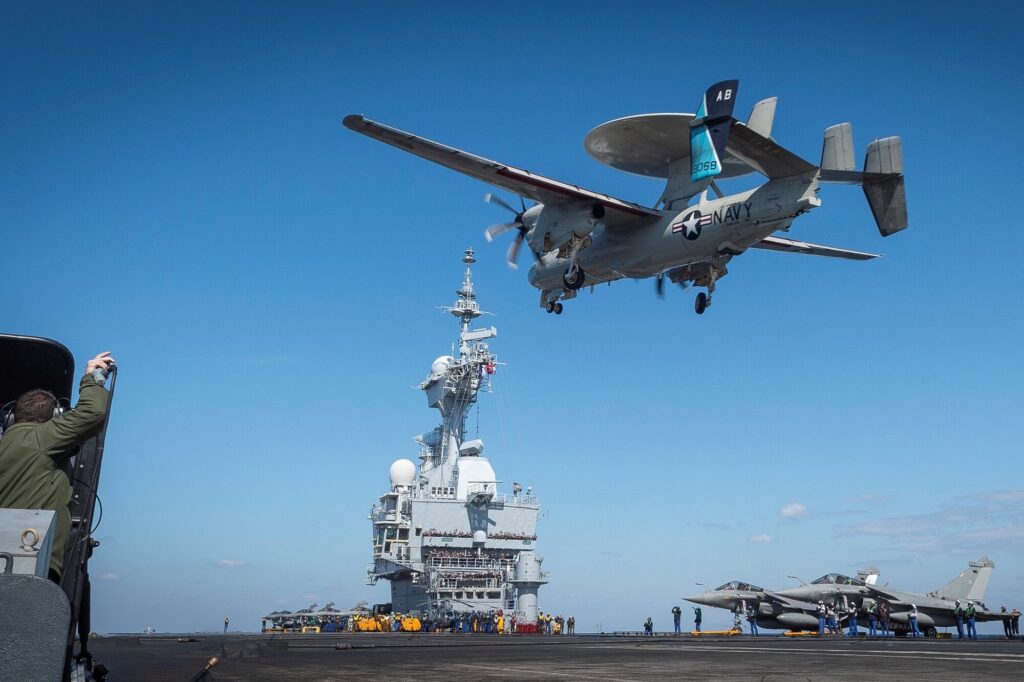
Construction is expected to begin in the second half of the 2020s, a timeline designed to avoid a capability gap as the Charles de Gaulle approaches the end of its planned service life.
Continuity risks weigh as heavily as ambition in shaping the program. France operates a single aircraft carrier, and the Charles de Gaulle is available only around two-thirds of the time due to maintenance cycles. Any significant delay to the new carrier could leave the French Navy without a fixed-wing carrier capability.
An assessment planned later in the decade will determine whether the Charles de Gaulle can be safely extended beyond its current retirement horizon, depending on the condition of its nuclear reactors and hull structure. The timing of the PANG program is therefore critical to ensuring uninterrupted carrier availability.