

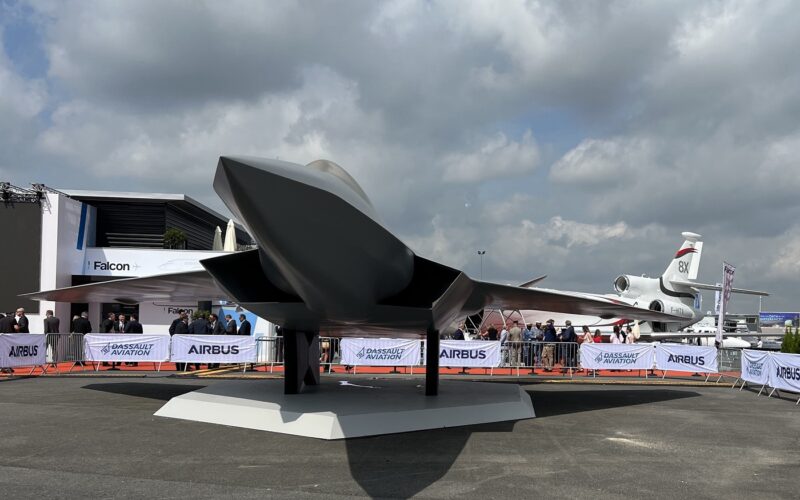
The head of Airbus has once again voiced his confidence in the European Future Combat Air System (FCAS), even as he acknowledged that the next-generation fighter program remains mired in structural difficulties, particularly in its industrial relationship with Dassault Aviation.
Speaking to French broadcaster BFM TV on December 10, 2025, Airbus CEO Guillaume Faury described FCAS as “an uphill battle,” capturing the sense of fatigue and frustration that has come to define the long-running Franco-German-Spanish effort to develop a sixth-generation combat aircraft.
Despite the rhetoric, Faury insisted he still believes in the project and in the need for a European combat aircraft. At the same time, he again pointed to recurring governance and cooperation problems with Dassault as a central obstacle to the program’s progress.
Long-running industrial disputes at the core
Airbus represents Germany and Spain in FCAS, while France’s Dassault is the designated lead for the New Generation Fighter, the program’s manned aircraft subprogram. That arrangement has been the source of repeated disputes over industrial leadership, workshare, and control of key technologies, stalling progress for years.
Faury’s comments echo previous public warnings from Airbus executives, but they come at a moment of heightened political and industrial tension around FCAS.
Just hours earlier, Germany’s powerful IG Metall trade union called on Berlin to push for Dassault’s removal from the program, accusing the French manufacturer of prioritizing national interests over European cooperation. The union warned it would withdraw its support from FCAS unless political leaders intervened.
Strategic doubts and alternative paths
Launched in 2017, FCAS is intended to deliver a “system of systems” centered on a next-generation fighter, supported by collaborative drones and a networked combat cloud, with entry into service planned around 2040. The program is estimated to cost more than €100 billion over its lifetime.
However, in recent months, mounting doubts have emerged about whether FCAS remains viable in its current form.
Senior German Air Force officials have publicly acknowledged that alternatives may need to be considered if industrial deadlock persists, while lawmakers have questioned whether Berlin should continue investing in a program that shows limited tangible progress.
Meanwhile, a French senator blamed the strained relations between engineering teams on failures from Airbus Germany to deliver specific “technical sub-assemblies for which it had responsibility.”
At the same time, the UK-Italy-Japan Global Combat Air Programme (GCAP) has emerged as a credible alternative, with Rome openly indicating it would be open to additional participants should FCAS fail.
Defense ministers from France, Germany, and Spain are set to meet on December 11, 2025, with Berlin and Paris reportedly seeking clarity on the future of FCAS before the end of the year.