

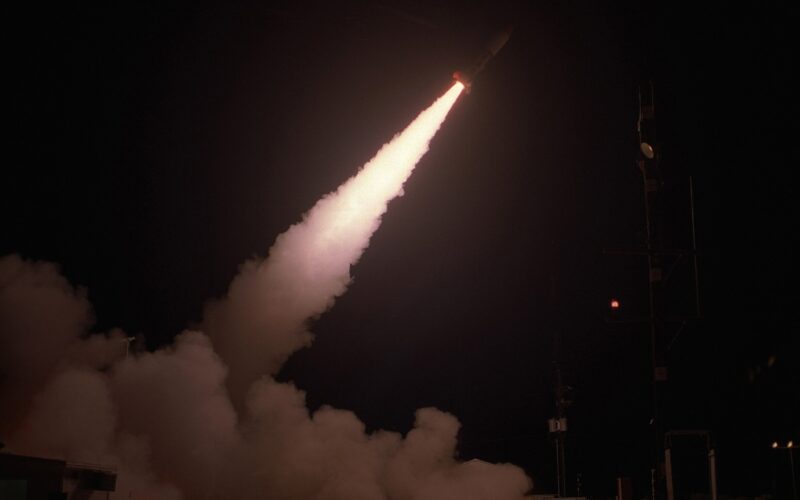
The UK Ministry of Defence has launched an accelerated competition to develop a ground-launched deep-strike ballistic missile intended for Ukrainian forces, as London moves to expand Kyiv’s conventional long-range strike options.
Announced on January 11, 2026, the effort is being run under Project Nightfall and calls for a missile capable of delivering a 200-kilogram conventional high-explosive warhead to ranges beyond 500 kilometers (311 miles), while retaining effectiveness in high-threat environments marked by heavy electromagnetic interference.
According to the UK MoD, detailed requirements were issued to vetted industry partners on December 19, 2025. The deadline for development proposals is February 9, 2026, with development contracts targeted for award in March 2026.
The ministry says the missile should be vehicle-launched, able to fire multiple rounds in quick succession, and then relocate within minutes, a concept intended to reduce exposure to Russian counter-battery action. The UK has also set a maximum unit price of £800,000 (about $1.1 million) per missile and a target production rate of 10 missiles per month.
Three industry teams are expected to receive £9 million (about $12.1 million) development contracts, with each team tasked to design, develop, and deliver its first three missiles within 12 months for test firings.
A moderated requirement set
Nightfall follows an earlier 2025 industry engagement in which the UK outlined a more ambitious target set for a tactical ballistic missile. In an August 2025 request for information, the MoD described a requirement for a ballistic effector capable of carrying a roughly 300-kilogram warhead to at least 600 kilometers (373 miles), with basic maneuverability, the ability to navigate in a GNSS-denied environment, and a circular error probable target of around five meters.
That earlier phase also reflected a more aggressive cost ambition, commonly cited at roughly £500,000 (about $670,000) per missile, before the January 2026 announcement raised the ceiling to £800,000 while reducing both payload and range thresholds.
European context: ELSA and parallel deep-strike work with Germany
Nightfall lands amid a broader European push to rebuild long-range land-based strike depth after decades of limited investment. The European Long-Range Strike Approach (ELSA), launched by France, Germany, Italy, and Poland and later joined by Sweden and the UK, aims to coordinate the development of next-generation precision strike systems for European forces.
Separately, the UK and Germany announced in May 2025 that they would cooperate on a future “deep precision strike” weapon with a planned range exceeding 2,000 kilometers (1,240 miles). That effort is positioned as a longer-horizon capability for European armed forces, complementing the much faster-moving Nightfall program.
Rapid prototyping and electronic warfare resilience
The UK MoD describes Nightfall as a rapid-prototyping and spiral-development effort with an emphasis on scalable manufacturing, mobility, and resilience against electronic warfare. While the government has stressed Ukraine as the immediate beneficiary, officials have signaled that experience gained under Nightfall may feed into future British long-range strike initiatives.