

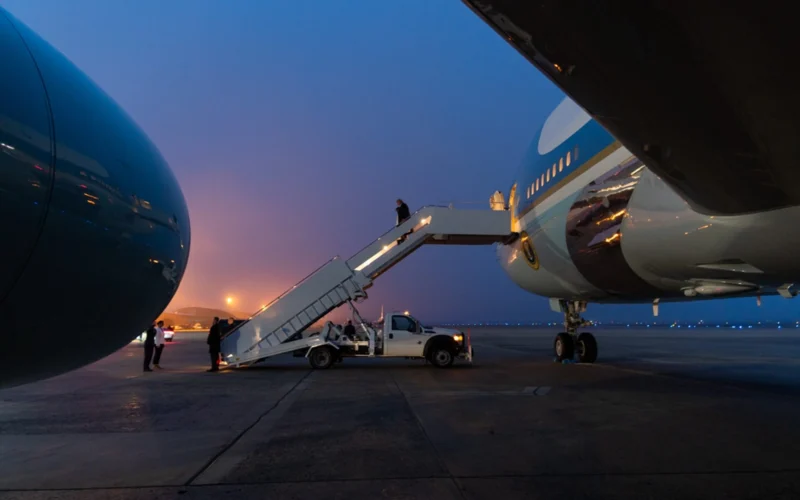
A United States Air Force VC-25A aircraft carrying President Donald Trump returned to Joint Base Andrews late on January 20, 2026, after what the White House described as a minor electrical issue was identified shortly after takeoff.
The aircraft, VC-25A tail number 92-9000, had departed Andrews on a flight to Switzerland when the crew reported the problem. White House Press Secretary Karoline Leavitt said the crew opted to return “out of an abundance of caution,” with reporters on board noting that some cabin lights temporarily went out following departure. The aircraft landed at 23:07 local time, delaying the president’s onward trip to the World Economic Forum (WEF) in Davos, Switzerland, by roughly two hours.
Aircraft changeover
Following arrival at Andrews, passengers disembarked and boarded a Boeing C-32A, the military variant of the 757 operated by the 89th Airlift Wing for senior US government transport. Once the president was on board, the C-32A carried the Air Force One call sign for the remainder of the trip.
Air Force One is a radio call sign for any Air Force aircraft carrying the president, though the role is usually flown by one of two VC-25A, heavily modified 747-200B jets. A second VC-25A is typically positioned to provide redundancy on presidential trips. However, the other airframe in the fleet, 82-8000, has been stored in San Antonio since December 2024. Thus, the switch was made to a C-32A instead.
The VC-25A
The VC-25A platform features significantly more wiring than the baseline 747, with hardened and redundant electrical systems designed to support secure global communications, classified data networks, and in-flight refueling operations. The VC-25A’s system architecture is built to ensure mission continuity during prolonged sorties, including in crisis scenarios.
The airframe also integrates self-sufficiency features such as internal boarding stairs, a dedicated baggage handling system, and specialized power and environmental control units, allowing operations at airports with limited ground support. That design philosophy places additional emphasis on electrical and power management reliability, with minor anomalies treated conservatively.
Aging presidential fleet
Both VC-25As entered service in 1990 and remain in daily use while Boeing continues work on their successors under the Presidential Aircraft Recapitalization program. The fleet’s age and bespoke mission systems have contributed to higher sustainment complexity and protracted modernization cycles, drawing periodic scrutiny as deliveries of the next-generation aircraft have slipped.
The US Air Force plans to replace the current VC-25As with the VC-25B, based on two Boeing 747-8 airframes that are being extensively modified with new power generation, communications, and survivability upgrades. The program has faced repeated delays, with current planning pointing to the second half of this decade for entry into service, a timeline that keeps the aging VC-25A fleet in front-line presidential use for several more years and gives minor technical events like this one additional political and public visibility.