
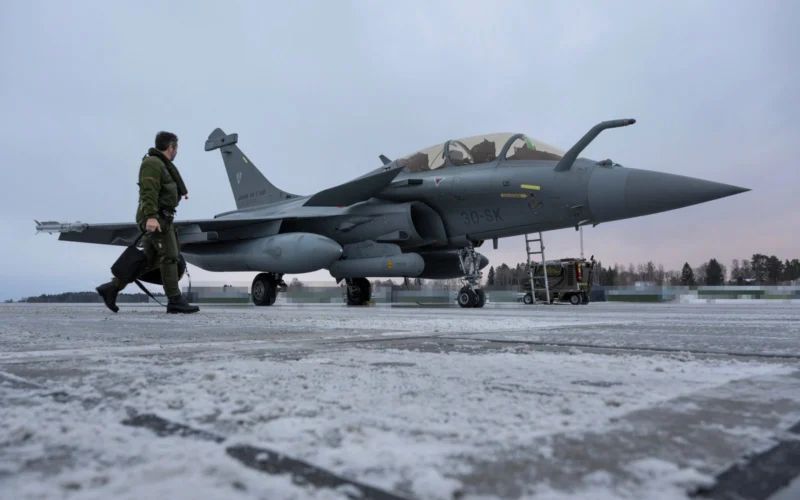
Two Dassault Rafale fighters from the French Air and Space Force’s fighter test and evaluation unit ECE 1/30 “Côte d’Argent” have deployed to Uppsala, Sweden, from January 19 to 23, 2026, as part of France’s Agile Combat Employment concept, known as FRA-ACE.
The detachment, drawn from Air Base 118 Mont-de-Marsan, includes around 30 personnel spanning maintenance, logistics, systems, and communications specialties, reflecting a deliberately reduced support footprint aligned with the ACE model of short, agile, and reactive deployments.
According to the French Air and Space Force, the Uppsala sequence includes experimental flights in cold weather conditions for the Rafale F4.1 standard, as well as a joint flight with the Swedish air forces.
Uppsala hosts one of Sweden’s military air bases. Sweden’s armed forces describe Uppland Wing (F 16) as responsible for operating Uppsala airport and supporting airspace surveillance and command-and-control functions.
Testing “MORANE”, France’s ACE approach
Operationally, the deployment reflects the Air and Space Force’s push to validate rapid dispersal of high-value assets, continued sortie generation, and sustained operations from alternate locations with limited organic infrastructure, an approach it packages under MORANE, its national implementation of NATO’s Agile Combat Employment logic.
In practical terms, that means deploying with fewer people and less equipment, then leaning on host-nation support and pre-arranged cross-servicing so aircraft can be fueled, armed, and turned around away from their main bases.
Early vignettes in northern Europe helped build that muscle, including a November 2022 detachment of two Rafale jets to Rovaniemi for Finland’s Täppä 22 exercise, which explicitly paired French Rafale with Finnish F/A-18 operations in Arctic winter conditions.
A much earlier proof point came in 2014 during Operation Ambre in Poland in response to Russia’s invasion of Crimea, when four Rafale jets deployed to Malbork with an 80-person detachment, including 16 mechanics, forcing crews to work in a notably stripped-down, improvisational setup compared with peacetime standards.
Why Sweden and Finland are a natural fit for ACE
Sweden and Finland are not newcomers to dispersed operations.
Sweden’s Cold War Bas 90 approach, now receiving renewed attention as the security environment has tightened, centered on distributing aircraft across multiple sites and complicating targeting by operating from a wider network of locations.
In that context, Saab’s Gripen is frequently touted as particularly well-suited to dispersed basing, an aircraft shaped by Sweden’s austere operating philosophy, emphasizing small crews, rapid turnaround, and the ability to function away from large, fixed hubs.
Finland has carried that mindset into the post-Cold War era through recurring dispersed-operations training, including highway-strip operations under its Baana framework, which the Finnish Air Force describes as training units to operate from a highway strip as part of its dispersed operations concept and to cooperate with allies.
NATO has increasingly highlighted these Nordic highway exercises as practical ACE laboratories for allied air forces.