

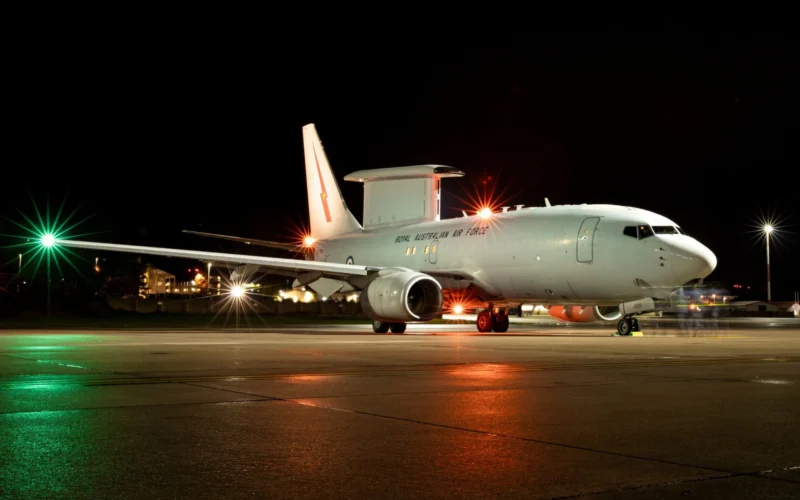
The Royal Australian Air Force (RAAF) is deploying a Boeing E-7A Wedgetail airborne early warning and control aircraft to the United Arab Emirates, along with 85 defense personnel and a supply of advanced medium-range air-to-air missiles, Prime Minister Anthony Albanese announced on March 10, 2026.
The E-7A Wedgetail is a sophisticated surveillance platform equipped with long-range surveillance radar, secondary radar, and voice and data communications systems.
It is designed to provide airborne early warning and control capabilities across wide areas, making it well-suited for monitoring and securing Gulf airspace. The initial deployment is set for four weeks, with crews expected to depart Australia by midweek and be operational by the weekend.
The Wedgetail has seen prior international deployments. In 2024, an RAAF E-7A completed a six-month rotation to Ramstein Air Base in Germany under Operation Kudu, supporting NATO’s mission in relation to the Ukraine conflict.
We're focused on keeping Australians safe. pic.twitter.com/GIir4JlqWF
— Anthony Albanese (@AlboMP) March 9, 2026
Albanese framed the latest deployment as strictly defensive in nature. “Our involvement is purely defensive,” he told local media, adding that the mission aims to protect both Australians in the region and allies in the UAE. Australia recently formalized an economic strategic partnership with the UAE, though this military deployment falls under a separate defense cooperation agreement dating back to 2007.
Albanese stressed that the first priority of his government is to keep Australians safe, citing that there are around 24,000 Australians in the UAE.
“Helping Australians also means helping the UAE and other Gulf nations to defend themselves against unprovoked attacks,” the Prime Minister said.
Albanese also emphasized that the Australian government is not deploying Australian troops on the ground in Iran.
The deployment comes as conflict in the region has disrupted the Strait of Hormuz, a critical chokepoint handling roughly a fifth of global oil and liquefied natural gas shipments. Around 115,000 Australians were in the Middle East when hostilities began, with approximately 2,600 having since returned home via commercial flights as several Gulf cities faced Iranian bombardment.