


Germany’s Federal Office of Bundeswehr Equipment, Information Technology and In-Service Support (BAAINBw) has awarded a contract to German aerospace startup Polaris to manufacture and operate a two-stage, fully reusable hypersonic research vehicle.
The program, known as HYTEV (Hypersonic Test and Experimentation Vehicle), is intended to provide the Bundeswehr with a dedicated hypersonic testbed for defense-related research and scientific and institutional experimentation. In a secondary role, the system could also be adapted as a spaceplane capable of launching small satellites when equipped with an expendable upper stage.
According to Polaris, the vehicle is designed as a horizontal takeoff system with dimensions and takeoff mass comparable to those of a modern fighter aircraft. The company aims to have the system flight-ready by the end of 2027.
A two-stage reusable concept
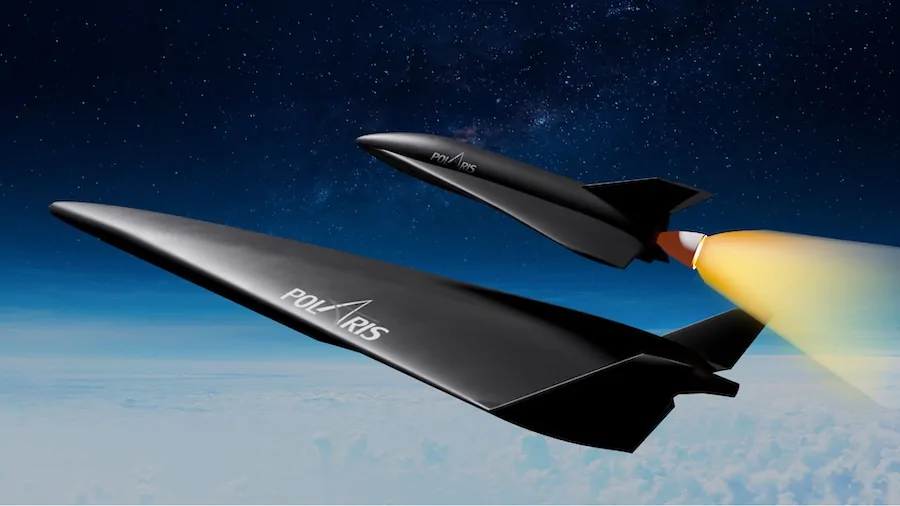
The HYTEV architecture consists of a reusable main stage and a rocket-powered upper stage. The main stage is expected to be powered by two turbofan engines combined with an aerospike rocket engine, enabling acceleration into the hypersonic regime before stage separation. The upper stage relies solely on rocket propulsion and can be configured either for experimental payloads or, in an alternative configuration, for small satellite launch missions.
Polaris said the concept was developed during preparatory work carried out in 2024 and 2025 under earlier BAAINBw-funded studies, culminating in the current manufacturing and flight-test contract.
A rare European hypersonic testbed program
The company described the award as a significant vote of confidence from the Bundeswehr, arguing that comparable contracts for fully reusable hypersonic research systems are rare in Europe and possibly globally.
Germany has so far relied largely on international cooperation and subscale demonstrators for hypersonic research. If successful, HYTEV would represent one of the most ambitious reusable hypersonic flight projects led by a European industrial player to date.
Polaris has not disclosed the contract value or the expected flight-test envelope, but earlier statements indicate that the program is intended to support both military capability development and broader aerospace research.