

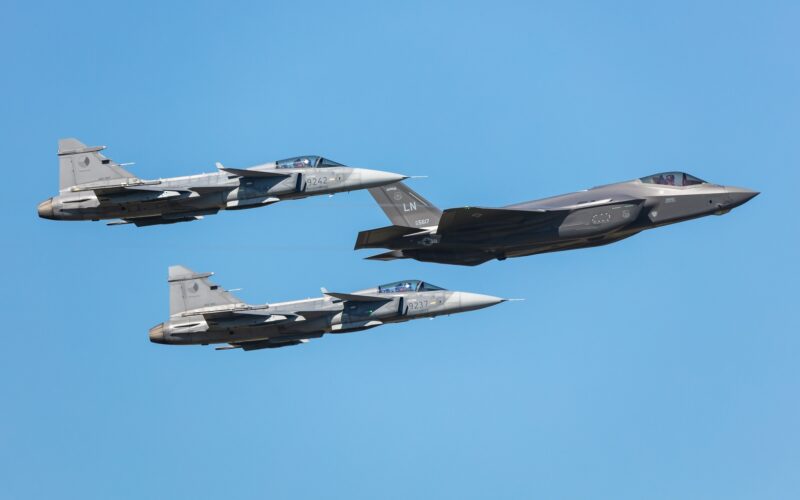
Canadian officials are weighing a mixed fighter fleet that could see Sweden’s Saab account for roughly half of the eventual replacement program by value, according to a National Post column by John Ivison published on January 28, 2026, citing unnamed sources.
The column argues that Ottawa is unlikely to follow through on the full 88-jet F-35 plan announced in 2022 and instead could buy fewer F-35As while adding the Gripen E as a second type. Canadian Defense Minister David McGuinty told the outlet that no final decision has been made.
Ivison links the procurement debate to Canadian Prime Minister Mark Carney’s recent Davos remarks on strategic autonomy and diversification. In his World Economic Forum address on January 20, 2026, Carney argued that allies will “diversify to hedge against uncertainty,” framing the shift as a form of risk management in a less rules-bound world.
US envoy warns NORAD would be “altered” if Canada pulls back
The mixed-fleet debate has been amplified by direct public messaging from US Ambassador to Canada Pete Hoekstra, who has warned that a Canadian pullback from the planned F-35 fleet would force changes to continental air defense arrangements.
In comments reported by CBC News, Hoekstra said NORAD “would have to be altered” if Canada does not proceed with 88 F-35s, suggesting the United States would compensate by flying more of its own fighters in Canadian airspace.
Hoekstra has made similar arguments before. In May 2025, he warned that moving away from the F-35 could jeopardize NORAD’s “interchangeability” logic, which assumes both air forces operate the same fighter type to integrate seamlessly into shared procedures, data links, and operational planning.
Saab’s counterweight is industrial, and jobs
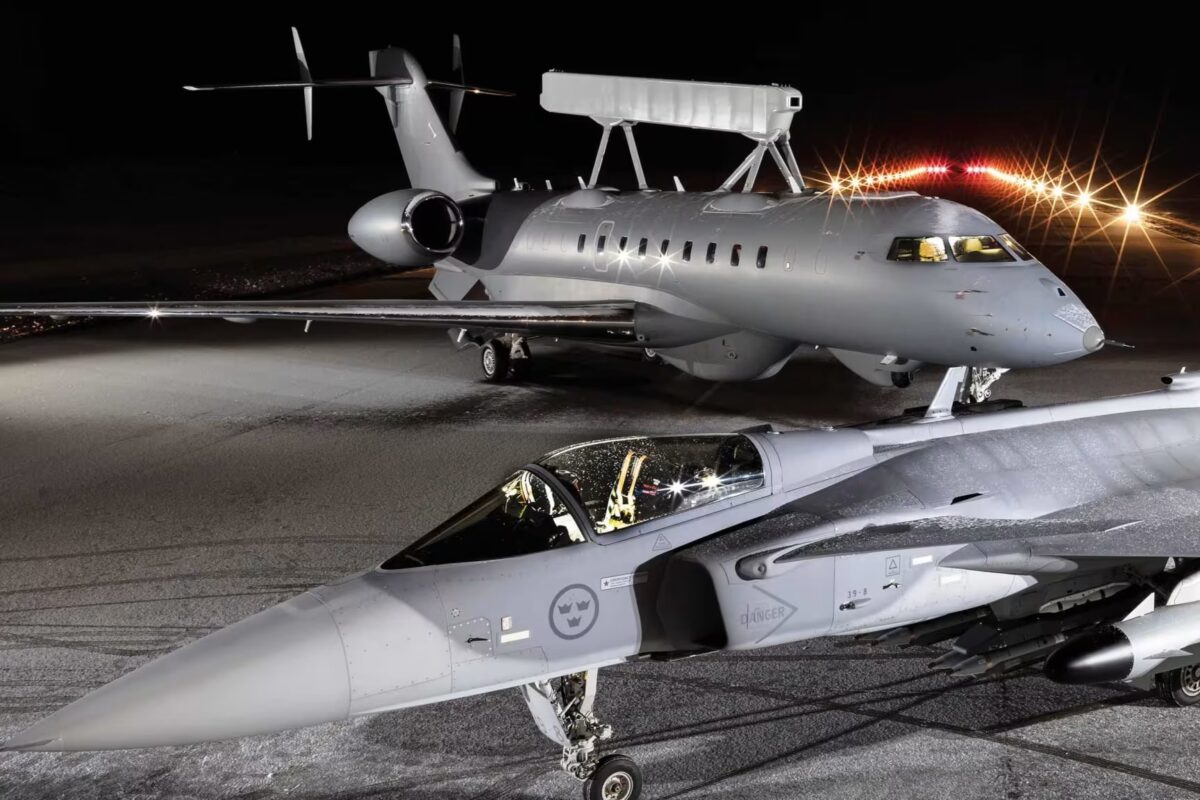
Saab’s pitch to Ottawa has increasingly centered on industrial return and domestic capacity, not just aircraft performance.
Saab said in December 2025 that localizing production of both the Gripen fighter and the GlobalEye airborne surveillance aircraft in Canada could support up to 12,600 jobs, with Bombardier positioned as a key partner through the existing GlobalEye relationship.
The offer is designed to appeal to Ottawa’s industrial priorities as it reviews the fighter program and to reframe the debate from selecting the “best aircraft” to choosing the “best overall package,” once long-term support, sovereignty, and domestic workshare are factored in.
Canada’s F-35 commitment is under review
The Liberal government first announced in March 2025 that it would review the purchase, citing heightened trade and diplomatic tensions with the United States, as Canada entered an election campaign.
Following his re-election, Carney has advocated for greater diversification in Ottawa’s defense and industrial partnerships. That stance was underscored by a new defense and trade cooperation framework signed with the European Union in June 2025. A final decision was initially expected by the end of summer 2025, but Carney’s office has not announced any outcome.
While the Royal Canadian Air Force remains openly in favor of the F-35, key cabinet figures, including Industry Minister Mélanie Joly, have raised concerns about the contract’s economic balance and the scale of industrial return.
A long and contentious procurement history
The current debate is the latest twist in Canada’s long-running fighter replacement saga. It began in 2010, when Stephen Harper’s government moved to buy 65 F-35As for about $6.7 billion, a plan Justin Trudeau pledged to cancel during the 2015 election as an overly expensive sole-source deal.
Ottawa then launched the Future Fighter Capability Project in 2017 as an open competition, but Dassault withdrew in 2018 over Five Eyes-related constraints. Airbus exited in 2019 arguing the terms favored Lockheed Martin, and Boeing’s Super Hornet was disqualified in 2021, leaving the F-35 and Saab’s Gripen as finalists.
Canada ultimately selected the F-35 again in 2022, citing NORAD interoperability, NATO commitments, and Arctic defense requirements, and announced a plan to acquire 88 aircraft valued at roughly $14 billion.
63 comments
I believe the Canada would be best suited to Buy the SAAB package, the the American F-35. The F-35 cost is to high to maintain, were the SAAB give more control, jobs and a great aircraft. I remember the Arrow aircraft it very very good aircraft at that time. The current in United States should make this a easy choice. I support Canada buying the SAAB Griffin-E and built-in Canada with the Rolls-Royce new engine.
The Canadian military does not have the resources both in therm of personnel and pilots and also equipment required to sustain 2 different fighter platforms!!! Please start using your brain people!
Australia, a smaller country, has a mixed fleet of 104 jets. I think Canada can do it too and should have more than 88 planes.
I suggest you use yours. Any country who purchases a US proprietary system of any kind seriously risks having their asset completely rendered inoperable at the whim of the political leadership in the US. We won’t buy the F35 – we just get to use it between very frequent downtimes. Contractually only Lockheed can work/service this aircraft. For the next 40 years. SAAB will be supporting our aviation industry, no strings or constraints. It will be a CANADIAN aircraft.
It should be a combination as the sab is more suited for Arctic weather and has Trump stated the issue for future Lanes will be more Arctic oriented with a vehicle that can that is already tested for those conditions in Finland and Sweden. The f 35 would be valuable if it had the Israeli variants, extended fuel Bay and range
👍
American here: I’d go with the mixed fleet. That way you’ll have some stealth capability when you need it, and a lower cost solution to use for those lower intensity conflicts like Afghanistan should NATO survive the orange. I must say I was unbelievably pissed off about what orange said about NATO troops. Orange may have forgotten about the friendly fire incident in Afghanistan. Perhaps he was never aware of it which seems likely. But we believe me very many Americans have not.
The gripen doesnt have the range, nor combat capabilities as the f35. Also, the gripen comes with US export controls as the US manufacturers, and licenses key components of the jet, engines, avionics, and munitions.
What is overlooked (conveniently?) in Ambassador Hoekstra’s remarks is the matter of TRUST. The F-35 is completely controlled by the Pentagon, right down to parts and in-flight/mission software. Saab offers complete control by the CAF, as well as assembly plants proposed IN Canada. Also not mentioned are the F35’s issues with cold weather ops. The Gripen is designed for both cold and ease of maintenance. Down time for repairs could be measured in hours as opposed to days (or weeks if parts are slow to arrive). Given the antics of the current US administration, spreading the load should be a no-brainer.
None of that matters when the old JAS 39s are shot down by J20s and J35s before they even know they’re there. Continuing to buy 4th Gen fighters in the era of stealth technology is the same as continuing to build wooden ships in the late 1800s after the introduction of the ironclads. Not to mention setting up domestic production, and then actually producing new aircraft will push the program out decades. The JAS 39 isn’t even an upgrade over the F18.
Let’s just point out the hypocrisy in the US ambassador statement. Currently NORAD is utilizing American F – 15s, F – 16 and F – 22s for continental defence in conjunction with Canadian CF – 18s. The United States is not replacing those fighters with F – 35s. In addition, the United States does have rights to overfly Canada as part of Norad.. as does Canada overflowing the United States in that role.
Given the demonstrated unreliability of the F 35 as well as the maintenance being tied to the manufacturer who also holds all of the intellectual property, the F 35 is an amazing aircraft, but not the only one that would be suitable for Canadian use.
TheSAAB Grippen is ideally suited for Canadian operations. It would be very easy to deploy an attachment of these aircraft to places such as iqualiit , Churchill, Whitehorse… And park them outside. You wouldn’t do that with a F35. further, it is apparently much easier to maintain in the field, cheaper to operate and Canada would have all of the intellectual property to maintain the aircraft.
A split buy makes sense in my opinion from a defense, industrial benefits, and trade perspectives. Trump wants Canada to spend more money on defense, Canada should determine how that money is spent!.
I agree with the preceding comments. Our country’s sovereignty is more important than hurting the US feelings.
It’s a case of not putting all our eggs in the one basket.
Hopefully we could save money that would allow us to buy a fleet of forest fire water bombers. This is something we and the rest of the world needs every year.
The Massachusetts ANG has removed all the F-15’s based there and will be getting F-35A’s in June 2026.
Many of us Milair followers were hoping the F-15EX’s would have been chosen for the Northeast Defence sector (NEADS).
This so called PM better get his crap together, if USA tells Canada to FO you’ll be speaking Chinese in 2 years ,Carney guy doesn’t look or act very smart. We thought sleepy Joe was bad but Carney leaves sleepy Joe way behind.
“Speaking Chinese in 2 years”
“Sleepy Joe”
“Carney guy doesn’t look or act very smart”
are all NONSENSICAL hyperbole rant that does little to show intellect.
,👍
No we will not. I’m a far right Conservative. More scare BS.
Trump’s comment that USA doesn’t need Canada , so FO we are a sovereign nation and will not be bullied with threats and tariffs .
lol why don’t you practice what you preach little man, and FO yourself. china isn’t interested in anything besides taiwan, but i don’t expect you to have any knowledge of world events from the bile pouring out of your mouth. sleepy joe was far better then PedoDonald the raping grifter
Hey genius, You just don’t get it! Brick by brick, Trump is dismantling the NATO alliance and now he’s aiming to destroy NORAD. It’s not about the relative performance of one aircraft v. another. It’s about alliances, allies and mutual trust. Trump has destroyed that and I fear it’s not coming back.
Couldnt agree more….way too many lib-tards in Canada…USA is our best ally with the closest value set aligned with ours, and we Canadians have prospered because of our trade, location, and cooperation with the USA. Liberals/ communists need to be removed from power and the baby boomers need to wake up and put your elbows down.
Canada is making a huge mistake if they switch from the F-35 to the Grippen. The F-35 is a far superior aircraft and better to have continuity among NORAD. Best to keep our eyes on the ball and get quality instead of buying an inferior defense plane based on non- military concerns. Thank you!
The F-35 is too expensive to buy, what good is a fleet of F-35’s if you can’t afford to fly them and they are totally controlled by the U.S. which given their attitude towards Canada would be economic & strategic suicide.
US current government has lost its credibility in the face of its allies. I don’t see gripen to be an inferior fighter jet.
Both jets are modern, besides Gripen is cheaper and all weather multirole fighter…
Head to head the F35 is undoubtedly superior to the the Grippen but its also much more difficult to maintain, re-arm and requires a large groundcrew and extensive fixed deicated bases. The Grippen is built to designex with a mall groundcrew and can operate from roads if necessary, for air superiority missions in hostile airspace the F35 is impressive but fighting a defensive war over Canada and with ground attack roles the Grippen comes into its own . Canada must realistically prepare for the unlikely event of economic trade war ( hopefully not a hot war) with the USwho could probably disable the F35 with a kill switch or just withhold or overcharge for spares/ software. If the choice is between F35s stuck on the ground or ( Canadian built) Grippens in the air , Id go for a mixed fleet keeping the best of both worlds
I disagree. I don’t think the Swedes would build an aircraft that couldn’t operate in Northern climates. What do americans know about the North? Not as much as the Swedes, or us Canadians. We need an aircraft that will not break down in the cold. That is where they will mostly be based. The F-35 is not known for cold climate operations. In fact they break down more in harsh climates. Its like buying an all electric car to drive from Toronto to Timmins in January. You will be grounded at some point of your trip. Go with reliability. And we also don’t bow to bullies.
F35s will be dead weight if America shows up, the grippen can hold it’s own it’s designed for asymmetrical guerilla warfare.
If the president of a country threatens to decertify Canadian made planes, should that country be trusted as a partner? What if the same or another whimsical president decides to withhold crucial upgrades or even supply of parts and software for maintenance???
No Canadian taxpayer wants to buy warplanes from a hostile adversary. Scuttle the F35 and get those Canadian-built Gripens!
You do understand that this is Trump last term in office….right?
With software foreign controlled missions and sovereignty is at a foreign whim. That is reality. And with the 35 what are we buying? An aircraft that fits into an Americcan vision over offence requirements while is that what is required for Canada. With a wide arctic and with limited flying time because of fuel load, we require dispersal, not fixes bases. The 35 combat readiness is below 50%. This is mostly based on temperate temperature conditions. In sub zero conditions this will drop to below 35 %. Also take into the extended maintenance requirements for the 35. As a defensive platform is stealth really rewire . The us claim that because of the 2 different platforms, interopeability will be affected. Just another false flag. Being an engineer and having worked in military communications that depends on having the proper type of equipment and common language. For what I comprehend the Grippen has that operability. If the source code, controlled by the us is a factor in communications interoperaability, why should one of the us partners have while it is nemied to Canada a norad partner whose territory is the most critical to protecting the us. In defense Canada is the US Achilles heel. They need us. Their defences is through a sovereign country. We hold the cards. Because of the grippens performents meshes more with our need and budget not to mention the run away costs which is the normal in US military procurement, the Saab plane and overall deal is far the best for Canada.. Any US threats. Are just bluster
Due to Trumps comment untimly delivery delay and cost overruns I believe Canada should go with the Saab aircraft. Ultimately if the choose the F35 there should be penalty’s involved due to delivery delays and cost overruns. Taking into account the cost, delays and job possibilities go with the Saab Gripen.
America’s diplomacy has been reduced to threats and lies based on an inherent hubris Pride cometh before a fall
These arguments keep talking about how many new jobs would be created, while leaving out that Canada not fulfilling it’s agreements on F35 will also result in the loss of jobs related to its share of production and sustainment services for the world wide F35 Fleet (all F35 procurement and sustaonment is apportioned throughout all the major participants and some select stakeholders) Somehow, someone in the PMs office in Canada has lost awareness of that fact in their anti-US stance.
Mix fleet of 32 F-35 fir NIRAD aNd NATO high intense first strikes and 80 to 100 Gripen E fighter jets for consistent artic and ocean patrol along with air support with 8 Bombardier Global Eye surveillance aircrafts. More feasible, economical and strategic for Canadian defenses. Sweeden, SAAB are reliable NATO partners.
Also creates jobs in our Aviation sector and allowing export capacity for selling to other middle NATO powers and helps to rearm and protect Ukraine from Russia.
Tell the Yanks to go fuck themselves eh?
I will never again visit American soil, I will never buy anything that is produced in America, I can’t stand that worthless thing called a president that half of stupid Americans put into power so why would I ever want F-35$ and if America flight path over Canada with their F-35 shoot em down!
Canada should quit acting butt hurt and just get with the program already , purchase the f35,s and REMAIN integrated to the norad agreement. It’s a vastly superior jet in every single metric than the gripen and Canada’s own military tests have already proved it. Face the facts , Canada is a minor defense partner in size and capabilities to the US. no harm no foul , just the facts atleast be willing to cooperate with integration into existing , long standing agreements and do they’re strategically smaller contribution to the defense of North america.
This is all due to Trump’s childish belligerence, which could cist tge US defence industry dearly. The F35 is superior…but like the superior Gernan Tiger tank in WWII, is high maintenance and failure prone. A decent case can be made for a mixed fleet with F35s for high risk intl use and Gripens for home patrol. Notr also that the advent of high performance drone fighters may reduce the need for super manned fighters.
I am of a mind that buying more of an American Fighter versus a comparable but not exactly the same from Sweden allows us to not have our eggs in the same basket. This is especially with all the threats from our supposed Ally. THE Grippin meats the requirements for Canada to protect our Northern Frontier not the Trump golden tomb and allows Canada to rebuild it’s aerospace industry using Canadian workers and knowledge so we do not give it away again like the Diefendbaker area where we were leaders not followers
My humble liberal vote goes towards the SAAB ENTRY.
Because of Trump’s insanity we are losing jobs,and Friends!
Look, we all know how well funded the Canadian military is. Is the F-35 capable? Sure. Yes. Absolutely.
But it could very well bankrupt their air force in maintenance costs, and they don’t tolerate short runways. And what are 88 fighter jets capable of defending in the world second largest country?
Even if Canada goes on with 88 F-35s, it would not lose to have more fighters on hand, if just for daily patrols. Low maintenance costs/requirements. STOL capable. NATO compatible. Familiar engines for F-18 technicians. If you can replace some of the CF-35 hours with CF-39 hours, you’d be saving already. Canada is in no shape to use F-35s for patrol duties.
It seems to make good sense to chose the Gripen. This plane is better suited to Canadian weather. Much cheaper to operate. Can be landed on highways so won’t be a sitting duck in obvious lnown locations. Has proven itself more than capable in combat scenarios. Has much canadian industrial adbantages. I sincrrely hope this government shows strength and chooses the Gripen.
Canada would need to be brain dead to buy the F-35 …
Well.
Why would anybody buy a plane when the producer keeps a kill switch?
And how did NATO function before, when not all the countries had the same plane?
And with the US going deeper and deeper on the way of a dictatorship, I am not so sure if it is a good idea. But Canada needs to finalize this, because we are already in deep dodo, and we need planes. Before Trump leaves the office, because there is no more time for our government to change it’s mind.
Canada can synchronize with the United States or it can 100% defend itself. Trump should start with barring their truck drivers from driving in the United States. Drop your loads at the border. Then let’s see how much more they like Sweden than US?
I think a serious consideration should be given to the US government accidentally leaking that the f-35 had a kill switch.
More over SAAB is willing to build us a plant so we have home production capabilities which will mean a longer more sustained fighter program, jobs from us and them and possibly expanding this relationship into more investment in the Canadian Economh which is anathema to the USA. They would never give us the ability to sustain ourselves with out taken everything they could from us.
U.S.A. logistics would LOVE us to be more beholden to Merica! Because if they choose to invade Canada all their parts and equipment is right
Buy anything but a threat. Or a big yap. American is totally unexpected and a joke laugh. I say Play hard ball with sniffing baby. No more pampering the yellow head. Thanks mark. I really didn’t like liberal government at all. But I think mark your okay. Just get out resources moving at light speed. Take no bullshit. One thing is a fact. Humans can’t stop climate change. Humans are not responsible for climate change. Mother Earth is inn charge. Yellow head I have to stay is right. Before all you yaps yap. Take the time to study this. Then yap. Don’t believe everything you hear. Be your own person.
I thought that Trump hates NATO, is considering pulling out, and believes that the US can take on any enemy on it’s own? So why so worried about Canada adding a different plane to it’s fleet?
At this stage Canadas biggest risk is being annexed as 51st state,to defend against that threat the F35 is useles if you dont own the intelectual property.Uselees to spend money on US aircraft you dont fully control.
Any other threat it is a common threat and it is in US interest to fight the threat before they enter US airspace.Any money spent should be on Gripen or non American alternative.
I have seen the comments by many about a mixed fleet causing training, spare parts and maintenance problems. i worked for a major Canadian Airline for 21 years – 14 of those in maintenance. We had Boeing 727, 737, 747, Douglas DC10, and Airbus aircraft and obviously training and parts to maintain them.
With only one type of jet which relies heavily on regular software updates – what if there was a glitch in an update or a faulty part grounding every one of them? Yes it has happened ! what if we were denied updates unless we kiss the ring of a dictator? We would have no backup! We must have at least two types from different suppliers!
100% Mixed. Accept the late F35s and go with GRipen. Canadians shouldnt allow us to be dictated iand bullied nto any procurement. Who buys from their enemies? Carney is doing an exceptional job on the world stage. Highly respected by all.
Trump is totally unreliable and can (and will) change his mind about the way he treats allies like Canada given his track record of instability. The Gripen has proven itself in simulated dogfights against the F35 and came out top dog. Stealth is not everything as the Gripen has proven. The USA insist on controlling every aspect of the F35, to the detriment of the buyer and thus have total control whereas the GRIIPEN offers Canada total control plus the option of building the aircraft in Canada with no strings attached. The F35 is grossly overpriced and requires enormous amounts of time and money to just fly the damn thing and is NOT proven for artic conditions unlike the Gripen which was BUILT for the arctic and can even use public roads as takeoff and landing straps. It’s a no Brainerd, let CANADA chose to buy the Gripen and tell Trump to stick it where the sun doesn’t shine with his threats. Canada has Trump over a barrel what with aluminum, electric supplies, uranium and even water supplies.go on Canada cancel the whole F35 purchase and build the Gripens yourself and stick two fingers up to Trump and his bully boy tactics.
One of the problems that is not mentioned in the he many comments is that Canada is contracted to buy the first batch of F-35 and I suspect if they didn’t follow through with that all sorts of lawsuits would come flying their way from the USA. That would lead to a split buy of two different types, which adds cost and complexity over the life cycle of operations. I think they should go ahead with the first batch of F-35 as planned and then sell them on to another third country that already operates F-35s such as UK, Denmark, Norway etc and then just buy a large amount of locally built SAAB Grippen E aircraft, that creates jobs in Canada and overcomes the costs of operating two different fighters
Any purchase by the Canadian government of US armaments or any goods or services for a matter of fact, should be tied to the new CUSMA agreement.
The US should reevaluate its defense commitment to Canada. The relationship is entirely one sided and unbalanced. This is an example whereby interoperability has been traded for a political pique. With Golden Dome on the horizon and the cost looming who needs a difficult, unpaid partner. They are like the guy who always wants to go to lunch but always has to pee when the check comes. Perhaps Mr. Ford will supply his legions.
The biggest issue with replacement of the CF-18A’s.
It is the constant delays by the Canada Govt to make decisions on procurement. This goes back to Pierre Trudeau where it was all talk. If Canada does not make a decision soon, Saab might just say the heck with you.
I was skeptical as well on the F-35″s having isues in the arctic but the US Air Force has F-35’s based at Eielson AFB Alaska. I have not heard of any issue with the F35’s there. Its located 25 miles sw of Fairbanks.
If people haven’t realized by now that the US is a toxic, worthless partner then there’s no hope for them. We flushed our aviation industry down the toilet once when we scrapped the Avro Arrow to please the US. Never again! If the yanks don’t like the idea of Canada flying Gripens then they should consider getting along with everbody else a little better. It’s their enemies we’re protecting them from, not ours. Russia may not last through 2026, and China will be busy occupying Siberia. The US is not our friend sad to say.
I completely understand the Canadian dilemma. Because of the disrespect and the capricious attitude of the current US administration both Europe and Canada are compelled to build a defensive capability that doesn’t depend completely upon the United States. Trump appears determined to destroy the Nato alliance anyway. I’m not sure if it’s simply because Trump admires Putin’s methods or if there is some secret agreement between them. In either case, Nato must be prepared to reform itself to operate minus the US, or perhaps temporarily while doing business as usual, depending upon what Trump does next. Any other response would subject them to an unacceptable risk of blackmail. Canada must also do everything possible to insulate itself against economic pressure by reaching new free trade agreements with Europe. They should not be so eager to reach an agreement with China that they allow themselves to be taken advantage of by the CCP, however. The CCP never honors it’s agreements but always seeks to turn them to their advantage.
It is actually most unfortunate that Canada doesn’t have more money to spend on it’s military because what they really need to do with the aircraft purchases is both things. They should go through with the original purchase order of F-35s AND the agreement with Saab to license build the agreed number in Canada along with the surveillance aircraft systems. Why? Not to curry favor with Trump but to prepare for the very real possibility that Xi Jinping will force a war on the world by invading Taiwan. The West has to be prepared for a multi year war if the Taiwanese are able to stop their initial invasion. Or that Putin will attack Nato if he rebuilds his army somehow. Or both possibilities. But Trump is still an unpredictable wildcard because he seems to want to pursue a policy of aggressive military occupation of the territories of his former allies. So depending upon the response of the US military and our Congress there may no longer be any guarantees of respect for territorial boundaries. Poland is already investing in a massive military buildup to prepare for Russia. And so are the Nordic countries because they know Russia. The real determining factor will be whether Germany begins investing 3-5% of their GDP either supplying Ukraine or building their own army. Unfortunately, it seems that the younger generations(and some German bankers) aren’t taking the threat of Putin and his cronies seriously enough yet. Oh, for the good old days of Prussian militarism.
According to the ambassador, moving away from the F-35 could jeopardize NORAD’s “interchangeability” logic, which assumes both air forces operate the same fighter type to integrate seamlessly into shared procedures, data links, and operational planning. The US Government and the ambassador at the time had no problem with Boeing bidding the F/A-18E/F Super Hornet as the RCAF’s next fighter in competition against the Lockheed Martin aeroplane. That aircraft is of course OK because even thought it was not the F-35 it was still something Made in the US. The short memories and the hypocrisy of all politicians around the world never ceases to amaze me.
Rather than acquiring 88 F35A’s as originally planned which is probably not enough of a jet fighter capability for the current dangerous world and for a country with a huge geographical responsibility and a population of 42 million; the following acquisition strategy offers many more potential benefits for Canada but at an increased financial and organisational cost for the RCAF:
50 x F35A Lightning II
100 x JAS-39 Gripen E/F
6-8 x GlobalEye AEW&C
Join the Swedish/Saab “Flight System 2020” program as a development partner, along with possibly Brazil’s Embraer, Ukraine and Germany?, for the 6th generation successor to the Gripen that could enter service in the mid to late 2040’s.
Jet fighters are capable of performing a wide spectrum of missions, these aircraft face a vast range of threats and many missions can be adequately or better performed by Gen4 or Gen4.5 aircraft. The F35 internal weapons capacity for example is quite small and the complexity of this aircraft will demand more servicing resources and will complexity will reduce availability especially during more demanding conditions. Earlier generation aircraft can bring many more weapons to the mission while having the ability to network with the F35 and AEW&C aircraft that can see further than all jet fighters, thus leveraging these expensive high end capabilities.
Gen5 or Gen6 stealth aircraft are not invulnerable and are not invisible to some longer wavelength ground radars or to electro optical sensors now widely used on jet fighters and can become visible when they use their own radars. Tactics must be developed for each aircraft type and these tactics must be continuously refined depending on the evolution of the threat. Mixed jet fighter fleet provides more options, each aircraft presents different strengths and weaknesses and can complicate life for any adversaries which also results in increased deterrence.
Locally assembling the Gripen and GlobalEye and joining Saab’s “Flight System 2020” program could enable Canada to expand and sustain a military aviation industry that will increase Canadian independence, resilience and geopolitical influence as well as that of the global middle powers that are increasingly under threat by the world’s hegemons. A military aviation design and production capacity can also enhance the civilian aviation industry as well as increase opportunities for other spin-off businesses and industries. Increased exports and reduced imports in the aviation sector and related areas can sustain many high value adding jobs and can help sustain the exchange rate of the Canadian dollar making imports a little cheaper for Canadian consumers. Ongoing government orders over the long term, some financial assistance with R&D costs, and global political lobbying for export contracts however remains a vital element for success – as it is for all other nations attempting to sustain a viable aviation industry.
Finally the neoliberal neoclassical economic concept that national governments are financially constrained and that they must borrow from the global financial markets when they spend more than they tax needs to be revealed formally to the general public as a lie designed to suit the parasitic interests of the global financial sector. Central banks issue the currency and the optimal fiscal position is not the balanced budget position but that which results in full employment. National governments of nations with fiat currencies do not fund any deficits by selling government bonds and do not incur debt or interest on that debt – because they are the issuers of the national currency.
Government bond sales are a parallel and mostly unnecessary relic of the pre 1971 gold standard era that also since the payment of interest on reserve balances of banks and financial institutions at the central bank was instituted which now defines the cash rate, now only act as an investment option for the financial sector – which is a form of social welfare for mostly the rich. From the national government’s perspective government bond sales could end tomorrow thus deflating the balloon of those that fear-monger incessantly about government debt and deficits. Note also the national government’s deficits are the private sector’s surpluses.
As John Maynard Keynes said in 1942 “We can afford whatever we can do”. Which means national governments are not financially constrained but are only constrained by the productive capacity of their national economies and by the prevailing rate of inflation. Idle resources such as the unemployed, underemployed or even the misemployed are a sign of fiscal and policy failure and represent wasted potential which benefits no one, including the business sector that usually drives the unnecessary economic policy of fiscal austerity by the national government based on lies about the nature of the national government’s debt and deficits.
Trump is gone in a couple years. Seems short sighted to make a long term strategic decision that could be costly later.
Canada should buy some Gripen, and at the same time, join Japan, UK and Italy in the program of 6th generation GCAP. And if US is so much concerned about NORAD can gift for free, including maintenance, more F35’s.