

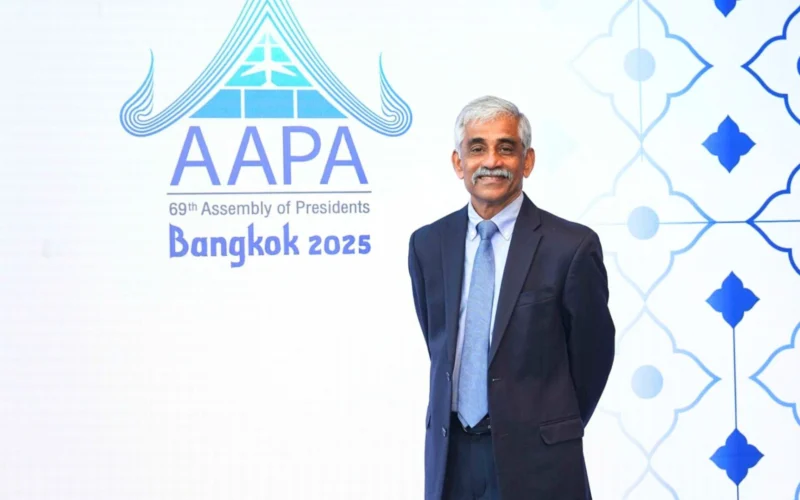
At the Fullerton Hotel in Singapore, just before the rush of the Singapore Airshow 2026, AeroTime sat down with Subhas Menon for what would be his final interview as Director General of the Association of Asia Pacific Airlines.
After six years at the helm of the regional aviation body, there was a reflective quality to his demeanor as he discussed both the challenges the association has overcome and the path ahead for his successor.
The timing is significant, not least because of Menon’s impending departure in April 2026, but because of the association’s founding. AAPA is about to celebrate its 60th anniversary in June 2026, marking six decades of representing the region’s airlines through countless crises, transformations, and periods of unprecedented growth.
Building strength through unity
When Menon assumed the role of Director General, AAPA had 13 member airlines. Today, that number stands at 18, a growth trajectory that continued even through the pandemic years when many industry organizations struggled to maintain cohesion.
“The larger membership, the broader voice,” Menon explained, describing the expansion as a priority set by the association’s members. “What was more gratifying was that even during the pandemic, the membership never wavered. They always believed that the association could play a very effective role for its membership in addressing regulatory issues, sustainability, and safety issues.”
The resilience of the membership during aviation’s darkest period clearly holds a special meaning for Menon. While airlines faced existential threats, they maintained their commitment to collective action and regional representation. Menon also noted that new carriers recognized the value of joining during this period, validating the association’s relevance during the crisis.
“The industry and the association remained intact even after the pandemic,” he said. “New members also realized they could do it with an association like us. That was the most gratifying part—the qualitative benefits from having a larger association.”
A legacy of continuity and progress
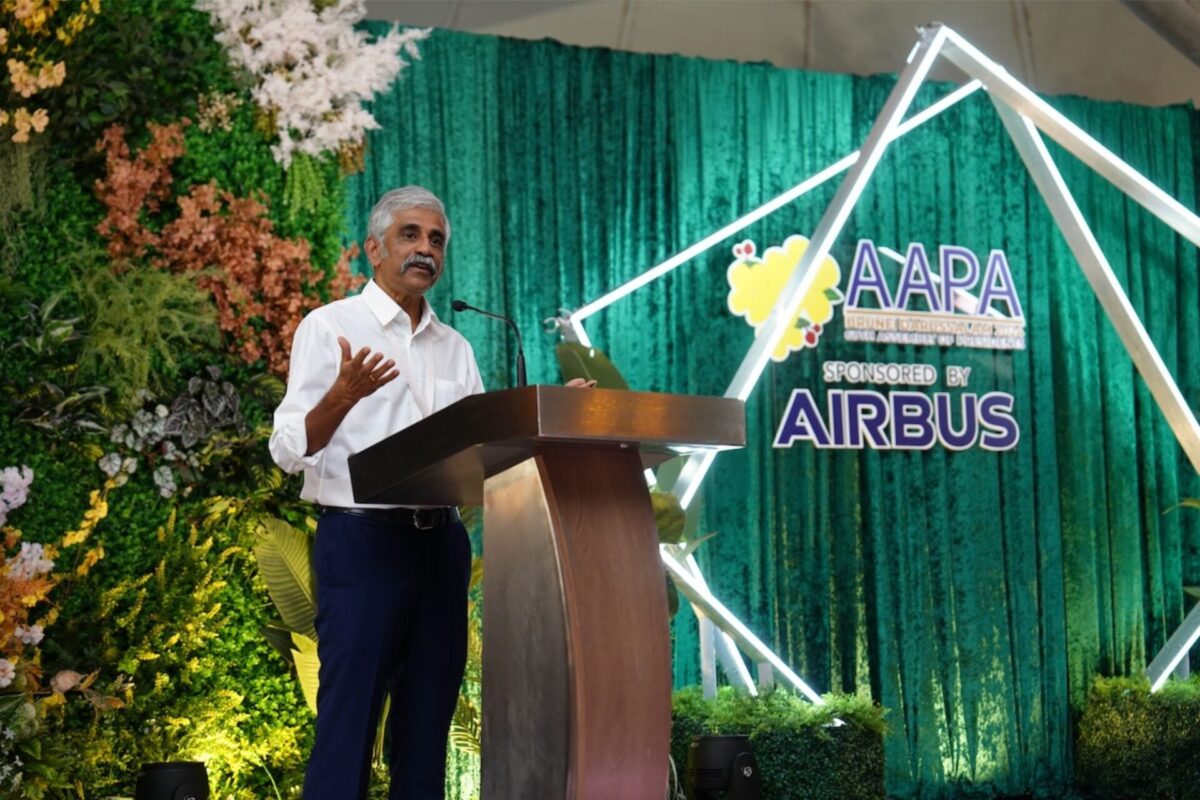
Menon, who is preparing to hand over leadership to Wong Hong in April 2026, described his tenure as part of an ongoing evolution spanning six decades rather than a distinct chapter.
“This association has been around for 60 years, so I would say it is a continuum rather than stops and starts,” he reflected. “I took off where my predecessor left off, and I’m sure my successor will take off from where I would be leaving off.”
Two achievements particularly stood out in Menon’s assessment of his six-year tenure. The membership expansion demonstrated the growing recognition of AAPA’s value proposition across the region.
In 2023, AAPA passed a resolution committing member airlines to achieve 5% sustainable aviation fuel use by 2030. The target wasn’t merely aspirational. It spurred governments across the region to develop supporting infrastructure and policy frameworks.
“This spurred the regulators, the governments, to work towards providing the infrastructure as well as the policy framework to achieve 5% by 2030,” Menon explained. “We are seeing more and more governments doing this—India, Thailand, Indonesia, and other states.”
The sustainability push reflected a broader evolution Menon had witnessed: increased industry unity. The association’s recent 2025 assembly in Bangkok featured aircraft manufacturers discussing supply chain solutions alongside airlines, demonstrating unprecedented collaboration across the aviation ecosystem.
Advice for his successor

With Wong Hong set to assume the director general role, Menon’s counsel focused on fundamentals rather than specific strategies. His advice centered on maintaining the member-centric approach that had guided AAPA’s priorities throughout his six years in the role.
“The starting point of anything that we do is really the membership,” he emphasized. “It is the membership’s communication with the director general that sets the tone for the association in terms of priorities, in terms of what is most important for the airlines.”
The advice reflects Menon’s operating philosophy: successful industry representation requires constant dialogue with constituents rather than top-down decision making.
“The biggest advice I would give him [Hong] is always start with the membership and ask them what is important for them, and then it’s our job to just go about and get it done.”
Navigating unprecedented challenges
As Menon transitions out of leadership, the industry is facing pressures that he described as “historically unique”. Geopolitical tensions are creating operational complexities unlike anything he said he had encountered in decades of aviation experience.
“To be very honest, I have not seen anything like this before,” he admitted. “It is an unprecedented challenge. Supply chain is also an unprecedented challenge, but the geopolitical tensions are huge, and what we see is that it’s quite arbitrary, it’s unpredictable, and it can change over time.”
The ripple effects extend beyond immediate operational concerns. Constant airspace closures due to conflicts, combined with supply chain disruptions, threatens both the world economy and air transport. Menon described it as a symbiotic relationship.
“You don’t know which is the chicken and which is the egg, but they feed off each other,” he explained. “This sort of thing actually affects economies and also the air transport industry.”
Despite these sobering realities, Menon maintained confidence in the industry’s resilience. His optimism stems from observing how aviation had weathered previous crises through adaptability and leadership.
“This industry is quite wily and savvy,” he noted. “It’s always rolled with the punches and has seen many crises. So I’m sure the leaders of this industry will take it further in 2026 and beyond.”
Looking ahead
As Menon prepares for his April 2026 departure, his reflection on AAPA’s six-decade history offers perspective on both continuity and change. The association he is leaving behind after six years is now larger, more unified, and increasingly influential in shaping regional policy, particularly around sustainability initiatives that will likely define the future of aviation.
His successor will inherit not just an organization but a platform for collective action during a period of unprecedented complexity. The challenges are significant: geopolitical instability, supply chain disruptions, and the ongoing pressure to decarbonize operations while maintaining growth.
Yet Menon’s confidence in industry leadership suggested that he was optimistic that the industry would be able to navigate these difficulties. For an association that had represented Asia-Pacific aviation through six decades of transformation, the current challenges are just another test of the adaptability that had characterized Asia-Pacific airlines throughout its remarkable growth story.
As AAPA approaches its diamond anniversary, the organization Menon leaves behind appears well-positioned for whatever industry challenges the next decade might bring.