

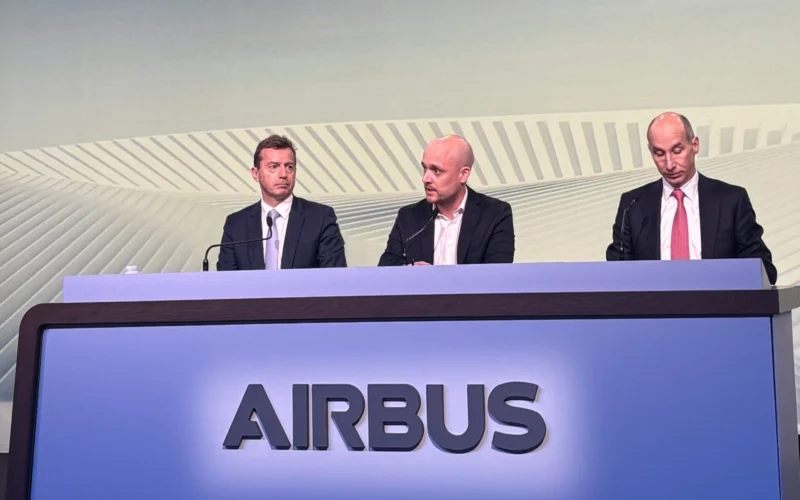
Airbus sees 2026 as a year to ramp up production while also playing a leading role in Europe’s efforts to strengthen its defense sovereignty, stated the company’s CEO, Guillaume Faury, during a press conference in Toulouse on February 19, 2026.
On the commercial side, Airbus is moving ahead with the A320 family replacement, which was previously announced for 2025.
Faury noted that there are several important design choices to be made by the end of this decade. Perhaps the most important is the type of propulsion, with both open rotor and ducted fan considered. The final choice will determine the aircraft’s architecture.
Faury also explained that each option has its own pros and cons, and Airbus is in talks with all engine manufacturers on this matter, although he singled out CFM as a potential partner for the open rotor concept, which is seen as a somewhat more modern option. However, he added that nothing has been decided yet because all the program participants are currently at the data collection stage.
Asked whether Airbus’ current strong position in the single-aisle market disincentivized the development of new platforms, Faury acknowledged the need to continue improving the current single-aisle products but noted that it is normal to have some major new developments every 20-25 years.
He reiterated that the successor to the A320 family will be a significant step change from current platforms and will deliver fuel burn savings of 25-30% compared with similarly sized aircraft of the current generation.
Faury also attributed Boeing’s recent success in catching up in terms of order numbers, in part to Airbus’ own success. Since Airbus’ order book grew to a point in which the gap between orders and production, any new prospective buyers faced relatively long lead times for delivery.
In response to journalists’ questions about the extent to which a more commercially assertive US administration may have contributed to Boeing’s recent order surge, Faury stated that companies like Airbus have to factor this in. He also reiterated that the European planemaker’s products remain very competitive on the global stage.
Addressing the Pratt & Whitney engine dispute
Faury did not hide his disappointment with the way Pratt & Whitney has handled ongoing issues with A220 engines, stating that the engine maker had not respected Airbus’ contractual rights. This, he said, is a matter that needed to be addressed, but did not elaborate any further.
According to Faury, the problem is that, faced with the multiple challenges of serving new production aircraft and addressing the recall of a number of engines found to have metallurgical defects, the engine maker had prioritized the latter. Faury said he believed the company should have made a greater effort to address both in parallel.
Faury also reiterated that the A220 delivery guidance offered alongside the 2025 Full-Year Financial Results reflects the outcome of the latest conversations with P&W and the delivery targets the engine maker said it could achieve in 2026. Airbus is working closely with P&W to make sure that at least the originally agreed 2027 volumes are met.
In any case, demand for the A220 is there; the program is making progress, and Faury said Airbus is comfortable that it will continue to receive orders to sustain its expected production rates.
2 comments
The problems with the P&W geared fan engine are a problem As the A.220 has proved to be a very popular Aircraft and has sold well.
The need for a larger model does give Airbus an opportunity to see if am alternative power plant could be fitted ?
But low fuel burn was an aim.of its original designe by Bombardia.
The pressure is on P&W now, but keep in mind that it applies to any engine manufacturer.