


NASA has effectively canceled the Lunar Gateway space station as the centerpiece of its Artemis architecture, announcing on March 24, 2026 that it will pause the program “in its current form” and redirect its lunar strategy toward infrastructure designed to support sustained operations on the Moon’s surface.
The move was unveiled during NASA’s “Ignition” event, where the agency outlined a phased plan for building a lunar base under the US National Space Policy.
While the agency stopped short of declaring Gateway formally terminated, NASA said it would repurpose applicable Gateway hardware and continue to draw on international partner commitments where possible, suggesting that parts of the program may survive in altered form even as Gateway itself loses its central role.
What Gateway was supposed to be
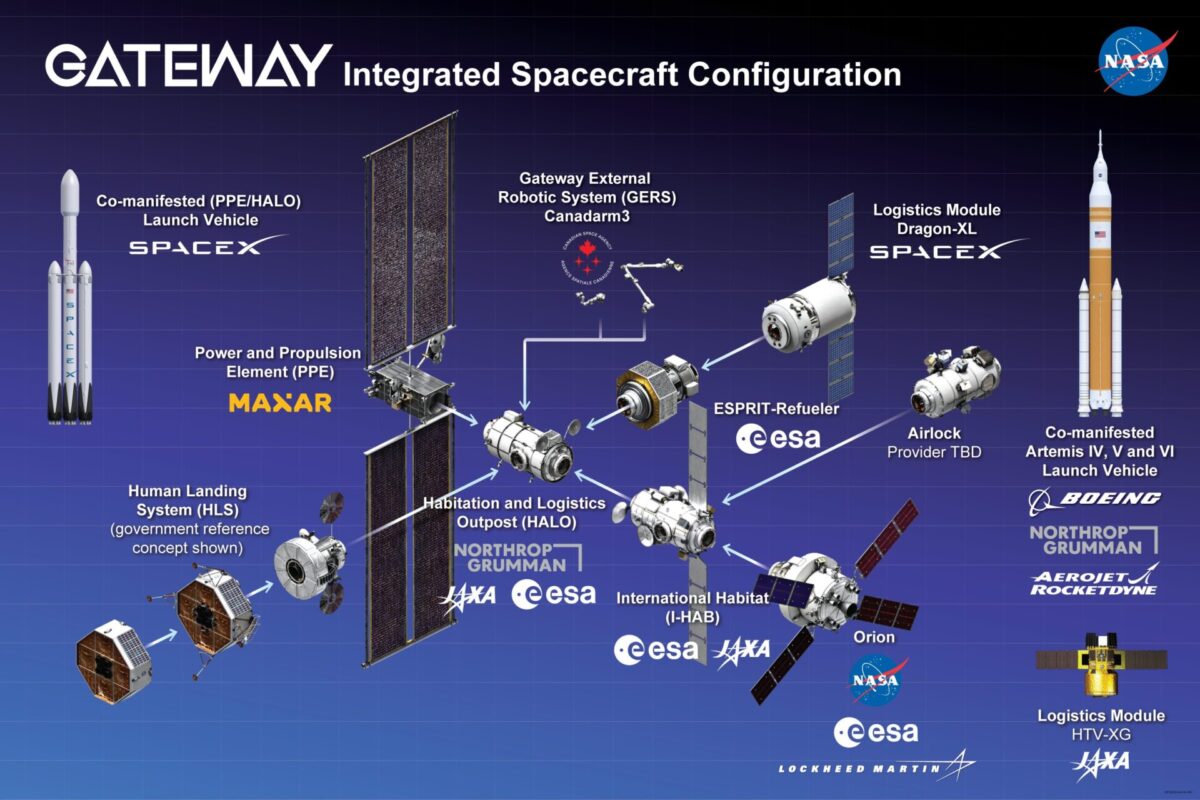
Gateway had long been marketed as a foundational element of the Artemis campaign, a small lunar-orbiting station meant to support crewed missions to the Moon and eventually deeper space exploration. NASA had said the first two elements, the Power and Propulsion Element and the Habitation and Logistics Outpost, would launch together on a SpaceX Falcon Heavy ahead of Artemis IV.
Five space agencies, namely NASA, the European Space Agency (ESA), the Japan Aerospace Exploration Agency (JAXA), the Canadian Space Agency, and the UAE Mohammed Bin Rashid Space Centre, were contributing to its assembly.
NASA’s surface-first lunar strategy
Instead, NASA is now betting on a surface-first architecture. The agency said its lunar base plan will unfold in three phases, beginning with more repeatable robotic and technology missions through Commercial Lunar Payload Services and the Lunar Terrain Vehicle program.
A second phase would introduce early semi-habitable infrastructure and regular logistics support, including JAXA’s pressurized rover.
The final phase would use cargo-capable human landing systems to deliver heavier infrastructure for what NASA described as a continuous human foothold on the Moon, including contributions such as the Italian Space Agency’s Multi-purpose Habitats and the Canadian Space Agency’s Lunar Utility Vehicle.
Part of a wider Artemis overhaul
The Gateway decision also fits into a broader reshaping of Artemis. NASA announced earlier in March 2026 that Artemis III, now planned for 2027, will no longer attempt the program’s first crewed lunar landing.
Instead, the mission will test systems and operational capabilities in low Earth orbit ahead of an Artemis IV landing targeted for 2028. NASA also said it wants to move toward at least one lunar surface landing per year, before eventually increasing the cadence further with more commercially procured and reusable systems.