

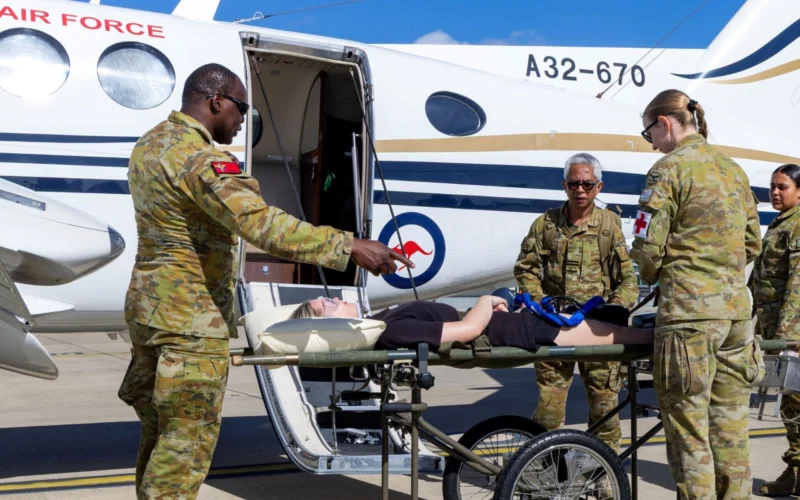
Australian Defence Force aviators tested their ability to evacuate casualties from simulated frontline conditions during a multinational medical exercise held in late March 2026.
Exercise Viper Walk, which ran from March 22 to 27, 2026, brought together personnel from 1 Expeditionary Health Squadron alongside counterparts from the Australian Army, Navy, New Zealand Defence Force, and United States Pacific Air Forces.
The exercise focused on agile healthcare delivery in both domestic and overseas scenarios.
Air evacuation with non-medical aircraft
A key component of the training involved using aircraft not typically configured for medical missions. A 32 Squadron KA350 King Air was deployed for air evacuation, testing crews’ ability to move patients using available assets rather than purpose-built medical platforms.
3️⃣ services, 3️⃣ nations
— Defence Australia (@DefenceAust) April 7, 2026
The @AusAirForce's 1 Expeditionary Health Squadron took part in Exercise Viper Walk 26 from 22–27 March 2026 in 📍 Queensland.
Exercise Viper Walk is a large-scale tri‑service medical training exercise conducted by @AustralianArmy’s 2nd Health Battalion,… pic.twitter.com/nYxA8MqiBo
Wing Commander Conan Brett, Commanding Officer of 32 Squadron, said the training prepares personnel for real-world evacuations where ideal equipment may not always be available.
“The more [training] we’ve done left of that event, the smoother it’s going to go,” Wing Commander Brett said.
Surface evacuations during the exercise used a combination of civilian white-fleet vehicles and Bushmaster protected mobility vehicles to move patients through the evacuation chain.
CT scanner deployed in field hospital
In what organizers described as a milestone for the ADF, teams integrated a CT scanner into field hospital operations during the exercise. The diagnostic tool, typically found only in permanent medical facilities, allowed personnel operating closer to simulated frontlines to identify serious injuries and begin treatment faster.
Multinational teamwork under pressure
The exercise emphasized interoperability between different services and nations. New Zealand Defence Force Lieutenant Issaac Compton said Viper Walk demonstrated that forces with different approaches can still deliver results when working together.
“Emergency departments are chaotic places and you often have to adapt on the fly,” Lieutenant Compton said. “The biggest lesson I’ll take home is that you can achieve a lot with the right people.”
Squadron Leader Koryn Roberts, Executive Officer of 1 Expeditionary Health Squadron, echoed that sentiment, noting that high-pressure scenarios helped teams integrate quickly despite cultural differences across services.
“As a blue [Air Force] commander working within a large joint force, you see cultural differences – but the biggest lesson is that they don’t actually matter. With good communication, we integrated quickly and got the mission done,” Squadron Leader Roberts said.