

On the second day of DAIMEX in the muddy testing range of Pabradė, Lithuania, amid the expected lineup of tactical UAVs and counter-drone systems, a much boxier silhouette appeared on De Havilland Canada’s defense literature.
The Short C-23 Sherpa, a Cold War-era tactical transport once operated by the US military, is being reintroduced to potential customers. The Canadian manufacturer that now holds the type certificate is openly testing whether there is still a market for it.
From heritage display to market sounding
De Havilland Canada says the type certificates for the Short Skyvan, Short 330, Short 360, and C-23 Sherpa family joined its portfolio in 2019. The Sherpa remained rather dormant in the lineup until Farnborough in 2024, when the company displayed the C-23B+ Sherpa as part of a 50th-anniversary presentation of the Short Brothers regional aircraft family.
The aircraft, originally designed by the Belfast-based Short Brothers in the early 1980s, has been refreshed with a Garmin G1000 cockpit. But the basic proposition remains close to the C-23B+ that served with the US Army National Guard until its retirement in 2014. It offers roughly 3.3 tons of payload, a square-section cargo hold, a full-width rear ramp that can be opened on the ground or in flight, rear paratroop doors, Pratt & Whitney Canada PT6A turboprops, and short-field performance from unimproved strips.
It is, in the most literal sense, a flying box.
Whether that is what European armed forces are looking for in 2026 is precisely the question De Havilland brought to Pabradė.
“We’re trying to determine whether there are any signals from European customers for such a platform,” Christophe Simon, De Havilland Canada Director of Sales in Europe, told AeroTime.
Regional demand for smaller tactical airlift?
The case for a Sherpa revival is not abstract, especially at a Baltic defense show. Lithuania had signaled at the Paris Air Show in June 2025 its intention to acquire three Embraer C-390 Millennium aircraft to replace its aging C-27J Spartan fleet, but Vilnius postponed the procurement in January 2026 and opted to modernize the Spartans instead, keeping them in service until 2036. Officials said a future transport aircraft purchase would require additional funding, while near-term priorities were better served by military infrastructure, the formation of a new army division, and integrated air defense.
Estonia has made a similar trade-off in another capability area. In April 2026, Tallinn halted a €500 million CV90 infantry fighting vehicle procurement and redirected the money toward counter-drone systems, air defense, surveillance and unmanned capabilities. The country currently relies on small utility transports including second-hand PZL M28 Skytrucks donated by the United States.
The pattern is clear: Baltic defense budgets are rising, but much of the new money is being pulled toward survivability, air defense, drones, infrastructure, fires, and ground-force expansion. In this environment, a smaller, rugged transport might offer a cheaper way to move personnel, pallets, or small detachments between dispersed sites without consuming the budgetary and operational bandwidth of a larger airlifter.
Twin Otter Guardian remains the main defense pitch
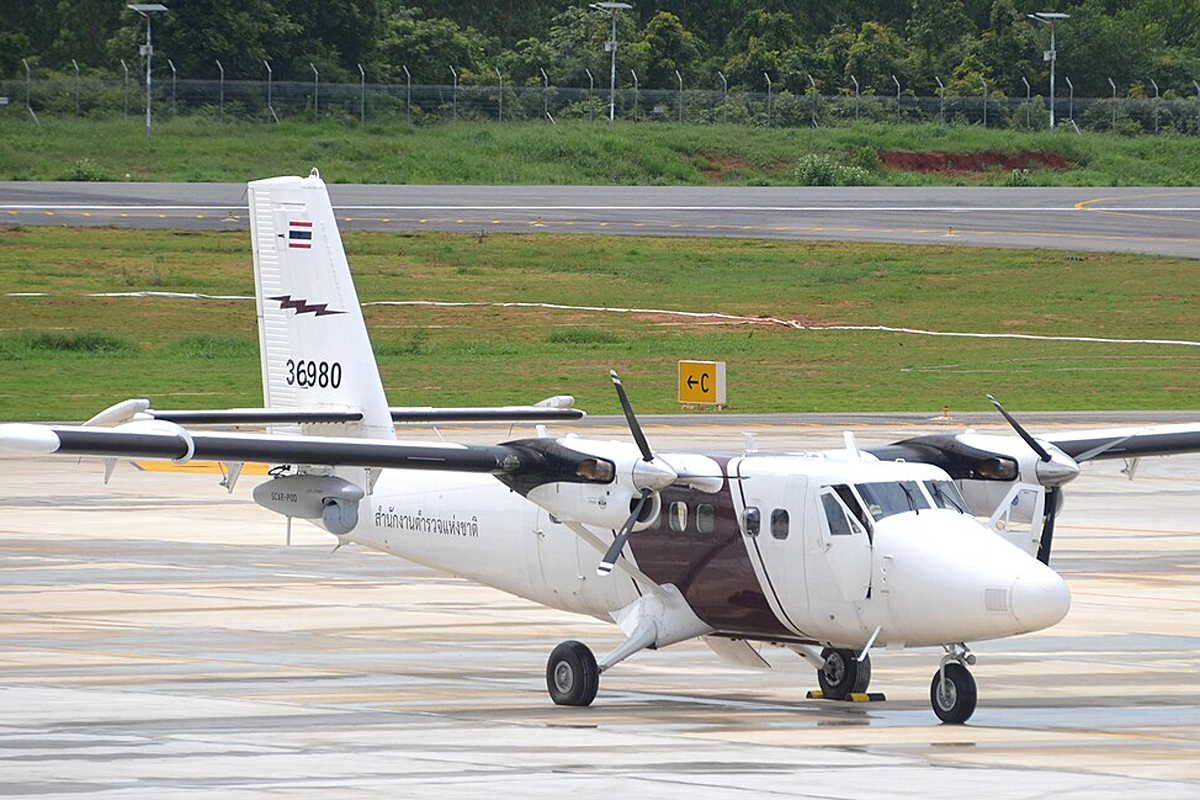
The Twin Otter Guardian formed the other half of De Havilland Defence’s pitch at DAIMEX. Where the Sherpa remains a market hypothesis, the Guardian is a current product, and the company’s argument rests almost entirely on modularity.
The same airframe, the representative said, can be configured for ISR, maritime patrol, paradrop, light tactical transport, medevac, or special forces insertion, with the ability to operate on wheels, skis, or floats.
“It’s the dream sales pitch to be able to walk to a customer and ask them, ‘okay, what do you want our aircraft to do?’,” the representative told AeroTime.
In March 2025, the French Air Force’s Centre d’Expertise Aérienne Militaire (CEAM) released imagery of a DHC-6 Twin Otter being used as a launch platform for FPV-class strike drones, as part of broader French experimentation with releasing one-way attack munitions from light transport aircraft.
Le @CEAM, avec l’appui de la @DGA et de la @FuscoAir , ont largué avec succès des MTO inertes à partir d'un DHC 6 TWIN OTTER ; sur la BA 123 d’Orléans-Bricy le 11 mars 2025.
— BTR (@pascalbtr) March 13, 2025
📷 LinkedIn CEAM pic.twitter.com/gjv1eXYNfO
Defense demand as an industrial hedge
For a manufacturer whose recent corporate story has been dominated by the effort to revive the Canadair firefighting aircraft line, the defense market also offers a hedge.
European defense budgets are rising, while the commercial regional turboprop market is not. Dash 8 production has been paused since 2022, and while De Havilland has signaled that it could restart the line, the business case becomes stronger if military and special-mission derivatives can support demand alongside airline customers.
This is why De Havilland Defence has launched as a distinct catalog in early October 2025, presenting the Twin Otter Guardian, the DHC-515 amphibious firefighter, special-mission Dash 8 variants, and the Sherpa under a defense-facing portfolio.
Though reviving the Sherpa would not be a simple industrial exercise, De Havilland has precedent in this area. Viking Air restarted Twin Otter production with the Series 400 in 2010 after a 22-year gap, while the DHC-515 is itself a modernized continuation of the CL-415 amphibious aircraft line. What De Havilland is now trying to determine is whether Europe’s tactical airlift gap is large enough to justify restarting production of an aircraft type that last rolled off the line in the 1990s.