

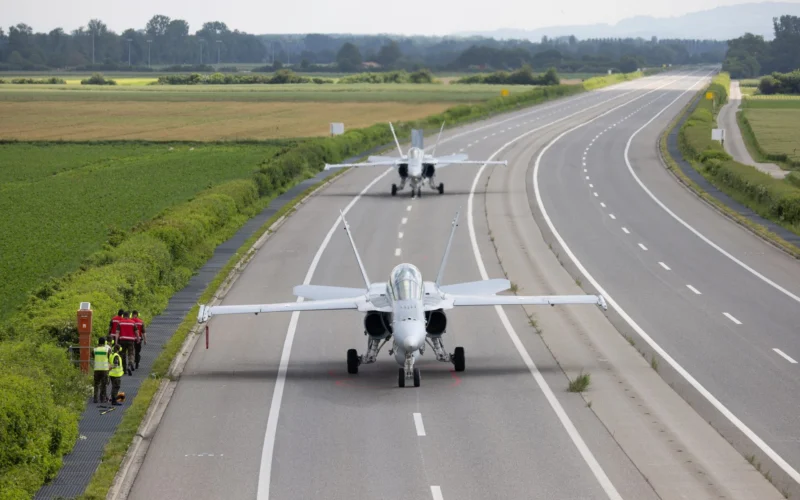
Switzerland may be forced to keep its decades-old Swiss Air Force F-5 Tiger and F/A-18 Hornet flying past their planned retirement to avoid an air-defense gap, after cost overruns and capability delays on its US F-35A Lightning II deal put the transition at risk.
The prospect is being pushed by lawmakers through postulate 26.3021, which would task the government with presenting an updated air-defense risk scenario for 2028 to 2030, and specifically with examining a temporary continuation of F-5 Tiger operations until the end of 2030 and an extended service life for the F/A-18 fleet beyond 2030.
The proposal originated in the National Council’s Security Policy Committee (SiK-N), which backed it on February 24, 2026, by 13 votes to 9 with three abstentions. It is now scheduled for debate in the full chamber.
Why the transition is at risk

The concern traces to a decision to cap the F-35A buy within the existing six billion Swiss franc ($7.6 billion) budget after the United States announced unilateral price increases of up to 1.3 billion Swiss francs ($1.6 billion), cutting the expected order to roughly 30 aircraft from the planned 36.
Deliveries are due from mid-2027 but in a reduced “truncated Block 4” configuration, with full Block 4 capability not expected before 2031 at the earliest, according to a US Government Accountability Office report from September 2025.
Supporters of the postulate warn the combination could thin out usable fighter capacity during the changeover, a strain compounded by Washington’s diversion of part of Switzerland’s F-35 payments.
The government wants the idea dropped
The Federal Council recommends rejecting the postulate. It argues that operating all three types in parallel is neither militarily sensible nor affordable, and that the F-5 retirement was already settled under the 2025 Army Message, with the type to be withdrawn by the end of 2027 as flight-hour limits are reached. Keeping the Tiger flying beyond 2027 would cost in the triple-digit millions without delivering modern avionics or weapons, it says, while noting that by the early 2030s Switzerland would operate about three-quarters of the world’s remaining F/A-18 C/D fleet.
That ceiling hardened on June 1, 2026, when the government confirmed completion of the F/A-18C/D life-extension program. Launched under the 2017 Armed Forces Dispatch at a cost of 450 million Swiss francs ($571 million) and carried out with RUAG, the work cleared all 30 aircraft to fly up to 6,000 hours each, keeping the fleet operational into the early 2030s but no further. The postulate asks the government to study whether the Hornets could be stretched beyond that limit.