

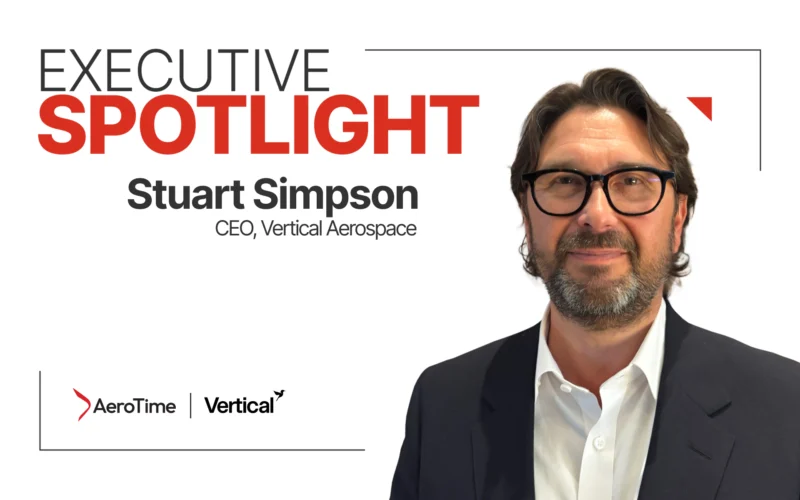
2026 has so far been a remarkable year for British eVTOL developer Vertical Aerospace, with the company surpassing a number of significant milestones.
The company has firmly established itself as Europe’s leading eVTOL developer, the only company which could be considered one of the leaders of the pack, alongside US and Chinese firms.
In December 2025, Vertical Aerospace unveiled the final design for its production aircraft, called Valo, and has since pushed the boundaries further by announcing a hybrid-powered variant with new use cases in mind, such as defense and emergency services.
AeroTime met with Vertical Aerospace’s CEO, Stuart Simpson on the sidelines of the CAPA Airline Leader Summit in Berlin (April 22–24, 2026) to discuss the company’s milestone and their significance for the company’s development timeline.
The conversation began by asking Simpson about the design changes and how they may have altered Vertical’s path to certification.
“The first thing to say is we reset the certification date to 2028. We were the first company in the whole industry to go out with a realistic certification date, and it was a big decision for the board,” he said. “But I felt very strongly as a CEO that you can’t mislead customers, suppliers, regulators and governments that are trying to work with you and support you.”
“We made the move to 2028 very consciously, and it was received extremely well in the industry. In fact, a financial analyst wrote that this was like having an adult in the room,” he continued. “We only moved to 2028, having worked with the CAA and EASA. Their certification directors and teams spent three days with us. They looked at our program, our project, our technical competence, and, importantly, they looked at the prototype and the final design, and they said, ‘Look, we will work with you to certify this product in 2028’. So, we set it very consciously.”
The Valo uses most of what was learned during the development of the VX4, the prototype that Vertical Aerospace has been flight testing since 2023.
“If you do subscale flying on a rotorcraft, you don’t really learn very much because the fluid dynamics are so complex. They’re totally different when you scale up. So, we were very clear we’d go full-scale straight away, which we did,” Simpson explained. “We wanted to do piloted flights as soon as possible, and that’s why we went down this route of building a full-size prototype piloted aircraft [the VX4 – ed. note]. Now the crossover between that and the Valo is extremely high.”
The VX4 has also allowed Vertical Aerospace to work with many of the systems that will be used in the Valo.
“If you think of it from a content perspective, the prototype, it’s got a tier one supplier that made the fuse, the wings, the pylons. We’ve got an aerospace supplier on the APUs. We’ve got the batteries, which we design ourselves. We’ve got our propellers. It’s got Honeywell’s flight control system, avionics displays,” Simpson said. “All of that carries directly across to the Velo. Now, the design is slightly different, but what we’ve really done is just shrink-wrap it and make it look beautiful.”
“The rotors front and rear and the wing are almost exactly the same. We’ve changed the length of the tail a little bit, which is slightly shorter for weight purposes, but effectively, 90% plus of that prototype carries over into the Valo,” he added. “It’s an extremely efficient way of doing it.”
Our interview with Simpson took place a few weeks after Vertical Aerospace completed the first transition flight of the VX4, so this milestone inevitably came up during conversation.
“A massive moment, it was extremely exciting! We’re on track. We are the only company with clear financial and operating metrics all the way through to 2030 and beyond to 2035 having done full scale piloted transition,” Simpson said. “We’ve hit every single metric. We’re about three months late on transition, but that’s within our current kind of timeline to get certified in 2028. So yeah, we’re on track, which is great.”
So far, Vertical Aerospace has received more than 1,500 orders for its eVTOL. What are those customers saying about the switch to Valo?
“Just to be clear, the VX4, the one that has been flying, was always a prototype,” Simpson explained. “We were very clear to the customers; it was a prototype. For example, it’s much heavier than the real aircraft, because there’s around 300 kilograms of sensors on the aircraft. So, we’re always very clear about that; the fundamental concepts are the same.
“We’re a winged tiltrotor. So, it’s exactly what the customers signed up for,” Simpson added, before confirming that the design change had considered a good deal of customer feedback.
“Actually, the customers were instrumental in designing the Valo. Twice a year, we pull our customers together for three days,” he continued. “We’ve been doing this for five years, and they have been saying to us what they need to make this a successful product, and the things that really define our aircraft.”
Simpson highlighted some of the key differentiating elements that the Valo will bring to the market.
“There are two things. Number one is safety. If you’re an airline, you can’t have pilots sitting in the same compartment as the passengers. So, we have separate pilot and passenger compartments. No one else can do it. They need a full redesign of the aircraft,” Simpson said. “The second thing is the luggage capacity. We are the only ones that can take luggage.
“Those two things mean for our 1,500 customers – which are split across the world in thirds, America is a third, Europe is a third, and the Middle East and Asia are another third – that we are delivering a product they are helping shape,” he continued. “It’s got the range they need. It’s got the luggage capacity they need. It’s got a separate pilot compartment. And we can start with four people and then scale it to six.”
“They were always very clear that they need it to be highly profitable,” he said. “And we’ve set out to design a profitable product.”
The financial outlook
For all its technical achievements, so far Vertical Aerospace has raised less capital than its direct US-based competitors. It is true that it has also been a lot more frugal, with its burn rate stable at around $100 million per year. This quantity, however, is set to increase as the company gets closer to certification.
“We are the most efficient from a capital perspective. We’ve spent 500 million, and we’re now leading the industry from a technical perspective with an aircraft that is redefining the sector,” Simpson said. “So, we are doing an outstanding job. Our past cash burn has been about $100 million per year. Last year was just under $120 million. We’ve always said the rate of spending increases because we are building the Valo. So, within the next 12 months, we’ll have to spend about $190 to $200 million.”
“We’re signing supplier contracts where they have to make tooling for the real aircraft. So that burns some more cash,” he added. “Our cash burn rate is increasing, but we are in the best cash position we’ve ever had. As we sit here today, we’ve got about $160 million of near-term cash.”
This is one of the reasons Vertical Aerospace raised another $850 million in April 2026. This quantity should enable the startup to make it past the certification timeframe, but the terms of the funding round appeared to have been structured in a rather complex way.
Not all of this $850 million is cash in the bank, Simpson clarified. However, he reiterated that the company could draw on these funds when needed.
“We have a facility of $850 million, of which $50 million is new equity. We’ve drawn down $25 million this week from that facility, and we can continue to draw it down whenever we need it,” he said.
The executive quantified the amount needed to get past certification in 2028 would be $700 million and contrasted this with the $800 million in funds it has, in theory, recourse to. Simpson said he expected Vertical Aerospace to become cash flow positive by 2030.
“And importantly, this round lets us access other capital,” Simpson said. “We have other people that want to invest, but we felt that the market wasn’t valuing the fact that we could have access to capital. This demonstrates we’ve got access to capital through to certification.”
Could the existing 1,500 aircraft commitments be transformed into cash?
“One of the things we’ve been very clear about is that these are Memorandums of Understanding (MOUs), and we will turn them into firm orders over time,” Simpson said. “So, we have two customers who have already paid us some money to secure places. We’ll be working with current customers and potential future customers to secure early build slots, and we’ll be doing that probably six to 12 months from now.”
Simpson added that the Valo has been well-received by both customers and prospects alike. “We’ve had some great meetings over the last few weeks. People can see that the Valo is real,” he added. “We’ve done the transition [flight]. So, we’ve proved the engineering works. People are very excited about the product, more so than we ever thought.”
Like other eVTOL developers, Vertical is also evolving its vision from a purely electric aircraft to a range of solutions, with hybrid propulsion for extended range, something that is seen as essential for some use cases, such as the military. However, could this become a distraction from the main goal of achieving certification for the Valo?
“I’ve been with the company for two and a half years. I signed off on the hybrid investment after I’d been with the company for barely three months. This was because the airframe we’ve designed can actually accommodate a hybrid,” Simpson explained. “The hybrid opens up huge other opportunities. It can take the range to 1,000 miles with the same payload as the electric. If you add payload to it, the sweet spot is probably 360 to 420 miles plus a ton of payload.
“That’s transformational,” he said. “It means London to Paris, Berlin to Munich, these kinds of journeys become very easy, seamless, cheap and silent, but it also opens up military applications.”
But how much of a drain on cash, attention and other resources does the design change represent?
“Well, the hybrid isn’t really a certification drain,” Simpson said. “We’ll certify the hybrid in 2029. It’s already been running on a bench. We’ll be flying a hybrid within the next 12 months. We’ve got a separate, isolated team working on it, and it isn’t really a drag on the main project. The reason for that being is that it is the same airframe.”
Simpson explained how the company is also leveraging the many commonalities of its base design to develop the hybrid version.
“Now, there are some small changes you have to make because you take out the batteries and put in a fuel tank,” he said. “But the overarching aircraft is the same. We don’t have to design another aircraft, which means that rather than being a massive distraction, it’s kind of an add-on. The reason we’re doing that is, again, that when we showcased what the hybrid could do, we had a lot of people saying this is what they would like us to develop.”
Hybridization is a path followed by other eVTOL developers, but once again, Simpson highlighted how its technological credentials put Vertical Aerospace ahead of the pack.
“They have to build a new aircraft because their aircraft is too small. By the time you put a hybrid in it, there’s no space. You can get eight people in our hybrid. So, we still have a highly usable aircraft in the hybrid configuration.”
Simpson added that, while the hybrid version has been well received, its order book is not open yet since he wants the aircraft to be flight tested first. This may happen within the next 12 months. Vertical Aerospace could target emergency services as one of the first markets for the new hybrid.
“We were in Miami at a launch event recently. Miami is a very forward-thinking city. We had the mayor and operations directors from airports. They really want it. They’re crying out for something that’s safe and quiet, because they have people coming off from the islands in Florida for medical emergencies, and residents around the hospitals in Miami hate the noise,” Simpson said. “This solves the whole problem. It’s a multi-dimensional interest we are getting on the hybrid.”
Which side of the Atlantic?
Vertical Aerospace is a British firm, but it is listed in New York. Is being based in Europe a challenge when trying to develop such capital-intensive technology projects?
“We are very proud to be anchored in the UK. It’s where we do our engineering. We’re in Bristol, at the heart of the European aviation industry. We’ve got a supplier base around us, so it’s a great place to be and our costs are around a third of what they are for our American competitors,” Simpson explained. “So that’s part of what allows us to be very efficient. We are certifying under the CAA and EASA, which means we are very much seen as European.”
However, the US features prominently in Vertical Aerospace’s plans.
“I’ve always been very clear that our first factory will be built in Europe, and our second one will be in the US,” Simpson said. “Now that is a way to get into the US supply chain and of course, the UK is a very trusted ally of North America, so we fully anticipate being able to access both the European and US militaries.”
The industrial plan
Another area in which the British firm is executing a clearly thought-out plan is manufacturing. How does Vertical Aerospace plan to scale-up production?
“If I look at the Velo, we have got around 75% of the suppliers close to being locked in, which is fantastic. We’ve done all the complex, long lead time items, which is exciting, Simpson said. “We signed a billion-dollar deal with Honeywell, Aciturri is doing the airframes for us. We’ve got choices on the batteries, so we’re in great shape on that. We still have to do things like seats, wiring harnesses, much more of the commodity ending spectrum.”
“In terms of industrialization, it’s very much a two-step approach, and the reason for that is we’re very efficient with capital,” he continued. “So, if you look at how you ramp up production, you have to learn how to build something as complex as this.
“My background is in the automotive industry. This is called cell-based manufacturing, where you put the airframe in the middle, and you bolt everything to it. This is very much how McLaren, Ferrari, and Bugatti build their hypercars. This is a well-known route to assemble high end products,” Simpson added, before pointing out that the person at the head of Vertical’s battery facility used to run McLaren’s manufacturing operations.
“We know how to industrialize, but you don’t need to build a big factory,” he added. “That’s just a waste of money right now. What I’m building is an expansion of the vertical Energy Centre. It will be three times the size and give me the capacity to build batteries through 2030 and I’m doing the same for the aircraft.”
Vertical Aerospace’s goal is to produce around 1,000 aircraft per year by the middle of the next decade. But it is in no rush to get to the full production scale.
“We’re building some facilities there, refurbishing a hangar as well, and that will give us a facility to build aircraft through to 2030,” Simpson said. “Now, the reason I’m doing that is that it gives us a chance to learn how to build it and decide where and how to do it.”
The company is investing in its facility at Cotswold Airport (GBA) in the Southwest of England, but Simpson is open to considering other locations for the Valo’s future assembly lines.
“I have offers to relocate to Spain, for example, for close to €50 million, and similarly for Germany and I’m also looking at a short list of sites in the UK,” he said. “We’ve also been approached to go to the US. We are working through the best place to locate the factory that will build 1,000 aircraft a year and a gigafactory for the batteries.”
“I’ll announce those within the next 12 months,” he added. “We don’t need to build them now because, again, you just waste money, waste capital.”
How many assembly lines will Vertical Aerospace need to fulfill its vision?
“We can reach those numbers through one factory, obviously, but I’ll probably open another one before that since it makes sense both economically and to gain access to certain markets,” Simpson said. “This isn’t like Airbus where you can fly to your customers. It’s easier to build it close to the market.”
But will there be enough demand for so many eVTOLs?
“The demand is absolutely staggering,” Simpson explained. “I had one customer who talked about buying 1,000 [aircraft]. Just one customer!”
We pointed out to Simpson that many in the aerospace industry see eVTOLs as a niche product at best.
“That’s a common critique,” he said, adding that he was approached to join Vertical two years before taking up the post and spent that time “looking around the industry”.
“My background is 30 years in engineering. I talked to customers, suppliers, competitors, analysts, technology people, to get a feel for it and what came across was that the technology is real; the funding is real, but, importantly, customer demand is extraordinary,” he added. “When you talk to customers, whether it’s in New Delhi, Mumbai, Tokyo, Osaka, LA, New York, Milan, Rome…people can’t get around in cities these days. It takes forever.”
Simpson continued by putting forward the case for eVTOLs as a time-saving tool for urban and regional air mobility.
“So, while the launch case is very much touristic, such as airport to city center or airport to tourist destination, the long-term vision is to be able to do multiple journeys across and around cities at zero emissions and effectively silently against the city background,” he said. “The aircraft is engineered to do so. You can’t dig tunnels, create more roads within cities. There’s no space, but more and more people are moving into cities, so they just need solutions. The demand is enormous.”
“Just to wrap this up, the cost per seat per kilometer of our aircraft is the same as a black cab in London,” he added.
Will Vertical’s home country, the UK, be one of the early adopters, or will the use cases be shrunk, as some in the industry fear, by regulatory barriers? Simpson is positive about the prospect of the UK becoming a leader in the eVTOL industry.
“I did the first commercial drone delivery in the UK. So, I personally drove that through the government. I’m familiar with working with the government,” he explained. “The UK government has got a group together on the Future of Flight industry group. We’re funded to the tune of £20 million, around $30 million.”
“The UK government has committed to having legislation in place by 2028 because the UK wants to showcase itself as an innovation-friendly country, and we need to in a post-Brexit world,” he added. “If I look at Japan, Korea, the US, the Middle East, these countries are desperate for eVTOLs because the citizens want them.”
On vertical integration vs. outsourcing
We got back to Vertical Aerospace’s industrial plan in order to better understand what are the parts that the company considers most strategic.
“We do the batteries and the propellers. We buy some 12,000 battery cells and then package them into the battery pack. We own all the IP around it,” he said. “We do the crash testing, the thermal runaway, the battery management system, everything around that and its industry leading. We’ve got the most powerful battery pack in the world for any eVTOL.”
Simpson went on to talk about the other parts and components that the company has decided to keep in-house.
“We do the propellers. We’re on the third generation of propellers, and we’ll probably get to gen five or six for the Valo. The reason we chose those two things is, first of all, the battery is the heart of the aircraft, so we wanted to own that. And the propeller is very, very important because you need to get very high torque at a low noise signature, so we felt that that was really an area where we could specialize in and differentiate our aircraft. So those two we picked to own, and we also do the integration.”
Which areas are Vertical Aerospace planning to outsource?
“An example of what we didn’t pick is flight control systems. When we worked with Honeywell, why go and try and design your own flight control system when you can take the world’s best from Honeywell? It’s got millions and millions of hours’ worth of flying on it, and we just need to adapt that to us,” Simpson said. “We know we can certify it because remember, this is all about certification. No certification, no business.”
So, what’s next for Vertical Aerospace?
“From a technical perspective, we have what’s called CDR, the critical design review, where we’ll sign up and contract with the final 25% of the supply chain,” Simpson said. “We will then be able to go to our customers and say, ‘Look, we can now guarantee the performance of the aircraft and the timing when we can deliver. So, we’d like to start negotiating on slots.’ That’s over the next six months or so, and then the next big [milestone] after that is we’ll fly the hybrid prototype, and then we will build the first Valo.”
Simpson also explained that Vertical Aerospace is preparing to train the pilots that will fly the Valo.
“We’re working hand in hand with the world’s largest pilot training company, and we’ll provide all the details of that over the coming 12 months,” he said. “To start with, we’ll be working with people that are already pilots, retraining in our aircraft. The conversion is very short. If you’re already a commercial pilot, it’s a matter of two to four weeks, something like that. The aircraft flies itself. In fact, it’s designed to be autonomous.”
Is Vertical Aerospace also thinking about autonomous flight?
“Autonomy is on the technology pipeline,” Simpson said. “Absolutely!”
In the meantime, those that wish to get a close look at Vertical Aerospace’s eVTOL will be able to do so at the Farnborough Air Show, July 20-24, 2026, where the British firm is planning to conduct demonstration flights.
“It will be an amazing moment for us,” Simpson said. “We are very, very excited.”