

Over the last couple of decades, the Middle East has emerged as the new “center of gravity” for the global aviation industry, particularly hubs like Dubai. So, it is understandable that we are seeing Dubai-based companies across the aviation value chain grow into major players in their respective market segments.
One of these is Dubai Aerospace Enterprise (DAE), a diversified firm owned by the Investment Corporation of Dubai, the emirate’s government investment arm.
DAE has quietly become one of the world’s largest aircraft lessors, particularly after the acquisition of two well-established players, Nordic Aviation Capital (NAC) and Macquarie AirFinance (MAF) in 2025 and 2026, respectively. What’s more, DAE combines its leasing business with a sizable maintenance, repair and overhaul (MRO) operation based out of Amman, Jordan.
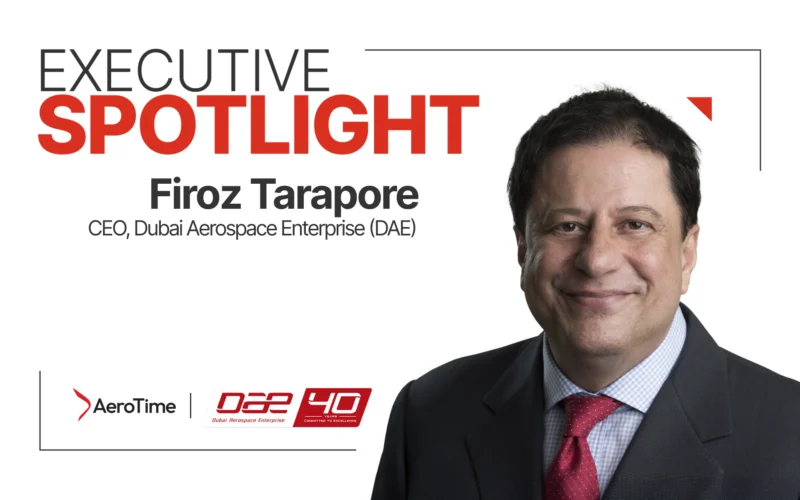
And while DAE tends to keep a relatively low public profile, the 82nd Annual General Meeting (AGM) of the International Air Transport Association (IATA), which took place in Rio de Janeiro on June 6-8, 2026, offered AeroTime the opportunity to sit down with DAE’s Chief Executive Officer (CEO) and a member of its board of directors Firoz Tarapore for an exclusive interview.
“DAE has two business lines: one is aircraft leasing, where we are a very large player, and the other one is airframe MRO, where we provide airframe heavy maintenance services,” Tarapore said. “The leasing business today is, I would say, about 85% of our business, and the engineering business is the remainder of that.”
“On the leasing side, our fleet today is about 700 aircraft and, as you may have seen, we have announced an agreement to acquire Macquarie,” he said. “So, when that transaction closes, our fleet will be in excess of 1000 aircraft, allowing us to serve customers in like 80-85 countries.”
These figures place DAE among the world’s top lessors, although Tarapore said he is not fixated with attaining a specific spot in the rankings.
“If you look at the number of aircraft, we will be the third largest out there, but for us it’s not that relevant,” he explained. “What’s relevant is the right number of aircraft to be relevant to our customers, to the OEMs, and to the suppliers.”
On dominating specific market niches
Here, Tarapore continued to explain DAE’s strategy when it comes to building its fleet.
“We do not work across the entire spectrum. In fact, we will focus on narrowbody and one widebody product from Boeing and Airbus each, and then two unique aircraft types,” he explained. “One is the ATR72-600, where we have a large position. And the other is the factory fresh B777 freighter from Boeing, where, again, we have a sizable position. We’re pretty much the only ones of our size focused on them.”
He continued: “Those are two things that we do differently from our large competitors because those products are very unique, and the profitability associated with that is also very attractive.”
What are the reasons for the company’s focus on these two specific aircraft models?
“From my perspective, the reason we want to play in this space is that these are unique aircraft. The number of aircraft being made each year by the OEM is limited, and the number of lessors in this space is also limited, and when you put all those things together, that makes for a fairly unique financial proposition from a risk-reward perspective,” he said. “It’s capital well deployed relative to other liquid narrowbody products, or even liquid widebody aircraft.”
Another reason for DAE’s strong position in the turboprop leasing market is the acquisition of Nordic Aviation Capital, a firm with a strong portfolio of regional aircraft.
“We are now a lessor with the largest ATR72-600 position, and yes, there are other lessors, but when you look at the number of lessors in this segment relative to the number of lessors in other narrowbody products, it may be five to 50,” he said. “So, the proportionality is very different.”
Perspectives for DAE’s MRO business
Besides the growth of the leasing business, DAE is also active in the MRO market, with a dedicated subsidiary providing airframe maintenance services out of its base at Queen Alia International Airport (AMM), in Amman, Jordan. Tarapore highlighted that this business works independently from the leasing operation, providing its services to many international airlines.
“That is a separate business line; it’s not meant for our fleet at all,” he said. “The only time these two divisions come together is if there is a commercial reason for it to come together. Our engineering business is really for fleets of airline clients. We provide services to large carriers in Europe, the Middle East, Africa, and South Asia. That’s our business. It’s an airline-based business.”
In line with many of its peers in the MRO space, DAE has also been investing in adding capacity at its Jordanian maintenance base.
“We have hangar space for 25 aircraft at the same time, 25 parallel lines of heavy maintenance. That’s a big business,” he said. “I think that makes us the fifth or the sixth largest single facility for airframe heavy maintenance in the world.”
On trends in the aircraft leasing and MRO markets
What are Tarapore’s views on the global leasing market and the main drivers behind it?
“Just like in the broader aviation industry, we are at a point where we’re seeing factors that we don’t normally see. There is a shortage of aircraft that haven’t been made for the last few years. There is a shortage because engine OEMs and supply chain people just cannot deliver what they need to deliver,” he said. “Landing gear overhauls, for example, don’t get done, so aircraft don’t come back into service. At the same time, customer demand has stayed relatively sticky, even if this is normally a price-sensitive industry; demand has held up strongly over the last few years.”
He added: “Put all of that together and what you get is an industry where, because profitability has ups and downs, leasing has become a genuinely important and significant solution.”
How does this translate into the leasing market?
“So, we see a climate that is very conducive. We see pricing that is relatively firm, and we see opportunities to grow, because some of these things are stickier than we thought they would be. They’re not going away, whereas by now you would have thought that they would have gone away,” Tarapore said. “So, we’re quite encouraged overall in the near term.”
But what about the longer term? Is Tarapore concerned that overinvestment today may lead to a glut in the market further down the road?
“If you look back, and then if you look forward, leasing today is approximately 50% of the fleet out there. If you look at the annual forecasts that Boeing and Airbus prepare for the next 20 years, and if you look back at how leasing is done, even if leasing doesn’t increase [its market share], that’s a massive increase in the number of aircraft that lessors will have to finance,” he said. “And over that period of time there have been events which have driven that number up and down, but overall, there’s a secular uptrend to our business. So, if we look out 20 years instead of five, the number of aircraft in the fleet that will be financed by lessors will be twice what it is now, which is a very unique way to kind of think about growth in our business.”
A truly global business
Although the company is run from Dubai, DAE has a truly global footprint with offices in Singapore, Dublin, and the United States.
“We originate from different jurisdictions around the world,” Tarapore stated.
Tarapore then outlined the advantages that the emirate offers for a global aviation business like DAE’s.
“Where you see special regimes, for example, in Singapore or Hong Kong, the special regime introduces a much lower tax rate in exchange for doing certain things well. In Dubai, when you’re starting the tax rate is nothing. You don’t really need a special tax regime to do that,” he said, referring to how much a draw for professional talent a particular tax regime can be. “There are many other organic advantages that you can have to be based there. I think more and more people are coming to Dubai and doing their business out of Dubai, not because of special regimes, tax advantages, but because from Dubai you can reach more parts of the world than from any other place.”
“For example, if you look at Emirates and flydubai together, there’s literally 200 cities that we can access nonstop,” he added. “It’s impossible to do it from any other part of the world.”
Few businesses areas global as aircraft leasing. What regions does Tarapore see as DAE’s core market?
“We don’t think about it like that. We think about whether we are buying the right aircraft at the right price, giving it to the right lessee with the right protection,” he said. “If we can say yes to all four of those conditions, then the aircraft can be whatever, and where we end up with is more of a scorecard than a target. That’s pretty much how we’ve run our business today. As a result of that, I think the Americas, everything from Canada down to Chile, is our largest division.”
While its Dubai base means that DAE sits at the center of one of the world’s hottest markets when it comes to aircraft demand, Tarapore reiterated the global scope of the firm’s business.
“After this transaction closes [the Macquarie AirFinance acquisition – ed. note] we will have 200 clients, all commercial airlines in about 80 different countries,” he said. “So, it is a true global business, and the way we underwrite is the way I described, just because you’re in one region doesn’t advantage you or disadvantage you in any way.”
Before we wrapped up our conversation, Tarapore also had time to comment on trends in the MRO market.
“I think the fundamentals for MRO are still very strong,” he said. “If you look at what we’ve created in Amman, any carrier in Europe with a narrowbody fleet can fly into us nonstop. Any carrier in Africa can do the same, as can any carrier in the Middle East, and even some in parts of South Asia for both narrowbody and widebody. The whole world is open.”
As is the case for the leasing market, the steady growth of the air travel industry continues to provide the basis for a demand in MRO services, something which has led many operators to rush to expand capacity.
“The product that we’ve created is really resonating and it does so in a way that leads us to think this business still has a very strong runway for further growth, because more and more aircraft come into service, more and more aircraft have their lives extended and therefore need checks, etc. And, because of where we’re located, we can capture a lot of that business at a price that makes sense,” he said. “So, I think we still think that the growth opportunities for airframes [maintenance] are still very strong, and we’re going to just keep going.”
In light of this strong demand, DAE has also invested in its own facilities in Amman.
“Last year we added a new hangar which added almost eight aircraft to our capacity. From 17, we can now go to 25 aircraft [simultaneously],” Tarapore said. “And once we have clarity on what the geopolitical situation looks like, we would say that there is capacity to do more.”
So, what’s next for DAE?
“I think on the maintenance side, it’s pretty simple in that we have the ability to add lines of maintenance every year to what we have and, on top of that, we have the ability to add certain special capabilities that we don’t currently provide, so that’s an easy thing,” Tarapore said.
“From a leasing perspective, last year we acquired NAC [Nordic Aviation Capital], so that was 200-plus assets. This year we’re acquiring Macquarie, so that’s 300-plus assets, and that has changed our business from a 400-500 aircraft fleet two years ago to a 1,000-plus aircraft fleet,” he continued. “In the meantime, I have said publicly that we think the optimum fleet size, the fleet size where you can optimize risk and return, is somewhere in that 800 to 1,000 aircraft range. Now that we’re here, we need to examine whether that’s something different. So, we will be examining that, and based on that, we’ll figure out what to do next.”