

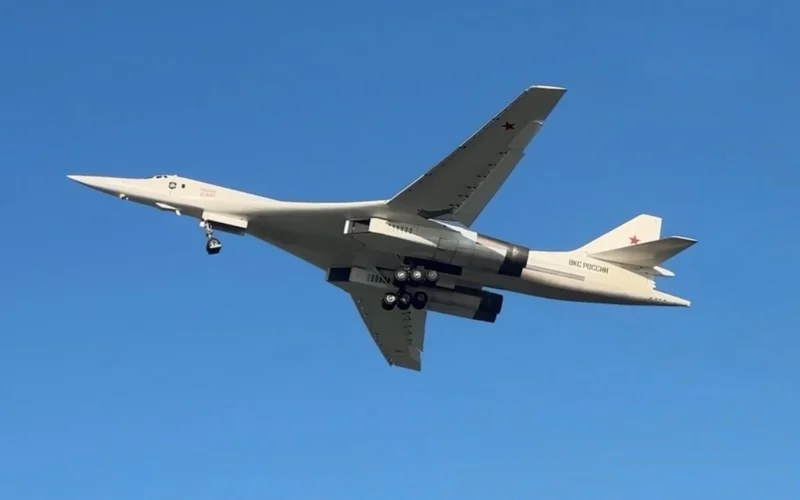
Russia’s Aerospace Forces conducted a long-range bomber patrol over the Barents and Norwegian seas on June 22, 2026, with Tu-160 strategic bombers remaining airborne for approximately 16 hours in international airspace and were shadowed by Norwegian fighters.
The Russian Ministry of Defense announced the mission on Telegram, stating that Tu-160 crews practiced aerial refueling during the sortie. MiG-31 fighters from the Russian Aerospace Forces provided escort throughout the flight. The ministry described the flight as planned and routine, stating that all operations were conducted in strict accordance with international airspace rules.
The bombers were intercepted by Norwegian F-35 fighter jets. The Russian flight group was composed of two Tu-160 bombers and two MiG-31 fighters, a spokesperson for the Norwegian military told AeroTime.
The Barents and Norwegian seas border NATO member states Norway and Finland, making the area a frequent zone of contact between Russian long-range aviation and allied intercept aircraft. Norway keeps two F-35A fighters on permanent quick-reaction alert at Evenes Air Station. During 2025, the Norwegian F-35 force launched on QRA 41 times and identified and documented 53 Russian military aircraft.
Arctic patrol pattern
Russia’s ministry noted that long-range aviation crews regularly conduct similar missions over neutral waters of the Arctic, North Atlantic, Pacific Ocean, Baltic Sea, and Black Sea.
The Tu-160, known by the NATO reporting name “Blackjack,” is the world’s largest and heaviest supersonic combat aircraft and the primary crewed delivery platform for Russia’s airborne nuclear deterrent. Russia delivered two modernized Tu-160M variants to its Aerospace Forces in December 2025, adding to a fleet that has also been used to generate cruise missile strikes against Ukraine.
A valuable fleet under pressure
The patrol also comes as Russia appears to be taking new steps to protect its long-range bomber force on the ground. The War Zone reported that satellite imagery showed large protective shelters under construction at Engels Air Base, one of Russia’s main strategic aviation hubs and a base associated with Tu-160 and Tu-95MS operations.
The shelters underline how carefully Moscow is now treating a bomber fleet it cannot easily replace. Operation Spiderweb, Ukraine’s June 2025 drone attack against Russian air bases, damaged around 10% of Russia’s strategic bomber fleet, according to a German military assessment. Though the reported losses centered on Tu-95, Tu-22 and A-50 aircraft, it exposed the wider vulnerability of Russia’s long-range aviation assets parked in the open.
2 comments
…proof of life?
Is our defense capable of taking them out? How many are there. Are they stealthy?
Do they fly carrying nuclear weapons in international airspace. Are they ever off our coasts or to our north?
Do we fly things like this near them? We used to. But not now?