

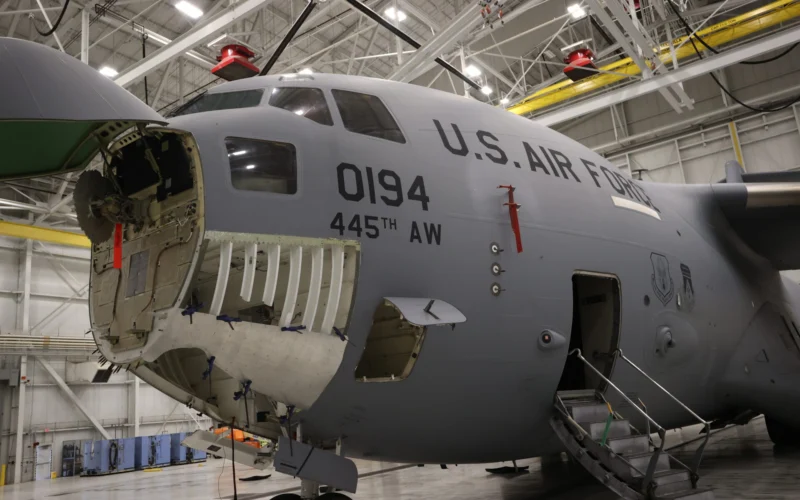
A US Air Force C-17 Globemaster III recently sat unflyable for nearly 17 months because no supplier would build the tooling to make one nose panel.
The aircraft returned to service on July 30, 2026, only after a US Air Force research unit formed the part using a robot instead, the Air Force Life Cycle Management Center (AFLCMC) disclosed.
The airlifter, tail number 01-0194, belongs to the Air Force Reserve Command’s 445th Airlift Wing at Wright-Patterson Air Force Base, Ohio.
A supply chain with no supplier
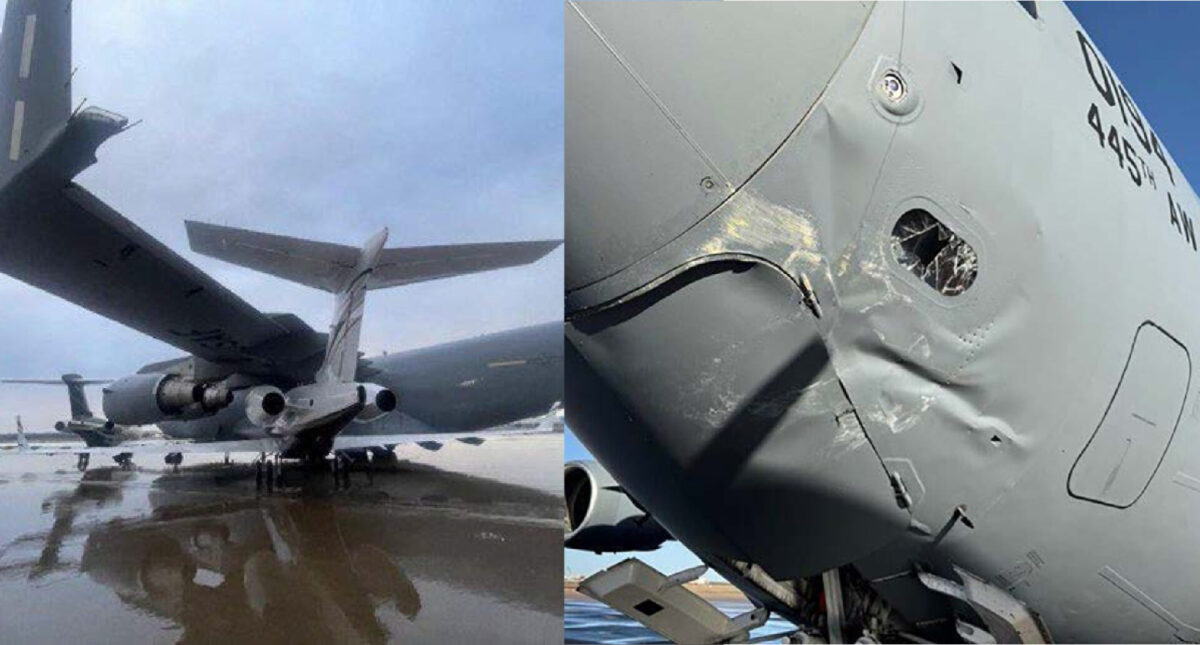
The C-17 was parked overnight at Perot Field Fort Worth Alliance Airport, Texas, on March 4, 2025, when a storm system drove two privately operated Bombardier Challenger business jets into it, damaging the left side door, fuselage and nose.
The same episode produced a confirmed EF-1 tornado in Irving and damaged aircraft at airports across the Dallas-Fort Worth area. AFLCMC put the microbursts at up to 80 miles per hour (approximately 130 kilometers per hour); contemporaneous reports cited gusts closer to 70 (112). The C-17 flew home with landing gear extended and a temporary nose panel repair qualified by Boeing.
Maintainers fixed the door and fuselage. However, the left nose panel needed fully replacing. Boeing, which holds a performance-based logistics contract covering C-17 sustainment worth up to $23.8 billion, could not find a vendor willing to build tooling for one panel. Production of the C-17 ended in 2015, but the US Air Force intends to operate the type for decades more.
Forming without tooling
The 445th Maintenance Group approached the Rapid Sustainment Office, an AFLCMC division that fabricates parts the supply chain cannot deliver. Its engineers selected incremental sheet forming, in which a robot follows a digital path to press a flat sheet progressively into shape, dispensing with dies entirely. Like additive manufacturing, the technique can produce low-volume replacement parts without costly dedicated tooling.
Working with the University of Dayton Research Institute, the team began production in January 2026 and delivered a panel for fit check on April 20, 2026. Boeing and the maintenance group completed installation in July.
AFLCMC claims that the process cut the repair job from an estimated two years, including one in storage, to months. The release does not say which authority certified the finished panel as airworthy, or what the storm damage ultimately cost.
The panel is the first incremental sheet forming component to fly on a US Air Force aircraft. The office says parts for a KC-135 and an F-15 are next in work.
2 comments
Couldn’t find a vendor? What happened to real sheet-metal mechanics?
Outstanding,said it couldn’t be done !