

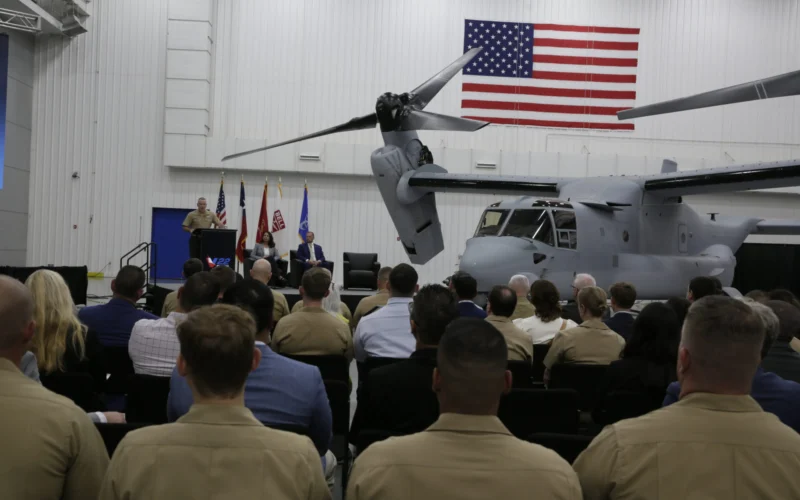
The US Marine Corps has received its 359th and final Bell Boeing MV-22B Osprey, completing the tiltrotor’s program of record nearly two decades after the type entered operational service.
The aircraft was handed over on July 28, 2026, during a ceremony at Bell’s assembly center in Amarillo, Texas.
The final Osprey will join Marine Medium Tiltrotor Squadron 162 (VMM-162), part of the 2nd Marine Aircraft Wing at Marine Corps Air Station New River in North Carolina.
“The MV-22B didn’t just join our fleet; it fundamentally changed the way the Marine Air-Ground Task Force generates combat power,” Lieutenant General William Swan, Deputy Commandant for Aviation, said.
Marine Corps shifts from procurement to modernization
The Osprey combines helicopter-like vertical takeoff and landing with the speed and range of a fixed-wing aircraft. It replaced the Boeing Vertol CH-46 Sea Knight as the Marine Corps’ principal medium-lift assault transport and now accounts for approximately 75% of the service’s rotary-wing assault support.
Since reaching initial operational capability in 2007, the Marine Corps MV-22B fleet has accumulated more than 686,500 flight hours across 114 operational deployments, supporting combat operations, logistics, medical evacuation and humanitarian missions, according to the service.
The end of new MV-22B deliveries shifts the emphasis toward sustaining and upgrading the existing fleet, which the Marine Corps intends to operate until 2055.
Planned work includes improving nacelle wiring, standardizing aircraft configurations, redesigning components and introducing upgraded proprotor gearboxes made from triple-melted steel to reduce the risk of metallurgical defects.
Bell has already reported significant maintenance benefits from similar nacelle work on the US Air Force’s CV-22 fleet. The company said in April 2026 that modified aircraft required 75% fewer maintenance hours and had recorded a readiness increase of more than 10%.
Safety fixes remain central to Osprey’s future
The delivery milestone comes as the wider V-22 program continues to address safety and readiness concerns following four fatal crashes since 2022 that killed 20 service members.
A US Navy comprehensive review and a separate Government Accountability Office report published in December 2025 warned that unresolved risks could lead to further “catastrophic” mishaps unless corrective work and oversight improved.
Several of the most significant issues concern the Osprey’s drivetrain, including hard clutch engagement events and material defects inside the proprotor gearbox. A new gearbox incorporating triple-melted X-53 steel began entering service in January 2026, while engineers are also developing a redesigned input quill assembly and additional drivetrain monitoring equipment.
Some aircraft remain subject to flight-hour-based restrictions while those permanent modifications reach the fleet. The Marine Corps said the restrictions introduced for the input quill assembly in February 2023 have prevented any further hard clutch engagement events.
V-22 production continues for the US Navy
Completion of the Marine Corps program does not mark the end of V-22 production. Bell and Boeing are continuing to assemble CMV-22B aircraft for the US Navy, while supporting upgrades to the US Marine Corps and US Air Force fleets.
The US Navy awarded the Bell Boeing Joint Program Office a $590 million contract for five additional CMV-22Bs in March 2025. Work under that contract is scheduled to continue until January 2028.
The US Air Force completed its 51-aircraft CV-22 program of record in 2025, leaving the Navy as the remaining US customer for new-build Ospreys.
Bell is already applying lessons from the V-22 to its next generation of military tiltrotors. The company is assembling the first MV-75 Cheyenne II test aircraft for the US Army, which selected the design to replace much of its UH-60 Black Hawk fleet. The company said the first MV-75 wing required 90% fewer labor hours than the first V-22 wing it produced.