

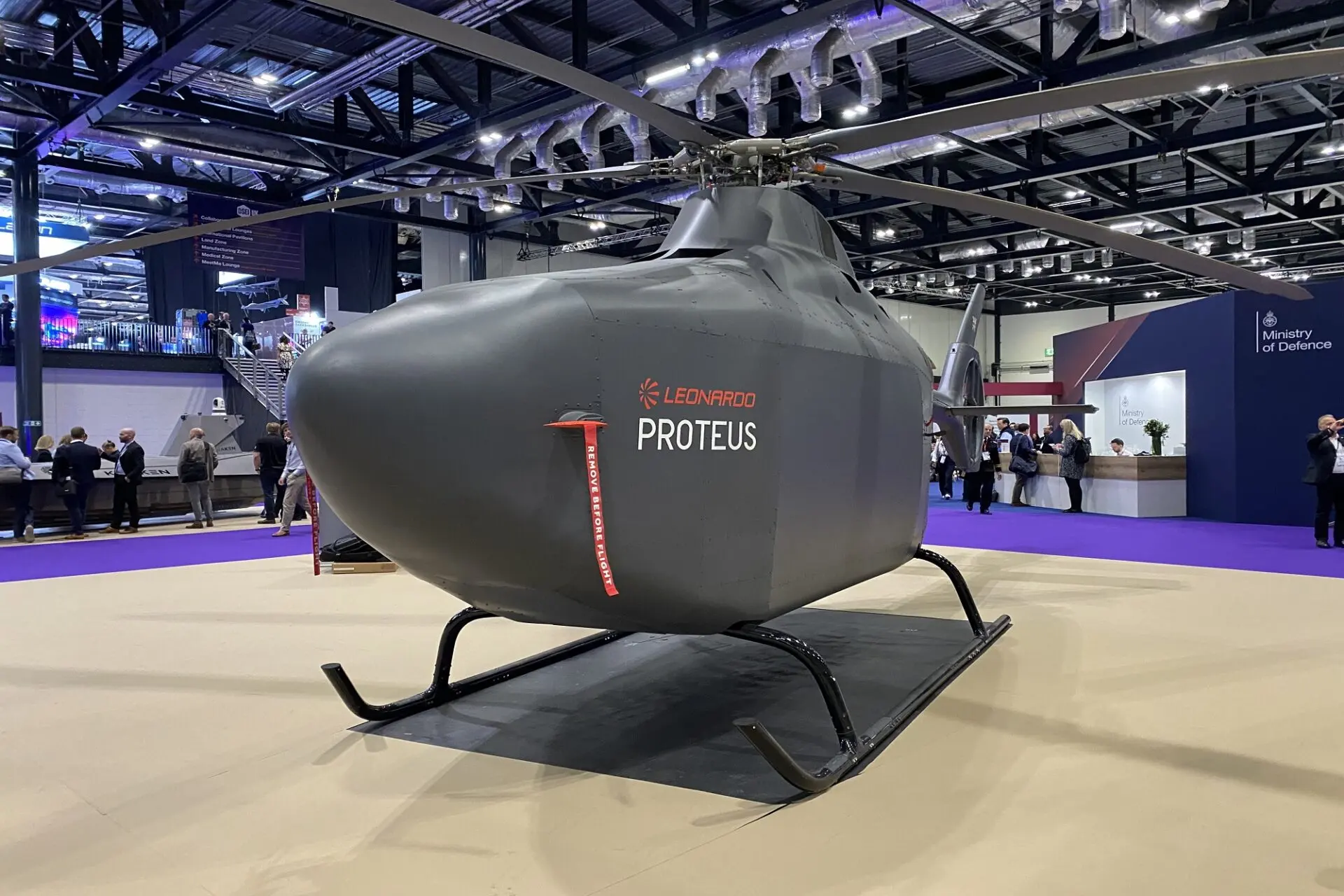
Italian defense group Leonardo will use Shield AI’s Hivemind software to develop additional autonomous capabilities for Proteus, the uncrewed helicopter demonstrator it built for the Royal Navy.
According to the announcement, Leonardo engineers will use the Hivemind Software Development Kit (SDK) to build mission autonomy for rotary-wing operations, including anti-submarine warfare (ASW), intelligence, surveillance, and reconnaissance (ISR), and logistics flights in contested environments. Neither company disclosed the value or duration of the agreement.
Shield AI says partners using Hivemind can develop, test, and update their own autonomous pilots while retaining ownership of what they build. Tom Schaefer, Vice President of Hivemind Engineering at Shield AI, said Leonardo’s engineers could adapt the software to their own mission sets and that “the work stays with them”.
Adam Wardrope, Vice President of Market Development for Helicopters in the UK at Leonardo, said the company could potentially extend its use of Hivemind to other programs in its rotary-wing portfolio.
Proteus already flew with Leonardo-developed autonomy

Proteus made its maiden flight from Predannack airfield in Cornwall on January 16, 2026, operating its own flying controls while test pilots monitored it from the ground, the Royal Navy said.
According to Shield AI, the autonomy used during Proteus’ first flight was developed by Leonardo. Hivemind will support further development of those capabilities. The aircraft’s modular bay can accommodate a payload of about one metric ton (approximately 2,200 pounds) or two standard NATO 463L pallets, with potential missions including ASW, airborne early warning, and intra-theater lift.
Proteus was developed with the Royal Navy and UK Defence Innovation (UKDI). It supports the Royal Navy’s Maritime Aviation Transformation (MATx) strategy, which sets out the service’s aviation plans through 2040, including the integration of uncrewed systems alongside crewed aircraft in future naval air wings.
Nigel Colman, Managing Director of Leonardo Helicopters UK, told AeroTime that Proteus could be configured to carry out search and rescue, Anti-Surface Warfare (ASuW), and Intelligence, Surveillance, and Reconnaissance (ISR) missions. In total, Leonardo was tasked with 16 mission sets to look at.
Hivemind expands across aircraft manufacturers
Leonardo is not the first aircraft manufacturer to license Hivemind to build its own autonomous capabilities. Shield AI announced a similar partnership with Korea Aerospace Industries (KAI) on March 20, 2025, to develop AI pilots for KAI’s crewed-uncrewed teaming work.
Shield AI is also developing its own aircraft, including the X-BAT vertical takeoff and landing (VTOL) combat jet, for which the US Navy committed an additional $150 million on October 8, 2026.