

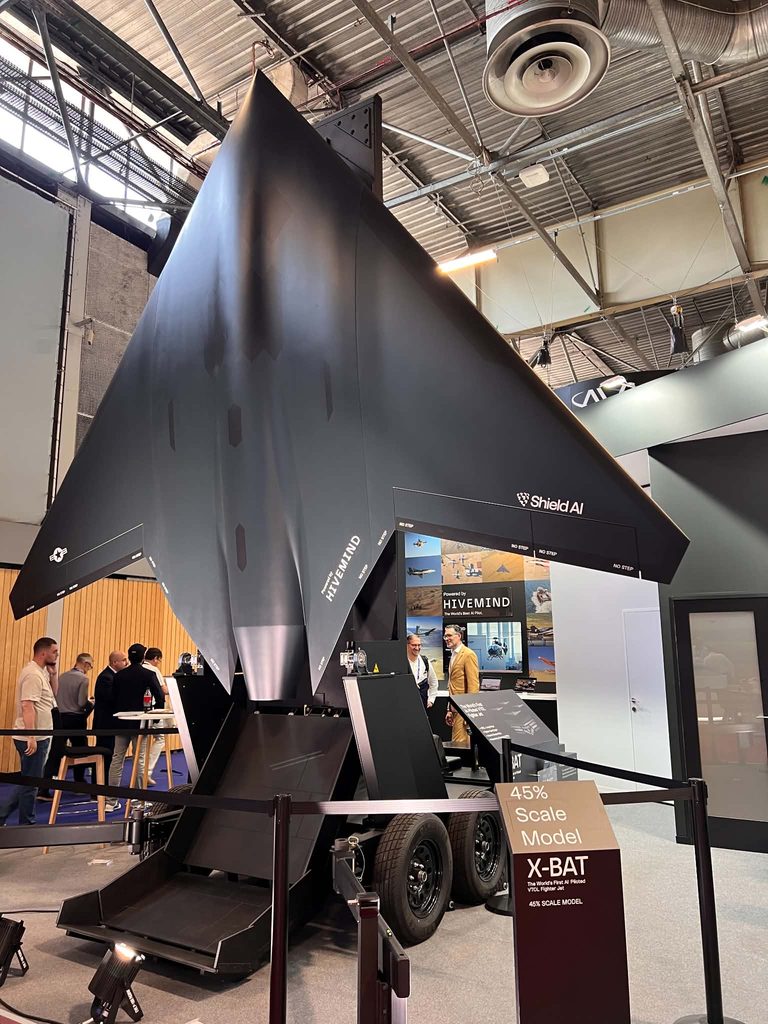
The US Navy has awarded Shield AI an additional $150 million to develop X-BAT, its AI-piloted fighter jet capable of taking off and landing vertically, the company announced on October 8, 2026.
Shield AI will invest another $150 million of its own money alongside the government funding, bringing total announced investment in X-BAT to $400 million.
The latest funding is intended to help prepare the aircraft for future exports by incorporating technology safeguards that would make it easier to sell to US allies.
Shield AI eyes international customers for X-BAT
The funding comes through the Defense Exportability Features (DEF) program, a Pentagon initiative that helps US defense companies develop weapons that can be sold abroad without exposing sensitive US technology. Companies participating in the program generally have to cover at least half of the cost.
Shield AI has not identified any potential export customers, but it is already laying the groundwork for international production and support.
The company has also signed an agreement with Greek infrastructure group GEK TERNA to explore manufacturing X-BAT components, assembling aircraft and establishing maintenance facilities in Greece.
The two companies hope to turn Greece into a regional hub for X-BAT operators in southeastern Europe and the Eastern Mediterranean. The exact division of work, and the location of the facilities, have yet to be agreed.
The partnership could be particularly relevant to Greece, which must defend hundreds of islands across the Aegean Sea. An aircraft capable of operating without runways could offer greater flexibility in a conflict.
X-BAT could operate from US Navy destroyers and aircraft carriers
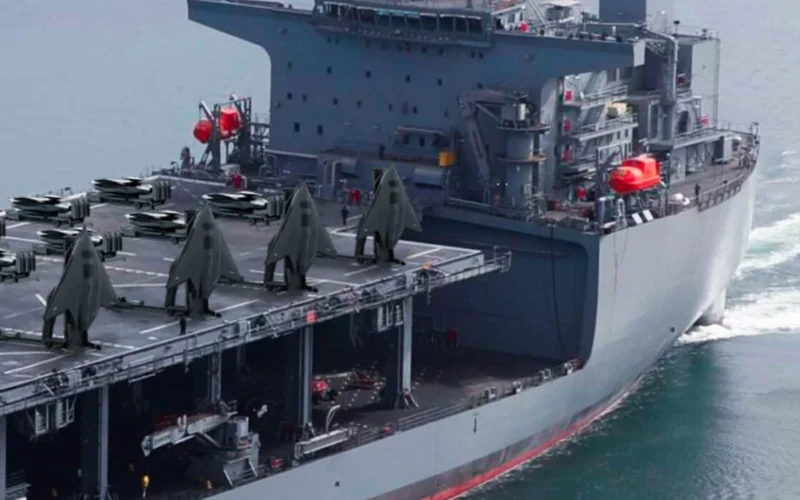
The latest award follows a separate $50 million investment announced in August 2026, under a US Navy initiative to develop long-range strike aircraft that can operate without conventional runways. Shield AI matched that funding with another $50 million of its own.
The initiative, known as Runway Independent Maritime Expeditionary Strike (RIMES), seeks uncrewed aircraft capable of carrying 1,000-pound-class weapons over distances of at least 1,400 nautical miles (2,600 kilometers).
Unlike conventional carrier-based fighters, these aircraft would be able to operate from smaller warships, including Arleigh Burke-class destroyers, as well as remote bases and islands.
Shield AI also sees a role for X-BAT aboard larger ships, including aircraft carriers and amphibious assault ships.
J.J. Cummings, Shield AI’s head of mission solutions for the US Navy and a former commander of the aircraft carrier USS Gerald R. Ford, said that X-BAT’s compact size could allow the navy to launch more combat sorties without disrupting existing flight operations.
The company is designing the aircraft to operate alongside conventional crewed fighters, potentially giving carrier air wings additional striking power without requiring major changes to flight deck operations.
The US Navy is separately exploring larger carrier-based combat drones, having issued a request for information to industry on August 31, 2026.
First X-BAT flight expected before the end of 2026
According to Shield AI, around 500 engineers at the company and its suppliers, including GE Aerospace, are working on the first X-BAT test aircraft.
The development team has already started the engine and tested the system that directs its thrust, allowing the aircraft to take off and land vertically. Wind tunnel tests have also been completed to check the design of its internal weapons bays.
X-BAT will use GE Aerospace’s F110 engine, which also powers variants of the F-15 and F-16 fighter jets. Its Hivemind artificial intelligence software is designed to fly the aircraft autonomously, not least in environments where GPS signals or communications are disrupted.
Shield AI aims to give X-BAT a combat radius of 1,000 nautical miles (1,852 kilometers), as well as the ability to carry weapons weighing up to 2,000 pounds in internal bays.
The aircraft has not yet flown, but Shield AI expects flight testing to begin before the end of 2026. That remains consistent with the schedule outlined when the company first unveiled X-BAT in October 2025.
If successful, X-BAT could give the US Navy a new way to deploy long-range combat aircraft from ships and remote locations without relying on traditional runways.