
JAS 39 Gripen
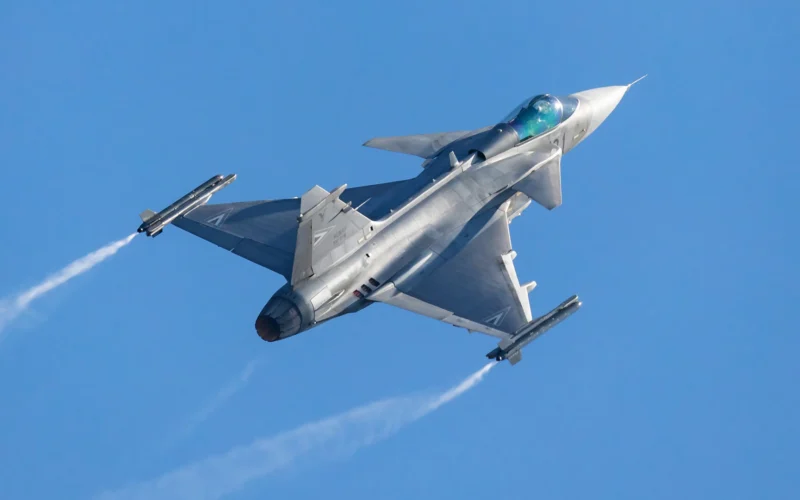
The Saab JAS 39 Gripen is Sweden's single-engine multirole fighter, designed under the 1982 JAS program, the acronym for fighter, attack and reconnaissance in Swedish, around dispersed-basing doctrine: operations from road strips with turnarounds by small conscript crews, the requirement that produced its low operating cost. It first flew in 1988 and entered Swedish service in 1996; about 250 have been built.
The Gripen E, with the GE F414G engine, an AESA radar and ten weapons stations, turned the program's second generation into its export engine: Brazil builds it locally under the 2014 contract, Thailand ordered in August 2025, Colombia signed for 17 in 2026, and the Swedish-Ukrainian letter of intent of October 22, 2025, covers up to 150 aircraft, with licensed production in Ukraine under study.
JAS 39 Gripen at a glance
Two generations serve side by side: the C/D that built the Gripen's reputation and the substantially new E/F now in production.
Variant comparison
| Specification | Gripen C/D | Gripen E/F |
|---|---|---|
| Configuration | First export generation, Volvo RM12 engine | Enlarged airframe, GE F414G, new sensors |
| Primary operator | Sweden, Czech Republic, Hungary, South Africa, Thailand | Sweden, Brazil; ordered by Thailand and Colombia |
| Status | In service; upgrades continue | In production |
The Gripen E is effectively a new fighter in a familiar shape, with more fuel, ten hardpoints, an AESA radar and one of the most advanced electronic warfare suites in service, positioned as the affordable alternative to heavier Western jets.
Full specifications
Latest JAS 39 Gripen coverage from AeroTime
Operators
Frequently asked questions
The E/F is a substantially new aircraft: a larger airframe with more fuel, the GE F414G engine, an AESA radar, ten hardpoints and a new electronic warfare suite, while keeping the Gripen's low operating cost.
Sweden, Brazil, the Czech Republic, Hungary, South Africa and Thailand, with Colombia's 17 aircraft on order and Ukraine holding a letter of intent for up to 150.
It was designed for wartime dispersal in Sweden: quick turnarounds by small conscript crews, single-engine efficiency and easy maintenance keep its cost per flight hour among the lowest of any modern fighter.