

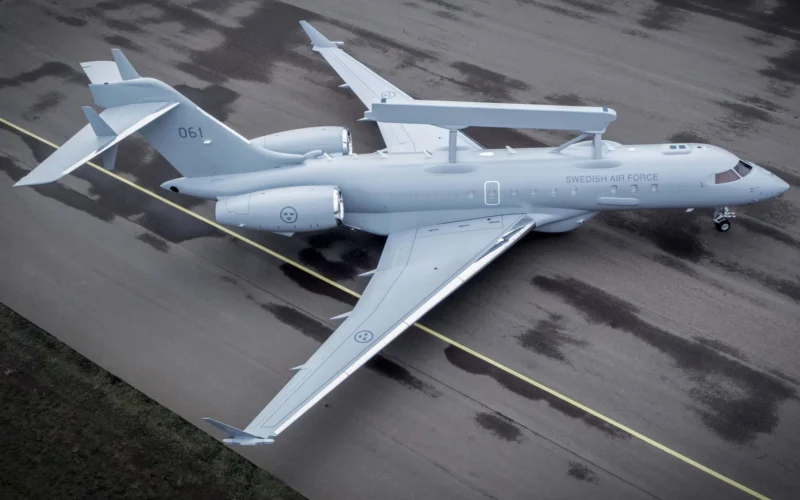
Saab rolled out the first GlobalEye airborne early warning and control (AEW&C) aircraft, built for Sweden at its Linköping facility, the company and the Swedish Armed Forces announced on October 15, 2026.
The aircraft, designated S 106 in Swedish service, will now undergo testing and verification ahead of its first flight and delivery, Saab said. According to the Swedish Air Force, delivery is planned for 2027.
Sweden is expected to become the first NATO member to operate GlobalEye, which combines Saab’s Erieye Extended Range radar with other active and passive sensors aboard a Bombardier Global 6000 business jet.
“The system gives us a genuine multi-domain capability that strengthens our ability to detect, understand and act across several domains,” said Jonas Wikman, chief of the Swedish Air Force.
GlobalEye is designed to detect and track targets in the air, at sea and over land, sharing information with aircraft, ships and ground forces. Saab gives its Erieye Extended Range radar a range of more than 550 kilometers (approximately 340 miles).
The Swedish Air Force also noted that the S 106 shares its Global 6000 platform with Sweden’s new TP 106 government transport aircraft, delivered earlier in 2026. The common platform could allow cooperation in training, maintenance and spare parts.
Sweden replaces radar aircraft donated to Ukraine
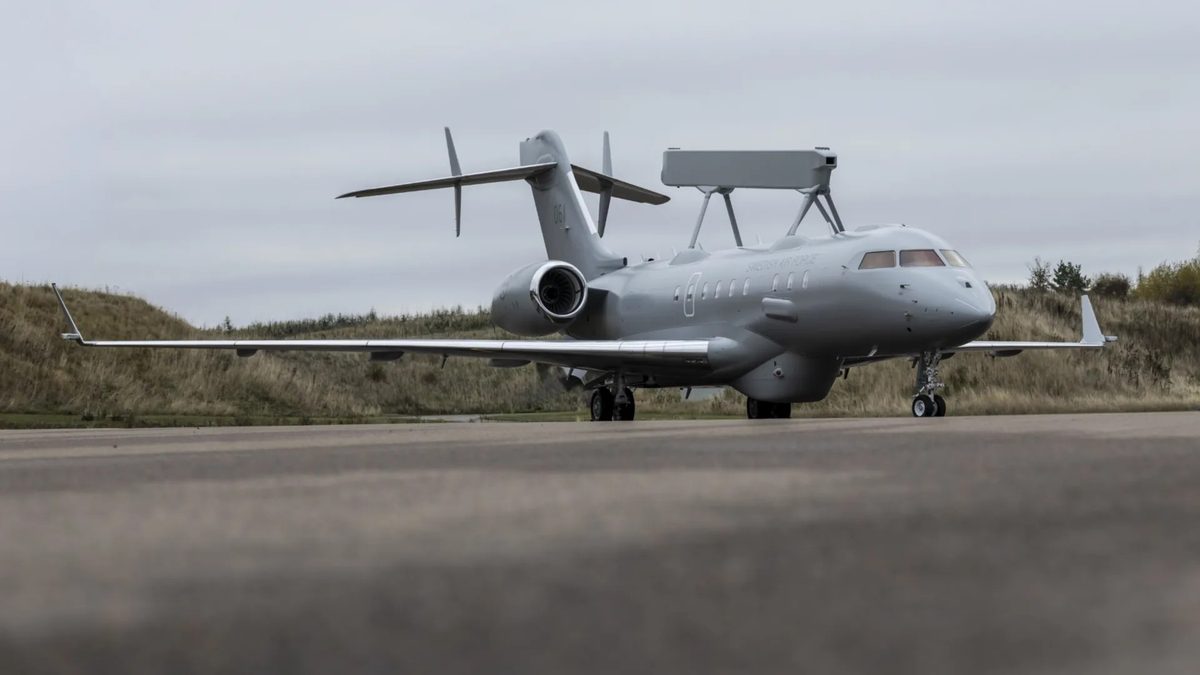
The Swedish Defense Materiel Administration (FMV) ordered the first two GlobalEye aircraft on June 30, 2022, under a contract worth approximately SEK 7.3 billion ($673 million at the time). Deliveries were planned for 2027.
The new aircraft will replace Sweden’s Saab 340-based ASC 890 surveillance aircraft, which the Swedish government pledged to Ukraine in May 2024.
At the time, the Swedish government acknowledged that the transfer would temporarily reduce its own defense capability. It pledged to offset the loss by procuring additional GlobalEye aircraft and accelerating the first two deliveries.
On June 27, 2024, FMV exercised an option to order a third GlobalEye, worth approximately SEK 2.6 billion ($245 million at the time), with a contractual delivery period extending to 2029.
Ukraine’s Ministry of Defense confirmed in September 2026 that the Swedish-supplied ASC 890 had flown its first combat missions in March 2026.
The 2027 delivery target announced at the rollout remains consistent with the original Swedish GlobalEye contract.
Netherlands plans to share Sweden’s GlobalEye fleet
Sweden’s GlobalEye fleet is also set to support the Netherlands, which signed a letter of intent with Stockholm on September 10, 2026, to acquire one aircraft.
Under the proposed arrangement, the Dutch aircraft would join a shared pool with Sweden’s three GlobalEye aircraft, allowing crews from both countries to operate the available fleet.
The Dutch Ministry of Defense said that its personnel would gain access to Swedish aircraft from 2028, three years before the planned delivery of their own GlobalEye in 2031.
The arrangement would give the Netherlands an operational AEW&C capability before receiving its aircraft, while allowing both countries to cooperate on training and further system development.
Saab stressed that it had not yet received a Dutch order when the agreement was announced.
GlobalEye gains ground across NATO
The Swedish rollout comes as Saab expands its GlobalEye order book and the aircraft emerges as a replacement for NATO’s aging Boeing E-3A Sentry AWACS fleet.
France ordered two GlobalEye aircraft on December 30, 2025, while an undisclosed Middle Eastern customer ordered another two on July 27, 2026.
At the NATO Summit Defence Industry Forum in Ankara on July 7, 2026, Secretary General Mark Rutte announced that the alliance would open negotiations with Saab for up to 10 GlobalEye aircraft to replace its E-3A fleet.
That multinational procurement would be separate from the aircraft ordered nationally by Sweden and France, as well as the one planned by the Netherlands.