
Sydney Kingsford Smith (SYD)
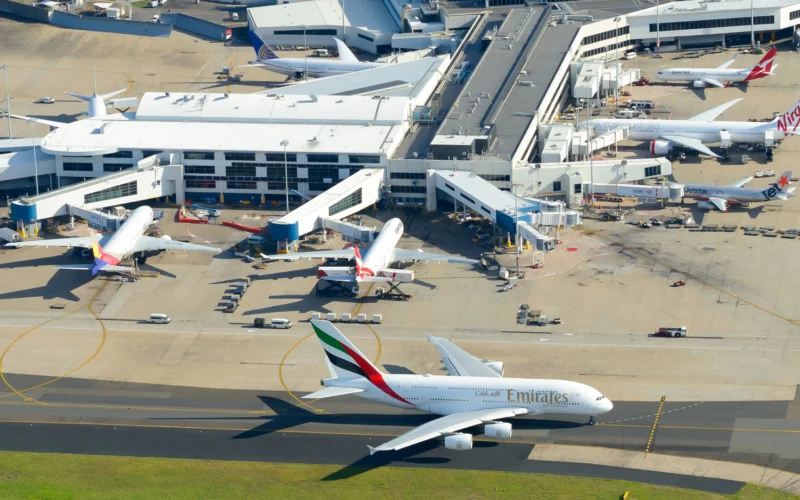
Sydney Kingsford Smith (SYD) at a glance
Sydney Kingsford Smith (SYD) is one of the oldest continuously operating airports in the world, flying since 1920, and Australia's primary international gateway: 42.5 million passengers in 2025, including a record 17.2 million international travelers, through three terminals wedged onto the smallest site of any major Australian airport, eight kilometers south of the city on Botany Bay.
The airport is Qantas's home and the exception among the world's great hubs: a strict 11pm-to-6am curfew and an 80-movements-per-hour cap, written into federal law, ration every slot. That constraint is why Western Sydney's new Nancy-Bird Walton airport, opening in 2026 with no curfew, exists at all, and why Kingsford Smith's story for the next decade is how a capped, curfewed, land-starved airport defends its gateway role.
Hub & base airlines
| Airline | Role | Terminal |
|---|---|---|
| Qantas | Home hub, domestic and international | T3 (domestic) and T1 (international) |
Terminals & infrastructure
T1 handles all international flying and set records in 2025 with 17.2 million passengers; T2 serves Virgin Australia, Jetstar and the regionals, while T3 is Qantas's dedicated domestic terminal. Three runways, two parallel over Botany Bay plus a crosswind strip, operate under a legislated 11pm-6am curfew and an 80-movements-per-hour cap that together define the airport's capacity more than any piece of infrastructure.Full specifications
Frequently asked questions
42.5 million passengers in 2025, Australia's busiest airport, including a record 17.2 million international travelers through T1.
Federal law bans movements between 11pm and 6am and caps operations at 80 movements per hour, protecting residents under the flight path; the restrictions are the main reason the new curfew-free Western Sydney airport was built.
T3 is Qantas's dedicated domestic terminal and T1 hosts its international operation, making Kingsford Smith the airline's home hub for both networks.